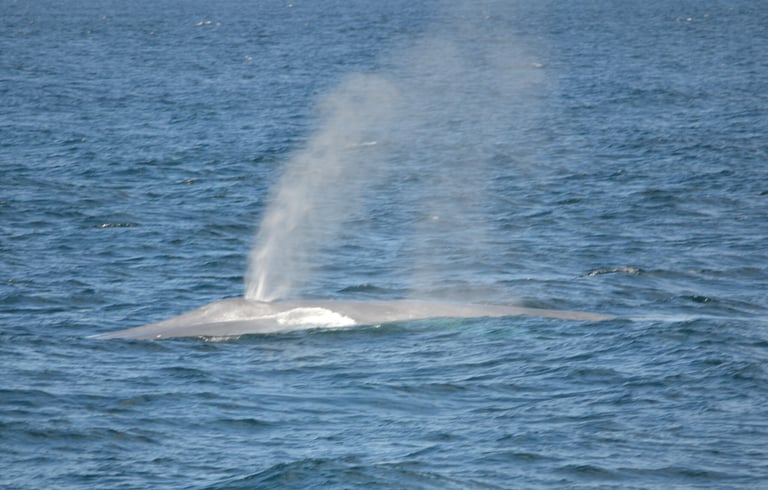
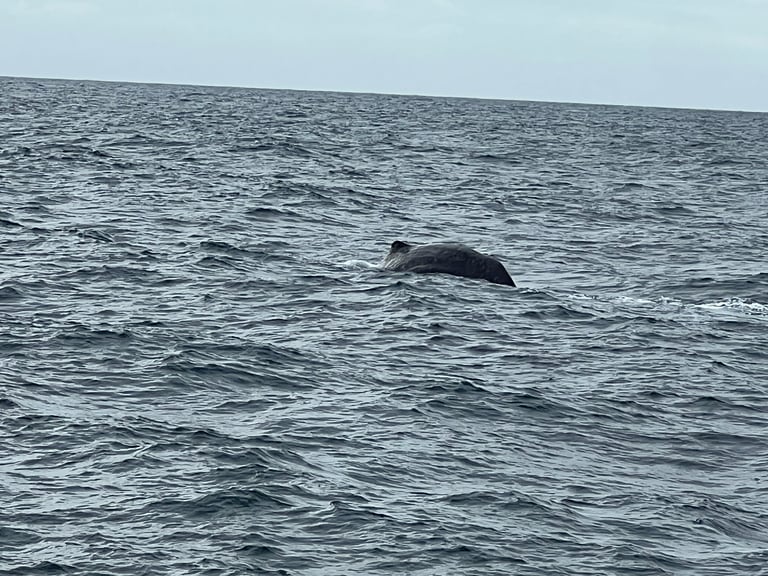
Male humpback whales sing continuously for up to 33 minutes at a stretch, weaving individual sounds into songs that rank among the most elaborate vocal displays in the animal kingdom.
The humpback whale (Megaptera novaeangliae) is a baleen whale and the only living member of the genus Megaptera, part of the rorqual family that also includes blue and fin whales. It ranges through every major ocean, from icy polar feeding grounds to warm tropical breeding waters, and is currently listed as Least Concern by the IUCN.
Few large whales are as easy to watch or as behaviorally rich. Its long pectoral flippers, frequent breaching, and cooperative feeding tricks have made it a favorite of whale watchers and researchers alike, offering a window into complex social and acoustic lives beneath the surface.
Identification and Appearance
The clearest way to recognize a humpback whale is by its unusually long pectoral flippers, each about one-third of the body length, combined with the knobby tubercles that stud its head and the leading edge of those flippers. No other large whale shares this exact combination of features, and the jagged trailing edge of the tail fluke adds a further distinguishing mark.
Adults typically measure 14 to 15 meters, though individuals up to 16 or 17 meters have been recorded; the longest confirmed lengths reach 17.4 meters in a male and 18.6 meters in a female, though claims of 17 to 18 meter animals are considered unreliable. Body mass can reach 40 metric tons. The body itself is bulky with a thin rostrum, a short dorsal fin that ranges from barely noticeable to distinctly curved, and 14 to 35 throat grooves that let the mouth expand enormously while feeding. The upper jaw carries 540 to 800 black baleen plates.
Coloration is dorsally black, while the underside shows a variable mix of black and white; whales in the Southern Hemisphere tend to carry more white pigmentation than their Northern Hemisphere counterparts. Flippers range from all-white to white only underneath, and a few individuals, such as the famous Migaloo, are entirely white through albinism. Because fluke color patterns and scarring are unique to each animal, researchers use them like fingerprints for individual identification.
Females run 1 to 1.5 meters longer than males on average, and a rounded structure called the hemispherical lobe near the genital slit distinguishes the sexes visually. Calves are born at around 4.3 meters and 680 kilograms, with dorsal fins that start out furled and gradually straighten and stiffen as the animal matures.
Distribution and Habitat
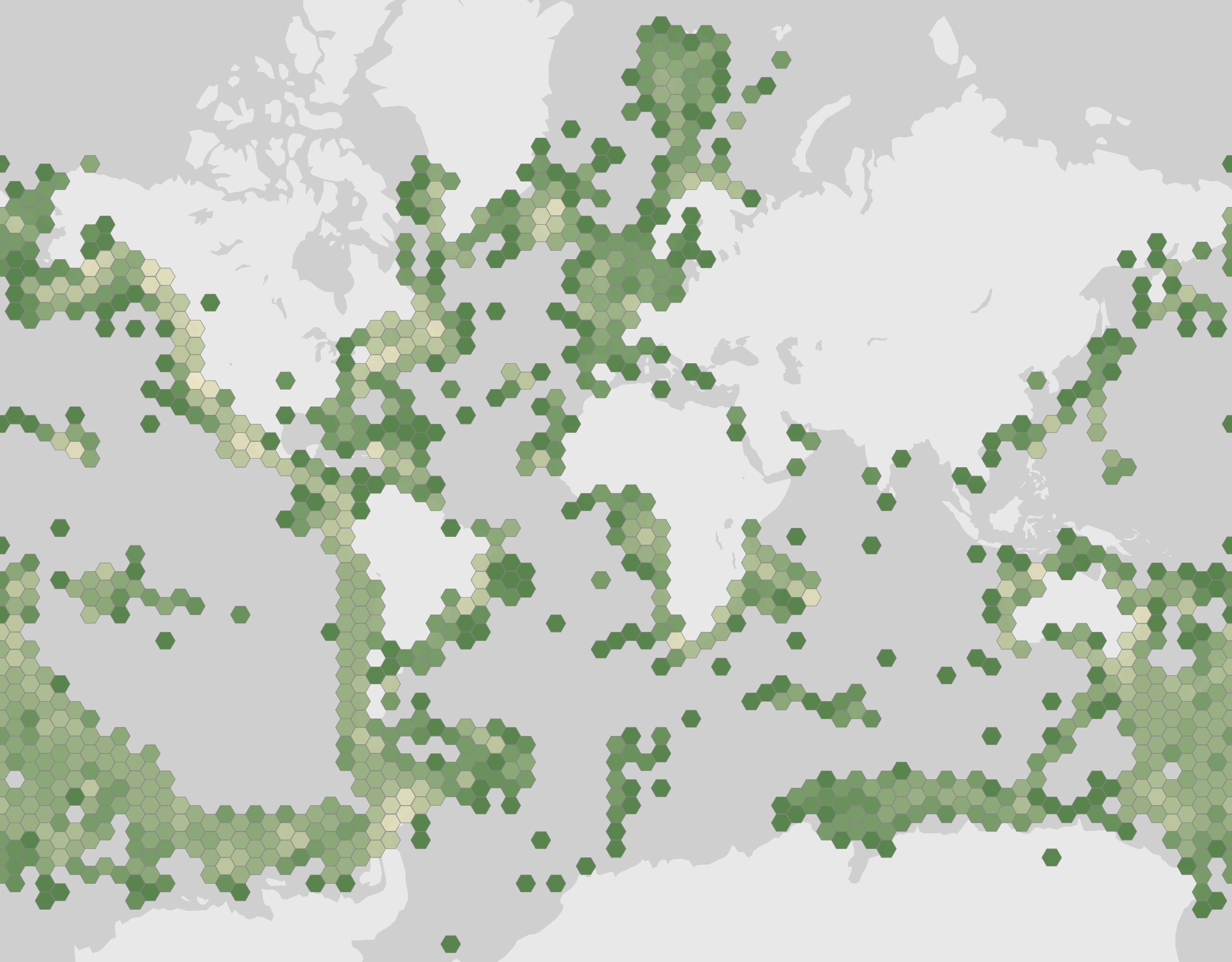
Humpback whales occur in marine waters nearly worldwide, avoiding only parts of the equator, the high Arctic, and some enclosed seas; the northernmost confirmed sighting was at 81°N near Franz Josef Land. They favor coastal waters and continental shelves, gathering on shallow banks near shore far more readily than most other large whales.
The species undertakes long seasonal migrations, sometimes covering up to 8,000 kilometers one way, between cold-water summer feeding grounds and warm winter breeding grounds near the equator. In the North Atlantic, one population winters in the West Indies and summers off New England, eastern Canada, and western Greenland, while a second winters around Cape Verde and northwest Africa before summering near Iceland and Norway. The North Pacific holds at least four breeding populations, tied to Mexico, Central America, Hawaii, and Okinawa/the Philippines, each with its own feeding grounds stretching from the Aleutian Islands to California or the Russian Far East.
In the Southern Hemisphere, seven recognized breeding stocks range from the southwestern Atlantic to the southeastern Pacific, feeding along routes that include South Georgia, the South Sandwich Islands, and the Antarctic Peninsula. A separate, non-migratory population lives year-round in the northern Indian Ocean, concentrated in the Arabian Sea around Oman and recorded as far as the Persian Gulf, Pakistan, and India. Feeding whales dive to depths of up to 200 meters and tolerate summer surface temperatures of 2 to 21°C, while winter breeding grounds can reach 28°C, unusually warm for a baleen whale.
Monthly observation counts show a clear rise through mid-year, peaking in July and August, with lower counts in April and May. As presence records rather than measures of abundance, these figures likely reflect seasonal concentration on feeding grounds rather than the full population or range of the species.
Behavior and Lifestyle
Humpback behavior shifts dramatically between seasons. Summer is devoted almost entirely to feeding, often in stable groups that cooperate and divide labor through coordinated sound, while winter brings little feeding at all as animals focus on giving birth, raising newborn calves, and competing intensely for mates.
Winter groupings fall into recognizable patterns: solitary transiting animals, lone singing males that hold a spot for hours, mating pairs, mothers with newborn calves, mother-calf pairs trailed by a male escort, and "competition groups" of three or more animals, occasionally up to fifteen, engaged in intense jockeying among males. Alliances between males appear to help displace rival escorts, a strategy that may connect the species' mating competition to sperm-competition systems seen in right whales and gray whales.
Humpbacks cruise at 7.9 to 15.1 km/h but can surge to 27 km/h when threatened; their long flippers give them exceptional maneuverability independent of tail movement. They typically dive for under five minutes in summer and 15 to 20 minutes in winter, commonly working depths around 80 meters but occasionally descending as far as 616 meters. Surface displays such as breaching, lobtailing, and flipper-slapping intensify with wind speed, possibly to send signals farther across choppy water, and may also help dislodge parasites.
Orcas prey on juvenile and even adult humpbacks, and mothers or unrelated adults will escort calves to deter attacks; some researchers suspect this predation resumed only after whaling-era population crashes pushed orcas toward other prey. Sharks, including tiger, dusky, and great white sharks, have also been documented attacking weakened or entangled humpbacks, occasionally with fatal results.
Communication
Male song is the humpback's signature form of communication, built from a strict hierarchy of subunits, units, subphrases, phrases, and themes that combine into songs lasting 4 to 33 minutes, though some Hawaiian males have sung continuously for up to seven hours. The vocalizations span 100 Hz to 4 kHz with harmonics reaching 24 kHz or higher and can travel at least 10 kilometers underwater; remarkably, the pattern of phrase repetition follows Zipf's law, the same statistical rule found in human language.
The purpose of singing remains debated. It shows little evidence of establishing dominance, yet non-singing males sometimes disrupt singers aggressively, and females seem drawn more to gatherings of singers than to isolated ones, hinting at a lek-like mating dynamic. Songs drift gradually in the Northern Hemisphere but undergo sudden, cyclical "revolutions" in the south, and can spread between neighboring populations across successive breeding seasons.
Beyond song, humpbacks use a range of other calls tied to specific social contexts. Quick "snorts" mediate interactions within mother-calf-escort groups, while longer "grumbles" appear to signal body size and social status among males. "Thwops" and "wops" act as contact calls, high-pitched "cries," "violins," and "shrieks" mark active competition among rival males, and short "grunts" and "barks" occur when an individual joins a new group.
Hunting and Diet
Humpback whales feed by engulfing enormous volumes of water and prey at once rather than skimming continuously. Ventral throat grooves let the mouth balloon outward to take in the load; the whale then closes its jaws and forces the water back out through its baleen plates while the tongue helps push trapped prey down the throat.
To concentrate prey before engulfing it, humpbacks use an unusual range of techniques. In the "ring of foam" method, a whale circles at the surface slapping its flukes to encircle prey, then dives and rises through the center with its mouth open. Lunge feeding sends the whale surging vertically or obliquely through dense prey patches, while bubble clouds and bubble columns, released through underwater exhalation, herd, confuse, or trap fish and krill like a makeshift net. Tail-slashing and the "inside loop," a rapid 180-degree roll and U-turn, create turbulence that the whale then feeds through, and "flick-feeding" is reserved specifically for capturing euphausiids.
Prey varies strongly by region and is taken almost entirely during the summer feeding season. In the eastern North Pacific and Bering Sea, favored prey includes Atka mackerel, Pacific saury, euphausiids, sand lance, capelin, and herring, while fish make up roughly 95 percent of the diet for North Atlantic populations feeding near Cape Cod and Greenland, including sand lance, herring, and pollock. Australian and Antarctic humpbacks rely more heavily on euphausiid krill. Some winter feeding does occur opportunistically, as documented off Baja California Sur and Nayarit in Mexico.
Feeding technique also changes with age: no humpback younger than two years old performs tail-slapping feeding, even though calves are weaned around one year, and rudimentary versions of the behavior appear only later among juveniles.
Reproduction and Raising Young
Mating in humpback whales is polygynandrous, with both sexes taking multiple partners during the winter breeding season in tropical waters. Males compete fiercely for access to females, trailing lone females and mother-calf pairs as "escorts"; the closest male, the "principal escort," fights off "challengers" through tail-slashing, ramming, and head-butting, while "secondary escorts" trail farther back. In some encounters near Hawaii and the Cook Islands, males have been filmed releasing bubbles beneath a female's genitalia, a behavior she appears to accept and respond to rather than avoid.
Gestation lasts 11 to 11.5 months, during which the fetus develops teeth before switching to baleen in the final months. Births are rarely witnessed by humans; one recorded off Madagascar took only four minutes. Mothers typically move into shallow coastal water before giving birth in mid-winter, which reduces harassment from escorting males, and they commonly help their newborn calf reach the surface for its first breath. A single calf, around 4.3 to 5 meters long, is the norm.
Calves nurse on milk rich in fat, protein, and lactose for up to a year, though they can begin taking solid food by six months and are typically weaned around five months. Young calves have furled dorsal fins that straighten with age, and older calves spend increasing time away from their mothers as they gain independence.
Females generally breed once every two years, though twice in three years occurs when lactation extends beyond five months. Sexual maturity arrives at 4 to 5 years by some estimates, or as late as 5 to 15 years depending on the population, with physical maturity assumed around 8 to 12 years. Humpbacks can live over 50 years, and the oldest confirmed individual reached 95 years of age.
Conservation and Threats
The humpback whale is currently assessed as Least Concern by the IUCN, with a worldwide population estimated at around 135,000 animals as of 2018, including roughly 84,000 mature individuals. Regional numbers include about 13,000 in the North Atlantic, 21,000 in the North Pacific, and 80,000 across the Southern Hemisphere, though the isolated Arabian Sea population numbers only around 80 individuals and is considered endangered in its own right.
These figures mark a strong recovery from the whaling era. Southern Hemisphere hunts killed more than 60,000 humpbacks between 1910 and 1916 alone, with further exploitation peaks in the 1930s and 1950s, and North Pacific catches exceeded 3,000 in a single season during 1962–63. Bans were introduced piecemeal: the Antarctic in 1939 (though abandoned by 1949), the North Atlantic in 1956, the Southern Hemisphere in 1963, and the North Pacific in 1966, followed by the International Whaling Commission's global commercial whaling moratorium in 1985.
Today's main threats are entanglement in fishing gear and vessel collisions, alongside underwater noise, coastal habitat disturbance, and climate change. NOAA recorded 88 stranded humpbacks along the US Atlantic coast between January 2016 and February 2019, more than double the prior three-year total, prompting an official unusual mortality event declaration in April 2017 linked chiefly to vessel strikes and entanglement. Around the Strait of Magellan, humpbacks are the whale species most often reported in ship collisions.
Protections include dedicated reserves such as Ballena Marine National Park in Costa Rica and the Hawaiian Islands Humpback Whale National Marine Sanctuary, established in 1992.
Cultural Significance
In Māori tradition, the ancestor Kahutia-te-rangi took the name Paikea after being carried to safety in Aotearoa by a humpback whale, having invoked the sea god Tangaroa for aid. The renaming reflects a broader Māori practice of adopting new names after profound survival or achievement, a custom that preserved oral history and tied personal identity to ancestral and divine narratives.
Humpbacks once held major economic importance as one of the species most heavily hunted by commercial whalers, prized for oil used in lamps, machine lubrication, margarine, and cooking fat, with meat processed for human food and animal feed and bones ground into fertilizer.
That economic relationship has largely shifted to ecotourism. Commercial whale-watching tours built around humpbacks began in New England and Hawaii in 1975, and Hawaiian tours alone now generate about $20 million annually for the local economy, drawing visitors to the species' active surface behavior and tolerance of boats.
Fun Facts
- Some individuals are entirely white due to albinism, the most famous example being a whale named Migaloo.
- Because color patterns and scars on the tail flukes are unique to each animal, researchers use them like fingerprints to identify individual whales.
- The tubercles on a humpback's head are mostly hollow and each contains at least one fine hair, suggesting they serve a sensory rather than purely structural function.
- Humpback brains contain spindle cells, a type of neuron linked to social cognition and theory of mind in humans and also found in some other whales and dolphins.
- Eyesight is relatively poor, allowing humpbacks to make out silhouettes at long range but only finer detail up close.
- Depending on which part of the ear is stimulated, computer models suggest humpbacks can hear frequencies ranging from as low as 15 Hz up to 9 kHz.
- Humpbacks can unlock the epiglottis and larynx and shift them toward the mouth, allowing them to blow bubbles orally rather than only through the blowholes.
Photos
Photographs from via iNaturalist, licensed under CC0 1.0., by dpcmiller via iNaturalist, licensed under CC BY 4.0., by patrickc via iNaturalist, licensed under CC BY 4.0., by Kalvin Chan via iNaturalist, licensed under CC BY 4.0., by Charlotte Kirchner via iNaturalist, licensed under CC BY 4.0., by jk6000 via iNaturalist, licensed under CC BY 4.0., by Павлик Лисицын via iNaturalist, licensed under CC BY 4.0., by Rosario Douglas via iNaturalist, licensed under CC BY 4.0., and by Ingvild Riska via iNaturalist, licensed under CC BY 4.0., credited on each photo.
Ecology and classification
Classification
- Phylum
- Chordata
- Class
- Mammalia
- Order
- Cetacea
- Family
- Balaenopteridae
- Genus
- Megaptera
- Species
- Megaptera novaeangliae
Sources
- GBIF Species names and classification
- iNaturalist Photos
- Wikidata Common names and conservation status
- Wikipedia Summary extract
- Encyclopedia of Life Habitat, diet and behavior traits
- Animal Diversity Web Animal habitat, behavior and diet
- AnAge Longevity