The sperm whale is the largest toothed predator alive and the largest of all toothed whales, an animal so distinct in shape and scale that it is unlikely to be mistaken for anything else in the ocean.
Classified in the order Cetacea and family Physeteridae, the species ranges across every ocean basin from tropical seas to the edges of the polar ice. The IUCN lists it as Vulnerable, a status that reflects a slow recovery from more than two centuries of commercial whaling.
Few animals combine such raw physical power with complex social life and sound production, making the sperm whale one of the most studied and storied creatures in the sea.
Identification and Appearance
The sperm whale's block-shaped head is its most distinctive feature, taking up one-quarter to one-third of the animal's total length and giving the body an unmistakable silhouette unlike any other whale.
Adults show striking size differences between sexes. Females mature sexually at 8 to 9 meters and rarely exceed 12 meters in length, while males mature at 11 to 12 meters and can reach 18 to 19 meters, weighing up to roughly three times as much as females of similar age. Newborns measure 3.5 to 4.5 meters at birth, already large by whale standards. A male measuring 18 meters is estimated to weigh around 57 tonnes, and the largest reliably measured individual, taken by a Soviet whaling fleet near the Kuril Islands in 1950, reached 20.7 meters and an estimated 80 tonnes, though such giants are rare: 95 percent of recorded sperm whales measure under 15.85 meters.
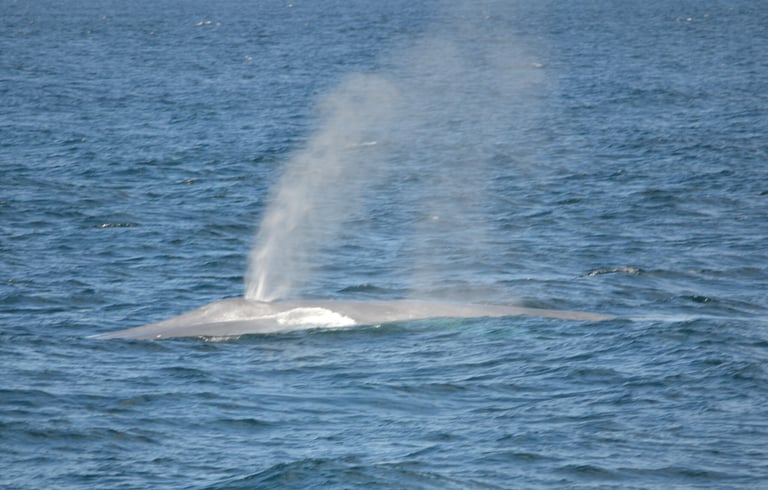
The blowhole sits far forward on the head and is shifted to the left side, producing a bushy spray that angles forward rather than straight up, a useful field mark at sea. The flukes are triangular, thick, and proportionally larger than those of any other cetacean; the whale raises them high out of the water at the start of a deep feeding dive.
Historical claims of exceptionally large individuals, including a whale said to have measured 25.9 meters that sank the whaleship Essex, are treated with skepticism by researchers, who suspect measurement error or exaggeration in such records.
Distribution and Habitat
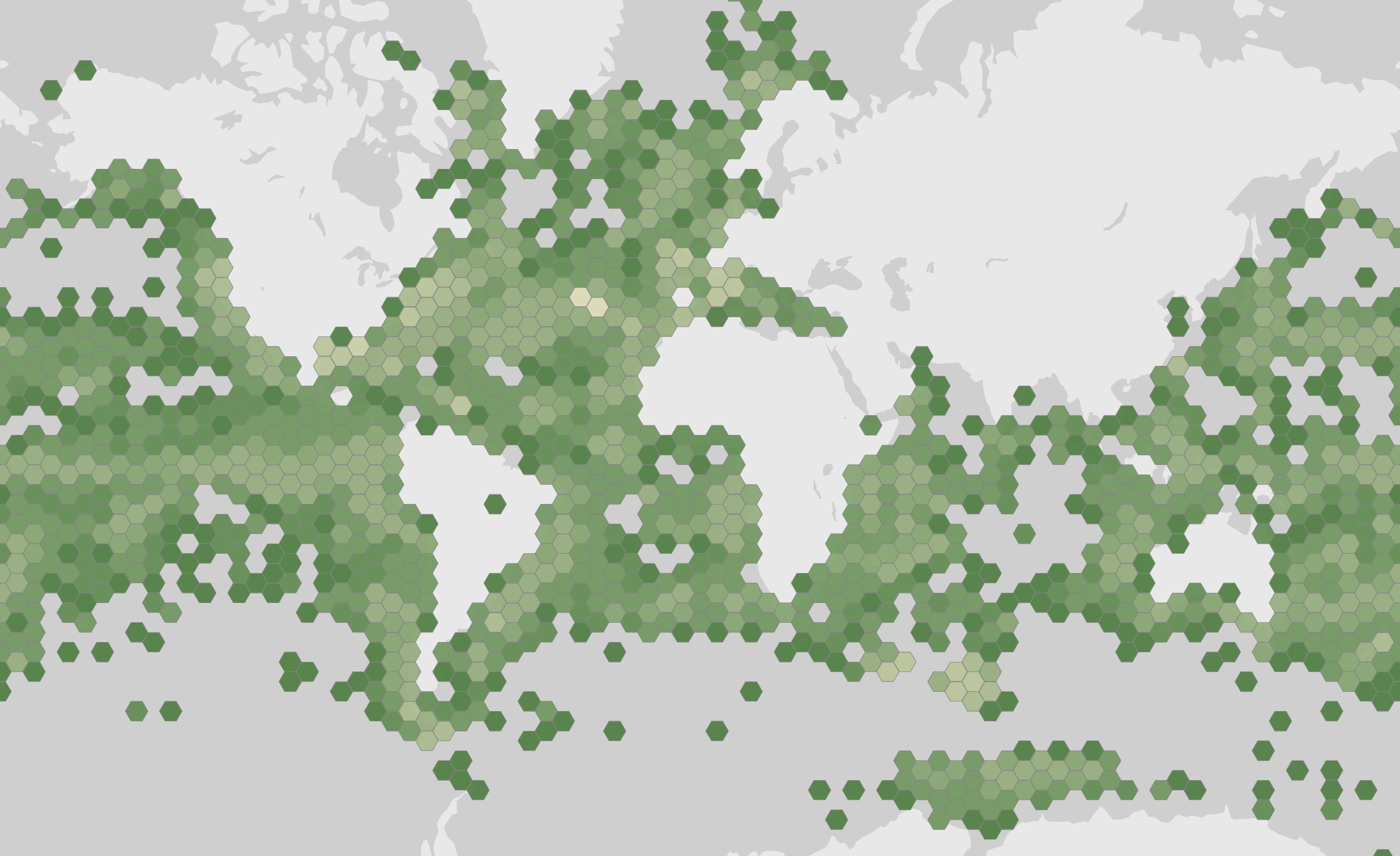
Sperm whales are among the most widely distributed mammals on Earth, occurring from the tropics to sub-polar waters in every ocean except the Black Sea, where shallow, oxygen-poor entrance waters appear to exclude them; their presence in the Red Sea remains uncertain.
The species favors ice-free waters deeper than 1,000 meters, though it can be found closer to shore where the continental shelf narrows and drops quickly to 310–920 meters, as around the Azores, Dominica, and several coastal sites in East Asia including the Kuril Islands and Japan's Shiretoko Peninsula. Only adult males regularly range into higher latitudes; females and young stay in warmer waters. Populations are denser near continental shelves and submarine canyons, and coastal aggregations, once more common before large-scale whaling, persist in places such as Kaikōura in New Zealand and the Davao Gulf in the Philippines.
Genetic evidence suggests the modern world population descends from a Pacific Ocean group of roughly 10,000 animals around 100,000 years ago, with the Atlantic colonized in multiple waves as ice caps retreated and advanced.
Monthly occurrence records show observations peaking sharply in June and July, more than three times the totals recorded in December and January. Because these figures come from opportunistic sightings rather than surveys, they hint at seasonal presence in certain regions rather than proof of a broader migration pattern or population change.
Behavior and Lifestyle
Female sperm whales and their calves live in stable matriarchal groups called social units, typically holding six to nine individuals but sometimes more than twenty, with members rarely joining or leaving once established. Unlike orcas, whales within a unit show no strong tendency to associate with genetic relatives.
Mature males take a different path, drifting into loose bachelor groups before eventually living largely solitary lives, returning to female groups only to socialize or breed. Females and calves spend about three-quarters of their time foraging and the rest socializing, mostly in the afternoon, when whales rub against each other and exchange the clicking patterns known as codas.
The main natural threat comes from orca pods, which target groups containing calves. In response, sperm whales form defensive circles, either facing inward with tails pointed outward in the "marguerite formation" or facing outward in a "heads-out formation," using their powerful flukes to fend off attackers. Killer whales are described by some researchers as usually dominant in these encounters despite being outnumbered, though documented attacks on adult bulls have not been recorded as successful.
Solitary bulls sometimes intervene to aid vulnerable groups encountered nearby, and have even been recorded beaching themselves together, a form of cooperation that remains only partly understood.
Communication
Sperm whales produce the loudest sounds of any animal, with echolocation clicks reaching a source level of 236 decibels. These clicks are generated by forcing air through a pair of "phonic lips" near the blowhole; the sound then bounces repeatedly through the spermaceti organ and the lens-like melon before leaving the head as a focused beam, a process that also makes each whale's click pattern unique and traceable to the size of its own spermaceti organ.
Four click types serve different purposes. The regular echolocation click is used to search for prey at a distance, and a rapid, high-frequency "creak" takes over once the whale is homing in on a target. Slow clicks are heard mainly from males on breeding grounds, where they make them 74 percent of the time, suggesting a mating signal rather than a foraging tool.
Codas, short rhythmic sequences of three to twelve clicks in stereotyped patterns, are the most socially significant sound. Learned within a stable social unit, they help whales reconnect after long solo foraging dives that can occupy more than 70 percent of their time, and some patterns even mark identity at the level of the wider clan, encoding shared travel and foraging habits distinct from other clans.
Hunting and Diet
Sperm whales locate prey through echolocation, diving to depths of 300 to 800 meters and occasionally 1 to 2 kilometers on hunts that can last more than an hour. Tagging studies show they often attack upside down at the bottom of a dive, likely using the dim silhouette of prey against faint surface light to line up an attack.
Medium-sized squid make up most of the diet; a study around the Galápagos found squid of the genera Histioteuthis, Ancistrocheirus, and Octopoteuthis, most weighing between 12 and 650 grams, accounted for the bulk of prey taken. Giant squid and colossal squid are eaten as well, though no battle between a sperm whale and either species has ever been directly observed; white scars on whale skin are thought to be evidence of these encounters. Fish such as demersal rays, sharks, and occasionally swordfish round out the diet, and off New Zealand's Cook Strait, whalers once recorded a squid-to-fish ratio of about 1.7 to 1 by weight.
Feeding is not limited to open hunting. Sperm whales sometimes strip sablefish and toothfish directly from commercial long lines in the Gulf of Alaska, a behavior fishing operations have complained about, and they have been seen investigating or harassing megamouth sharks. Some evidence suggests females may cooperate when hunting Humboldt squid. Prodigious eaters, sperm whales consume roughly 3 percent of their body weight in food every day.
One long-standing idea, that the whale's powerful clicks might stun prey before capture, has not held up under testing; measured sound pressure on squid falls well below the level needed to cause injury, ruling out acoustic stunning as a hunting tool.
Population and Ecological Role
The global population is estimated at as many as 360,000 sperm whales, though the true figure remains uncertain given the difficulty of surveying an animal that spends most of its life in deep water far from shore.
As a deep-diving predator of squid and fish, the sperm whale plays a role in linking surface and deep-ocean food webs, feeding at depth and returning to breathe and defecate near the surface, a cycle that moves nutrients upward through the water column.
The species also hosts several parasites: a 1976–1977 Antarctic whaling season sample found every one of 35 whales examined carried the nematode Anisakis physeteris in the stomach and the tapeworm larvae Phyllobothrium delphini in the blubber, while whales with a placenta were infected with Placentonema gigantissima, among the largest nematode worms ever described.
Conservation and Threats
The IUCN classifies the sperm whale as Vulnerable, and it is listed as endangered under the United States Endangered Species Act. Commercial whaling, which drove centuries of decline, has largely ceased, though Japanese vessels reportedly took 51 sperm whales between 2000 and 2011.
Since the 2000s, entanglement in fishing gear and collisions with ships have become the greatest threats to the population, followed by ingestion of marine debris, chemical pollution, and rising ocean noise. Long-line fishing crews in the Gulf of Alaska also report whales taking fish directly from their lines, though this is a nuisance for fisheries rather than a threat to the whales.
International protections are extensive. The species sits on Appendix I of CITES, banning commercial international trade in its parts and derivatives, and on both Appendix I and II of the Convention on the Conservation of Migratory Species, which call for strict protection and habitat conservation. It is also covered by regional agreements including ACCOBAMS in the Mediterranean and Black Sea region and the Pacific Cetaceans MOU.
Cultural Significance
Sperm whale teeth carry deep cultural weight across the Pacific. In Fiji, teeth known as tabua are traditionally given as gifts of atonement or esteem in negotiations between chiefs, a practice still important in Fijian life today; in New Zealand, Māori carved rare tooth pendants called rei puta from teeth taken from beached whales, since the species was not actively hunted in traditional Māori society.
European contact flooded Pacific markets with teeth, collapsing their value as a traditional currency but giving rise to the maritime art of scrimshaw. In literature, Herman Melville drew on the true story of the whaleship Essex, sunk by a sperm whale, to write Moby-Dick, linking the animal to the Bible's Leviathan and cementing its fearsome reputation; Jules Verne cast a group of "cachalots" as savage hunters battling the submarine Nautilus in Twenty Thousand Leagues Under the Seas.
The sperm whale was named Connecticut's official state animal in 1975, chosen for its historical link to the state's whaling industry and its modern status as an endangered species. Some historical sea serpent sightings are now thought to have been harpooned or entangled sperm whales misidentified at a distance.
Fun Facts
- The sperm whale has the largest brain of any animal on Earth.
- Research led by Mauricio Cantor of Dalhousie University on sperm whales off Mauritius suggests that processes similar to those shaping human cultures may create multilevel social structures in the wild.
- The species has been described as a flagship example of how socially transmitted culture can shape population structure, behavioral flexibility, and vulnerability to environmental change.
Photos
Photographs from via iNaturalist, licensed under CC0 1.0., by Fred Derks via iNaturalist, licensed under CC BY 4.0., by Rui Ribeiro via iNaturalist, licensed under CC BY 4.0., by John Powers via iNaturalist, licensed under CC BY 4.0., by Kyle Elshoff via iNaturalist, licensed under CC BY 4.0., by Cheryl Stinchcomb via iNaturalist, licensed under CC BY 4.0., by Amy Riordan via iNaturalist, licensed under CC BY 4.0., by Julien Savoie via iNaturalist, licensed under CC BY 4.0., by Patrick Lam via iNaturalist, licensed under CC BY 4.0., and by Daniel K via iNaturalist, licensed under CC BY 4.0., credited on each photo.
Ecology and classification
Classification
- Phylum
- Chordata
- Class
- Mammalia
- Order
- Cetacea
- Family
- Physeteridae
- Genus
- Physeter
- Species
- Physeter macrocephalus
Sources
- GBIF Species names and classification
- iNaturalist Photos
- Wikidata Common names and conservation status
- Wikipedia Summary extract
- Encyclopedia of Life Habitat, diet and behavior traits
- AnAge Longevity