The black-tailed gnatcatcher carries most of its identity in its tail: a long, black feature lined with white outer feathers that flicks constantly as the bird forages through desert shrubs.
This small insectivorous bird belongs to the family Polioptilidae and ranges across the Sonoran and Chihuahuan Deserts of the southwestern United States and northern Mexico. It is nonmigratory, remaining in arid desert habitat throughout the year, and the IUCN lists it as Least Concern.
For a bird so small, it lives an outsized life in a harsh landscape, staying paired with its mate through every season and defending the same patch of scrub year-round.
Identification and Appearance
The most useful field mark is the tail: black on the underside, edged with white outer feathers, and disproportionately long for a bird measuring only about 4.5 to 5 inches (11 to 13 cm) in total length.
The body is blue-gray above with white underparts, giving it a subtle, understated color pattern that blends into desert scrub. During summer, males develop a black cap that extends down to the eyes, a feature that disappears in winter plumage.
Females and winter males lack the black cap entirely, making them difficult to distinguish from the closely related blue-gray gnatcatcher by plumage alone. In these cases, the tail remains the decisive clue: the blue-gray gnatcatcher shows mostly white underneath its tail, while the black-tailed gnatcatcher shows mostly black.
While foraging through desert shrubs for small insects and spiders, the bird often gives harsh, scolding calls, another useful cue when visual identification is uncertain.
Distribution and Habitat
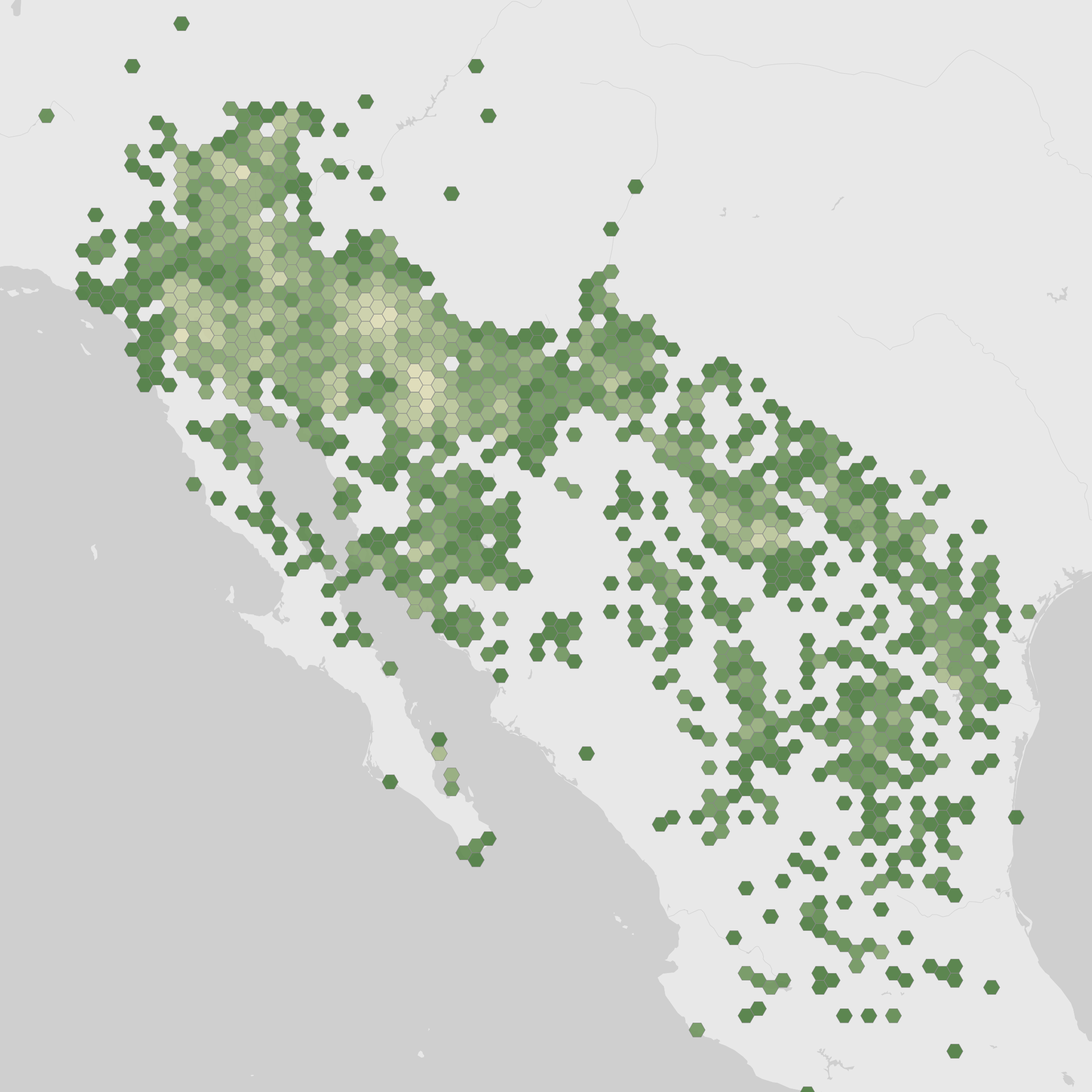
The black-tailed gnatcatcher occupies arid scrublands across a range of roughly 1,140,000 square kilometers spanning the Sonoran and Chihuahuan Deserts of the southwestern United States and northern Mexico. It favors open habitat, particularly desert washes, chaparral, and shrubland, and avoids denser or more closed vegetation types.
As a nonmigratory species, it remains within this desert range throughout the year rather than shifting seasonally to different regions. Observation patterns across the months show the bird present consistently year-round, with somewhat lower counts during the hottest mid-summer stretch, consistent with reduced activity during peak heat rather than any seasonal departure.
Its association with desert biomes is strong enough that the species is considered a characteristic bird of arid scrubland and desert wash habitat wherever it occurs.
Behavior and Lifestyle
Black-tailed gnatcatchers live in pairs throughout the year, defending a shared territory and foraging together in trees and low shrubs. This year-round pair bond and territorial defense set the species apart from many small songbirds that only pair up for a single breeding season.
Activity continues across all seasons, though the birds become noticeably less active during summer heat. Even then, they keep foraging during the hottest parts of the day by seeking out shady spots with a cooler microclimate rather than stopping activity altogether.
Outside the breeding season, pairs are not tied to a fixed breeding ground and instead wander more widely through the surrounding region. When breeding, however, they become sharply territorial: a bird will dive-bomb any intruder that approaches an active nest too closely.
Foraging style also distinguishes this species from its close relative, the blue-gray gnatcatcher. The black-tailed gnatcatcher rarely catches insects in midair, relying instead on gleaning prey from branches and shrubs while perched or hovering near the tips.
Communication
The species relies on visual, tactile, acoustic, and chemical channels to communicate, though its most conspicuous signal to human observers is acoustic: harsh, scolding calls given while foraging through desert shrubs. These calls likely serve to signal alarm or maintain contact between paired birds moving through dense scrub where visual contact can be difficult.
Hunting and Diet
The black-tailed gnatcatcher feeds primarily by gleaning insects and spiders from the tips of branches, most often while perched but sometimes while hovering just above the foliage. This perch-and-glean method makes up the bulk of its foraging activity in low shrubs and trees across its desert range.
It occasionally makes short forays into the air from a perch to catch insects in flight, but this is an infrequent tactic rather than a primary hunting strategy, setting it apart from more aerial insectivores. Collected specimens have shown traces of vegetable matter in the stomach, though this appears to account for only a small fraction of the diet.
As a strict insectivore, the species meets all of its water needs through the food it eats, without needing to drink free-standing water, an adaptation well suited to life in arid desert scrubland.
Nesting and Breeding
Courtship leads to a monogamous pair bond that lasts for the breeding season and, in many cases, appears to extend beyond it, though the exact duration of these bonds remains unclear. During breeding, the male defends a foraging territory around the nest site.
Both sexes build an open-cup nest, typically placed in low shrubs less than five feet off the ground. Where available, desert mistletoe (Phoradendron californicum) is often chosen as the nesting substrate, since it provides good concealment for the structure. The nest is woven from weeds, grass, strips of bark, spider webs, and plant fibers, then lined with softer material.
Females lay three to five bluish-white eggs marked with red-brown dots, occasionally ranging up to six per clutch. Both parents incubate the eggs, which hatch in about 14 days, falling within a documented range of 11 to 15 days. The altricial chicks are fed by both parents and fledge 10 to 15 days after hatching.
Pairs commonly raise a second brood shortly after the first, and double clutching is possible within a single season. Both sexes reach sexual maturity at about one year of age.
Population and Ecological Role
Cowbirds heavily parasitize black-tailed gnatcatcher nests in some regions, laying their own eggs for the gnatcatcher pair to raise alongside or instead of their own young. Despite this pressure, the species' population appears to be holding up well, suggesting the birds can absorb a degree of brood parasitism without broader decline.
As an insectivore foraging through desert shrubs and trees, the species plays a role in controlling populations of small insects and spiders within its arid scrubland habitat.
Conservation and Threats
The black-tailed gnatcatcher is classified as Least Concern by the IUCN Red List, indicating no major cause for concern about its survival at present. It is protected in the United States under the Migratory Bird Act, though it carries no special status under the US Federal List or CITES.
The main documented pressure on the species is nest parasitism by cowbirds, which can be heavy in some regions, though the overall population appears to be holding steady despite this pressure.
Cultural Significance
No significant cultural associations or human uses have been documented for the black-tailed gnatcatcher.
Fun Facts
- The tail underside is the clearest way to separate this species from the blue-gray gnatcatcher: mostly black in Polioptila melanura, mostly white in its relative.
- Desert mistletoe is a favored nest site when available, its dense growth offering the nest extra concealment from predators.
- The species obtains all the water it needs from its food, without drinking standing water, a useful trait for a bird living in desert scrubland.
Photos
Photographs from via iNaturalist, licensed under CC0 1.0., by Katrina Smith via iNaturalist, licensed under CC BY 4.0., by eklemp via iNaturalist, licensed under CC BY 4.0., by rociojgo via iNaturalist, licensed under CC BY 4.0., by Julio Cesar Ruiz García via iNaturalist, licensed under CC BY 4.0., by Aaron Liston via iNaturalist, licensed under CC BY 4.0., by tcantrell52 via iNaturalist, licensed under CC BY 4.0., by ian bullock via iNaturalist, licensed under CC BY 4.0., by Isaac Krone via iNaturalist, licensed under CC BY 4.0., and by Rachel Stringham via iNaturalist, licensed under CC BY 4.0., credited on each photo.
Ecology and classification
Classification
- Phylum
- Chordata
- Class
- Aves
- Order
- Passeriformes
- Family
- Polioptilidae
- Genus
- Polioptila
- Species
- Polioptila melanura
Sources
- GBIF Species names and classification
- iNaturalist Photos
- Wikidata Common names and conservation status
- Wikipedia Summary extract
- Encyclopedia of Life Habitat, diet and behavior traits
- Animal Diversity Web Animal habitat, behavior and diet
- AVONET Bird mass, habitat, migration, diet and range size