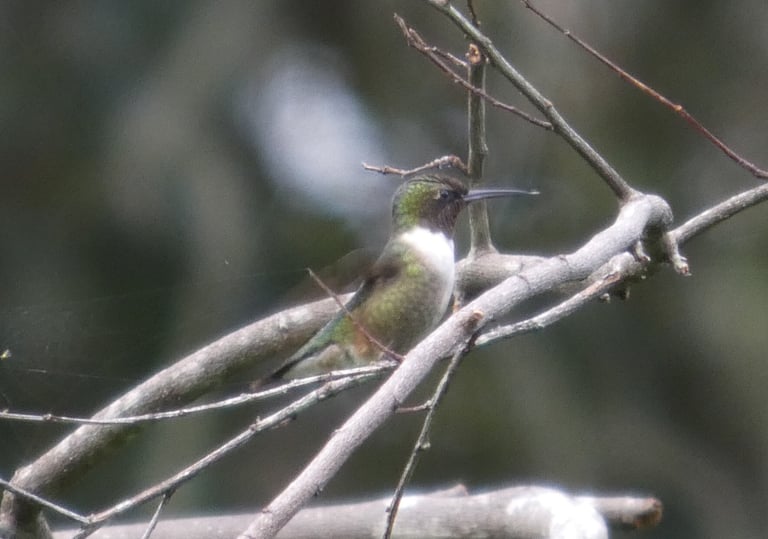
The male Anna's hummingbird is the only North American hummingbird species with a red crown, an iridescent crimson-pink cap that can flash brilliantly in sunlight or look dull brown in shade.
This small hummingbird, Calypte anna, belongs to the family Trochilidae and lives along the Pacific coast of North America, from southern Canada into northern Baja California. It is listed as Least Concern by the IUCN, and its population has been expanding for decades, a rare conservation success story among small songbirds and hummingbirds alike.
Identification and Appearance
The male's iridescent crimson-pink crown and throat, unique among North American hummingbirds, are the clearest way to identify the species, though the color depends heavily on the angle of light and can appear dull brown or gray without direct sunlight.
Anna's hummingbird measures 9.9 to 10.9 centimeters long, with a wingspan of about 12 centimeters and a weight of just 2.8 to 5.7 grams. Both sexes show an iridescent bronze-green back, a pale grey chest and belly, and green flanks, with a long, straight, slender bill suited for probing flowers.
Females also have iridescent red gorgets, though usually smaller and less brilliant than the male's, and they have a dark, rounded tail tipped with white on the outer feathers, unlike the male's dark, slightly forked tail. Juvenile males resemble females, with a dull green crown and a grey throat that may show only a few red flecks.
The iridescence itself comes from stacked melanosomes in the feather barbules, layered with keratin so they reflect light like partially opened blinds, a structural effect rather than pigment, which is why the crown's brilliance shifts so dramatically with viewing angle.
Distribution and Habitat
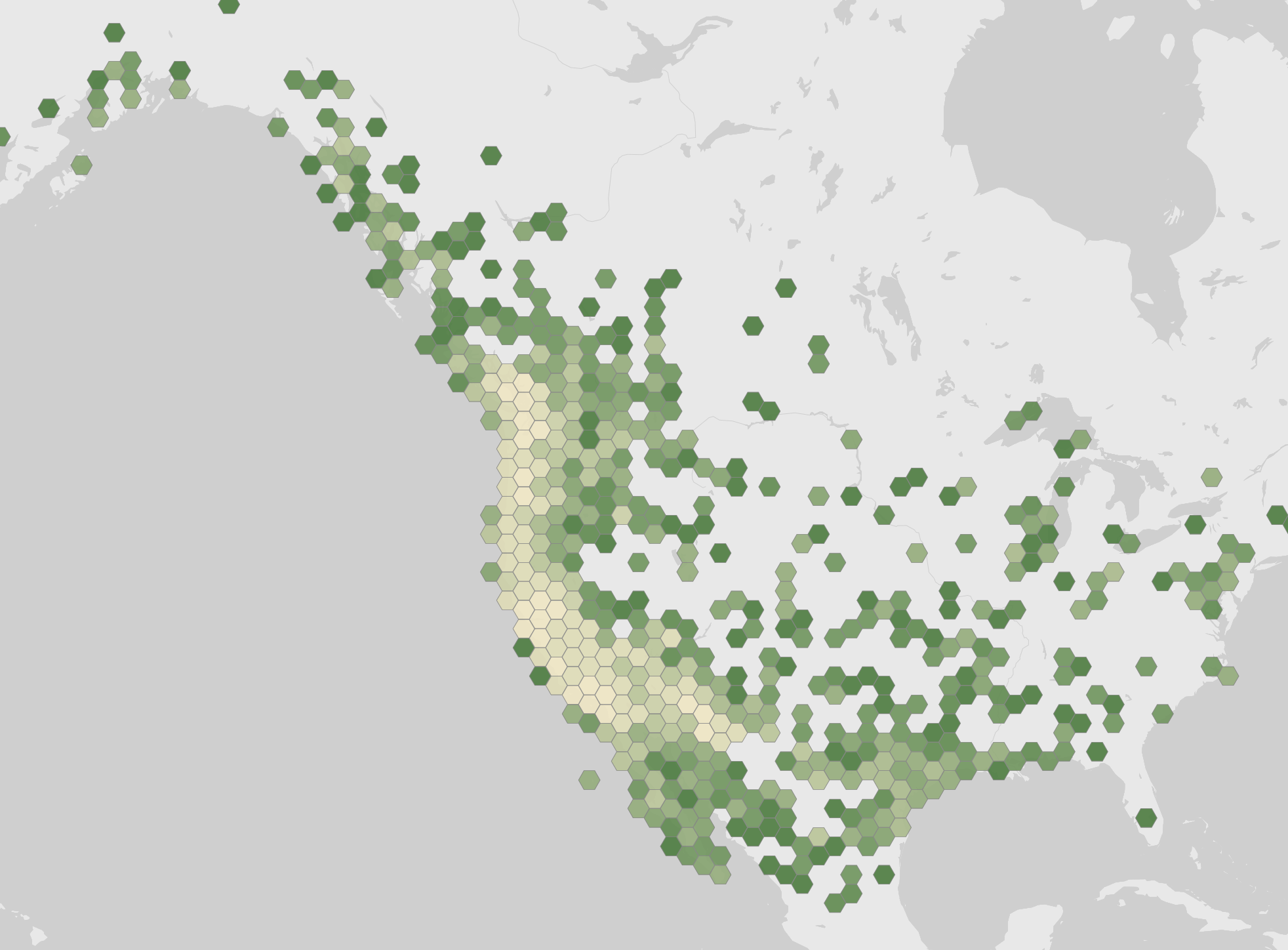
Anna's hummingbird occupies open woods, shrubland, gardens, and parks along the Pacific coast, ranging from southern Canada through California to northern Baja California, and inland into Arizona, southern Nevada, southeastern Utah, and western Texas. Most populations are year-round residents rather than long-distance migrants.
During the breeding season the species is largely restricted to California, where males and females separate by habitat: males favor open terrain such as canyon sides and hill slopes, while females settle in trees, including evergreens and oaks. Seasonal elevation shifts also occur, with birds moving to higher ground in summer and lower altitudes in winter.
The range has expanded substantially since the mid-20th century, pushing north into Oregon, Washington, and British Columbia and east into Arizona, a shift linked to widespread planting of non-native flowering plants such as eucalyptus and the spread of urban bird feeders. Anna's hummingbirds now hold the northernmost year-round range of any hummingbird species, with birds wintering as far as Seattle and even southern Alaska, enduring subfreezing temperatures, snow, and high winds.
The species has adapted well to urban and suburban environments and is now a common visitor to backyards and parks throughout its expanded range.
Behavior and Lifestyle
Anna's hummingbirds are solitary and strongly territorial, diving aggressively at intruders of any size that enter their space, whether rival hummingbirds or much larger animals. They are active by day and can become torpid at night to conserve energy, a survival strategy that becomes especially important during cold weather.
Birds with inadequate fat reserves or insufficient plumage survive subfreezing conditions by lowering their metabolic rate and entering torpor; those living at higher, colder mountain elevations use torpor more often and for longer periods than birds at lower elevations. During the day in cold climates, they gradually build fat reserves by converting sugar, preparing for the next cold night.
Hovering flight is powered by large pectoral muscles made entirely of fast glycolytic fibers, which respond quickly and resist fatigue, allowing the sustained high wingbeat frequencies hummingbirds are known for. The species is partially migratory, with some populations moving seasonally while others, especially in milder urban areas, remain resident year-round.
Communication
Male Anna's hummingbirds sing during courtship, unusual among northern temperate hummingbirds, producing a thin, squeaky song interspersed with buzzes and chirps that can last over 10 seconds. This vocal display is paired with a dramatic aerial dive performed over the male's territory.
When a female enters his territory, the male climbs about 40 meters before diving toward her, reaching an average speed of 27 meters per second near the bottom of the dive. At that moment his tail feathers produce an audible, explosive squeak, a mechanical sound rather than a vocalization, used to signal fitness during courtship.
Outside of these displays, males use a separate scratchy, metallic call while perched in trees and shrubs, likely serving territorial or general communication purposes.
Recordings
song · United States · Bushman · CC BY-SA
Diet and Feeding Habits
Anna's hummingbird feeds mainly on nectar, using its long, narrow bill and hovering flight to probe deep into tubular flowers, especially those with red, orange, or violet hues. It extends its tongue into the flower while hovering, extracting nectar efficiently without needing to land.
Among the flowers it visits most frequently are chaparral currant, fuchsia-flowered gooseberry, great-berried manzanita, monkey-flower, pitcher-sage, California fuchsia, western columbine, and Indian warrior, many of which are native chaparral species adapted to the bird's feeding and breeding schedule.
Beyond nectar, the species supplements its diet with tree sap extracted from holes in bark, sugar-water from backyard feeders, and small insects and spiders, the latter caught in flight or picked from spider webs. This combination of nectar and small invertebrates provides the protein needed for feather growth and general maintenance; males with higher protein intake develop more colorful, iridescent crowns than those with lower protein diets.
Nesting and Breeding
Breeding season begins with the arrival of winter rains, typically between November and December, and continues until April or May, during which a pair may raise two broods. Males establish territories while females independently build nests, bound together with spider silk and lined with soft plant material, feathers, or hair, with the exterior camouflaged using bark, dead leaves, lichen, or even bits of paint chip in urban settings.
Courtship begins when a female enters a male's territory; he performs aerial dives and chases her toward her nesting area, where she perches. Copulation lasts only 3 to 5 seconds, with the male mounting the female's back, sometimes gripping her crown feathers with his bill. The mating system is polygynandrous, with no lasting pair bond.
Each clutch typically holds two small white, elliptical eggs laid a day apart. The female alone incubates them for 14 to 19 days, and the altricial chicks, born with eyes closed, open their eyes around day five and are fully downy by day six. Chicks fledge after 18 to 23 days in the nest.
There is no male parental care; the female alone feeds and protects the young until independence, which comes within one or two weeks of fledging. Young often remain paired with siblings briefly before separating to establish their own territories by fall, and immature birds begin showing territorial behavior while still quite young.
Conservation and Threats
Anna's hummingbird is listed as Least Concern by the IUCN, reflecting its large and growing population. A 2021 estimate put the global population at about 9.6 million mature individuals, with roughly 8 million birds in the western United States and Canada, and the population has been increasing since 1970.
The species has benefited from human landscaping and feeding: suburban gardens, non-native flowering plants, and backyard nectar feeders have allowed Anna's hummingbird to expand its range and numbers since the 1950s rather than decline. It is protected in the United States under the Migratory Bird Act, though it carries no special federal or CITES status given its stable, expanding population.
Cultural Significance
Anna's hummingbird holds official status as the city bird of both Vancouver, British Columbia, and Sedona, Arizona, reflecting its familiarity and popularity in urban settings across its range.
The species also plays an ecological role tied to human landscapes, pollinating chaparral flora in California; many native plant species have evolved flowering and growth patterns timed to coincide with Anna's hummingbird's breeding and feeding cycles, representing a close, long-standing relationship between the bird and its native plant community.
Fun Facts
- Anna's hummingbird may hybridize with other species, including Costa's hummingbird; some hybrid specimens were once mistaken for entirely new species, such as the so-called Floresi's hummingbird, later identified as an Anna's and Allen's hummingbird cross.
- In flight, the birds can shake their bodies 55 times per second to shed rainwater or dislodge pollen and dirt from their feathers, with each twist lasting only four-hundredths of a second and applying 34 times the force of gravity on the head.
- Anna's hummingbirds may generate an electrostatic charge in flight that helps pollen stick to their beaks and feathers, aiding transfer between flowers.
- The species was first described in 1829 by Lesson under the name Ornismya anna, before later being placed in the genus Calypte, introduced by John Gould in 1856.
Photos
Photographs from via iNaturalist, licensed under CC0 1.0., by William Rogers via iNaturalist, licensed under CC BY 4.0., by Rachel Lee Harper via iNaturalist, licensed under CC BY 4.0., by Emerson via iNaturalist, licensed under CC BY 4.0., by Karen Offereins via iNaturalist, licensed under CC BY 4.0., by Liam Steele via iNaturalist, licensed under CC BY 4.0., by Matt Berger via iNaturalist, licensed under CC BY 4.0., by David Anderson via iNaturalist, licensed under CC BY 4.0., by Irina Mitine via iNaturalist, licensed under CC BY 4.0., and by Jonathan Eisen via iNaturalist, licensed under CC BY 4.0., credited on each photo.
Ecology and classification
Classification
- Phylum
- Chordata
- Class
- Aves
- Order
- Apodiformes
- Family
- Trochilidae
- Genus
- Calypte
- Species
- Calypte anna
Sources
- GBIF Species names and classification
- iNaturalist Photos
- Wikidata Common names and conservation status
- Wikipedia Summary extract
- Encyclopedia of Life Habitat, diet and behavior traits
- Xeno-canto Audio recordings
- Animal Diversity Web Animal habitat, behavior and diet
- AnAge Longevity
- AVONET Bird mass, habitat, migration, diet and range size
- GloBI What it eats, what eats it, parasites and pollinators
- SquamataBase
- Guzman et al. 2022