Few birds do what the great shearwater does: it breeds in the Southern Hemisphere and then spends the northern summer in the Northern Hemisphere. This seabird belongs to the family Procellariidae and nests in colonies on rocky islands in the South Atlantic. Outside the breeding season it ranges widely across the Atlantic Ocean.
The species is a large shearwater, and it is one of the most accomplished fliers among seabirds. Its life is spent almost entirely in the air or on the water, which makes it a rewarding species to study at sea.
Identification and Appearance
The most useful field mark is the white horseshoe on the base of the tail, set against otherwise dark upper parts. The underparts are mostly white, though a brown belly patch and dark shoulder markings break up the pale tones. A black cap and black bill complete the head pattern.
Adults measure 43–51 cm (16.9–20.1 in) from bill to tail, with a wingspan of 105–122 cm (3.5–4.0 ft). A typical bird weighs about , which makes it a heavy shearwater for its length.
In flight, the bird holds its wings stiffly, similar to a large Manx shearwater. The only other large shearwaters in its range are Cory's shearwater and the all-dark sooty shearwater. Cory's shearwater is paler overall, and the sooty shearwater lacks the white under parts and tail marking entirely.
Distribution and Habitat
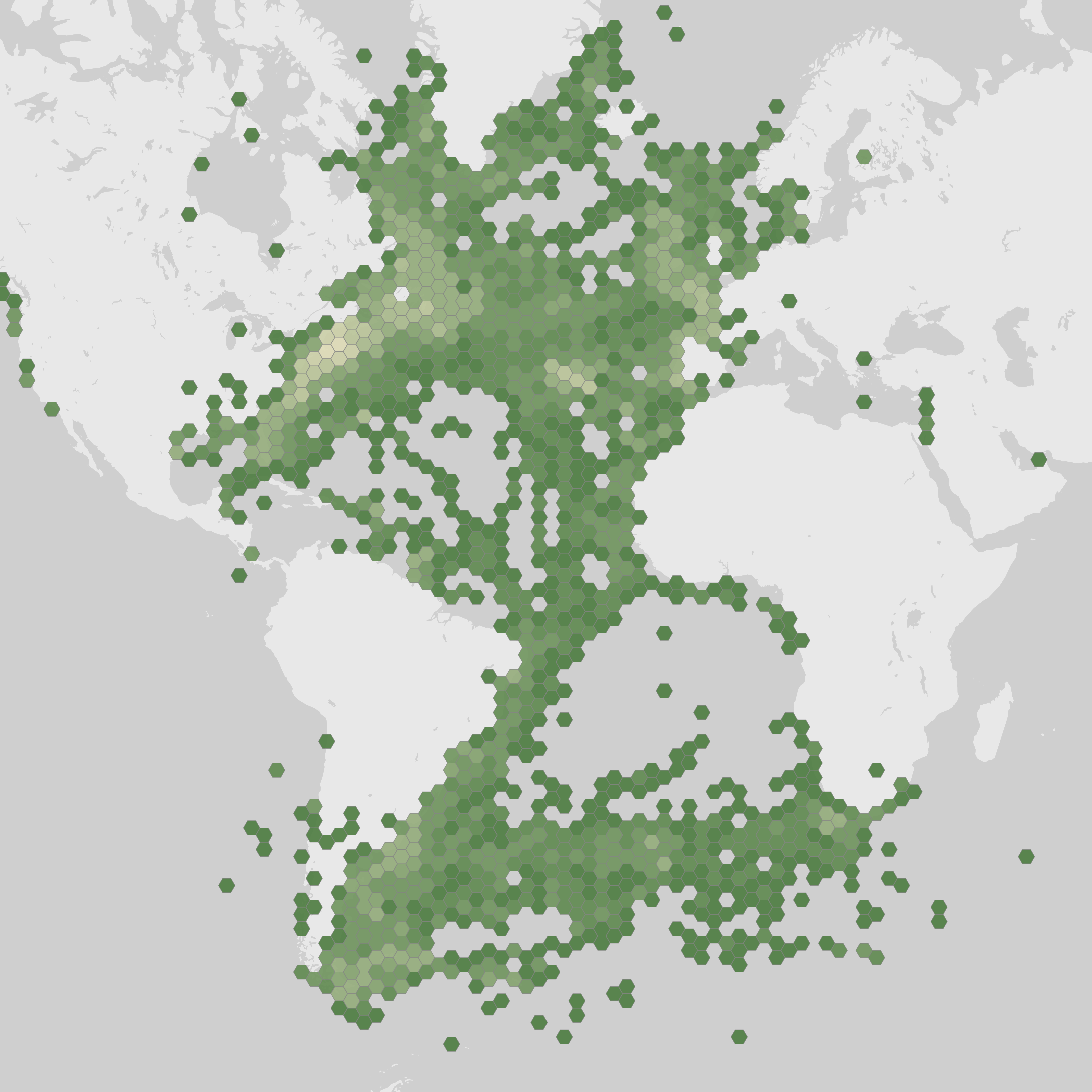
The great shearwater breeds on a handful of islands in the South Atlantic, including the Tristan da Cunha group, Gough Island, Nightingale Island, Inaccessible Island, and the Falkland Islands. Its breeding range is restricted to only four sites.
At sea, the bird is marine and pelagic, favoring cool offshore waters. Outside the breeding season it follows a circular migration route. It moves north up the eastern coast of South America and then North America, and it crosses the Atlantic in August.
On the return journey, the birds can be quite common off the southwestern coasts of Great Britain and Ireland. They then travel south again along the eastern side of the Atlantic.
During the breeding season, the species nests on sloping ground, mainly in grassland or woodland on hilly island shores. Its colonies are found on land, but the bird spends most of its life over open ocean.
Behavior and Lifestyle
The great shearwater is a social seabird. It flies, feeds, and migrates in flocks, and flocks often follow ships to find food. The bird spends most of its life in flight and rarely comes to land except to breed.
Its flight style gives the genus its name. The bird soars just above the surface, following the contours of the waves with outstretched wings. The wingtips shear the water surface, which is where the name shearwater comes from. Its flight is powerful and direct, with few wingbeats and stiff wings.
Underwater, the bird is agile and can rotate 180 degrees while using its wings to steer. On land, however, it is clumsy and awkward. Its large size makes it relatively safe from predation by Great Skuas, a major predator in the area, so it can remain active during the day rather than at night.
Communication
Birds give a harsh, raucous call while feeding, which sounds much like a gull. Near the nest at night, returning adults give a vocal croak.
Calls differ between the sexes. Female calls are shorter and have a lower frequency in the inspiratory phrase than the first harmonic of the longer expiratory phrase. In males, this pattern is reversed. Birds can tell female and male calls apart, which may help them choose a mate.
Visual signals and touch also play a role in communication. Visual displays, touch, and sound are all part of the species' social life at sea and at the colony.
Diet and Nutrition
The great shearwater is a hunter that catches live prey at the surface and below it. It uses three main methods. Plunge-diving begins with the bird striking the water from heights of 6–10 m with its belly and feet, then pushing its head under and entering a smooth submersion. Sometimes it briefly halts about 0.5 m above the surface, spreads its feet, and dives headfirst. Surface-seizing, which resembles the walking on water seen in storm petrels, involves landing with the feet, balancing with the wings, and picking food from near the surface. Pursuit diving is used to catch prey underwater.
Fish and squid make up most of the diet. Occasional food includes crustaceans, fish entrails, and other refuse discarded by fishing vessels. Birds that feed in groups compete for food and lash out at one another with their bills and wings.
After a dive, the bird bursts out of the water and flies almost directly upward.
Nesting and Breeding
The breeding season begins in October and often lasts until December. The species breeds in the Southern Hemisphere, restricted to a few far southern oceanic islands, including the Tristan da Cunha group, the Falkland Islands, and Gough Island.
The great shearwater nests in large colonies. It nests in burrows or in crevices among boulders along hilly island shores. Some pairs nest in small burrows or in open grass. The female lays a single white, oval, slightly pointed egg.
The egg is incubated for 53–57 days. The chick hatches helpless and needs constant care. Both the male and female feed and protect the young, and the chick becomes independent at about 105 days.
Adults visit their nests only at night to avoid predation by large gulls.
Population and Ecological Role
The species is abundant, with a minimum of 5 million breeding pairs on Tristan da Cunha and between 600,000 and 3 million pairs on Gough Island. Its feeding habits make it a predator of fish and squid in the open ocean, and it scavenges from fishing vessels.
The bird hosts several parasites. Lice such as Halipeurus gravis, Naubates, Naubates harrisoni, and Trabeculus hexakon are the main parasites, and Austromenopon paululum occurs less often.
Conservation and Threats
The great shearwater is listed as Least Concern on the IUCN Red List and is not globally threatened. Its breeding population is large, but its breeding range is restricted to four known sites, which makes it vulnerable to disturbance at those sites.
The main concern is harvesting by Tristan islanders. Each year, a few thousand adults and about 50,000 chicks are taken. Without a quota system to allow sustainable harvest, this could lead to a population collapse.
Some birds are also caught on the baited hooks of fishermen, though this happens only occasionally. Research on the effects of harvesting and bycatch is limited, and more study is needed to set safe harvest levels.
The species has no special status under the US Federal List or CITES.
Cultural Significance
In the past, great shearwaters were used as food and bait by sailors, but this practice has long been abandoned. Today the bird has little direct contact with people, apart from occasional encounters with fishermen and the islanders of Tristan da Cunha.
Photos
Photographs from via iNaturalist, licensed under CC0 1.0., by Pedro Eça via iNaturalist, licensed under CC BY 4.0., by Rita Clare via iNaturalist, licensed under CC BY 4.0., by er-birds via iNaturalist, licensed under CC BY 4.0., by Ryan F. Mandelbaum via iNaturalist, licensed under CC BY 4.0., and by Brandon Johnson via iNaturalist, licensed under CC BY 4.0., credited on each photo.
Ecology and classification
Classification
- Phylum
- Chordata
- Class
- Aves
- Order
- Procellariiformes
- Family
- Procellariidae
- Genus
- Puffinus
- Species
- Puffinus gravis
Sources
- GBIF Species names and classification
- iNaturalist Photos
- Wikidata Common names and conservation status
- Wikipedia Summary extract
- Encyclopedia of Life Habitat, diet and behavior traits
- Animal Diversity Web Animal habitat, behavior and diet
- AVONET Bird mass, habitat, migration, diet and range size
- GloBI What it eats, what eats it, parasites and pollinators
- Wardeh et al. 2015 (EID2)
- HWML Parasite Collection