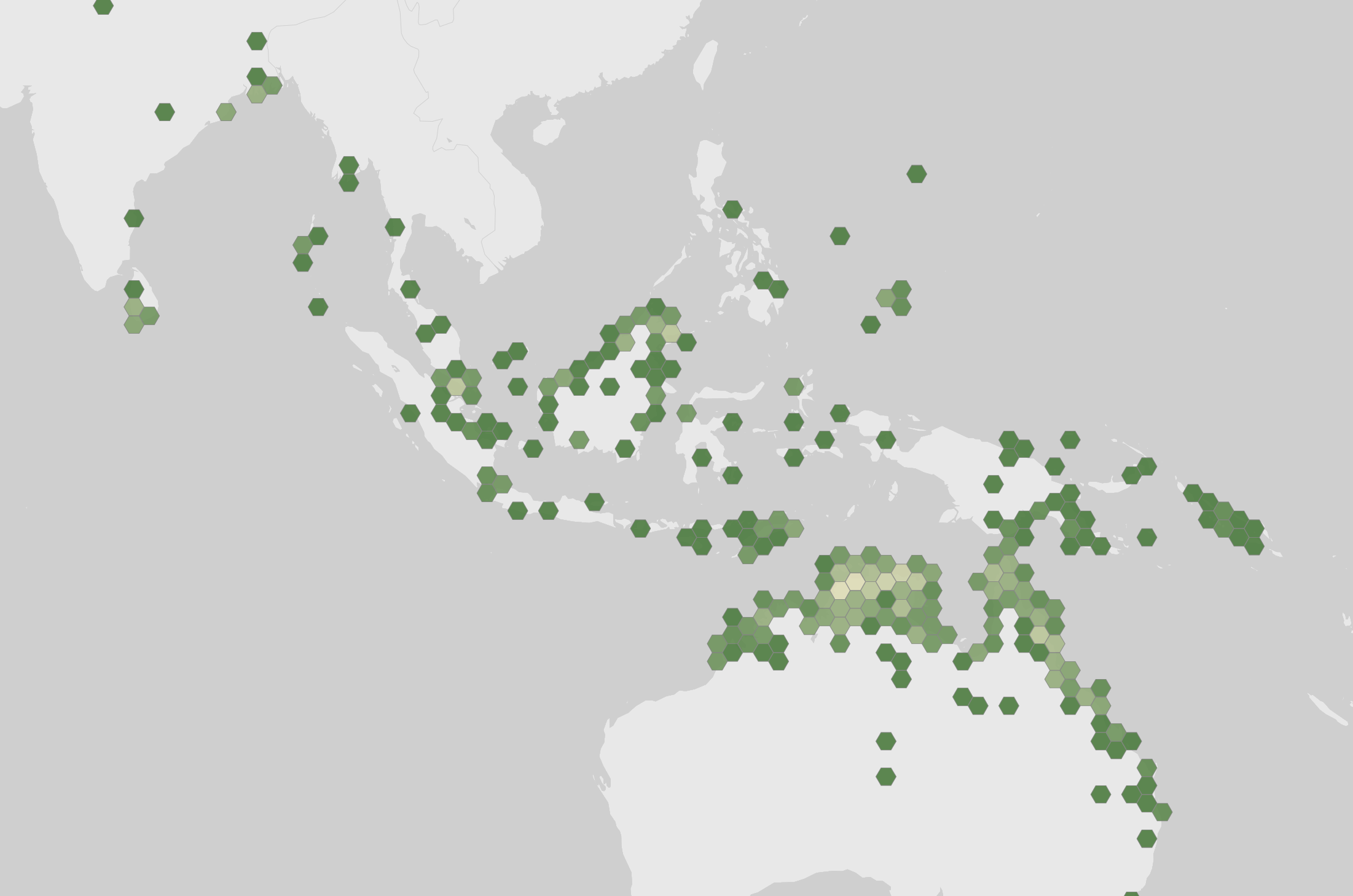
The saltwater crocodile is the largest living riparian predator, and adult males can reach about in length. It lives in salt water, brackish mangrove swamps and freshwater rivers from India's east coast across Southeast Asia to northern Australia and Micronesia.
It is a crocodilian that is more at home in the sea than most of its relatives. Its range covers coastal waters, river deltas and inland billabongs, and it can persist in both salt and fresh water through its life.
The species has been listed as Least Concern on the IUCN Red List since 1996, although it was hunted heavily for its skin until the 1970s and still faces illegal killing and habitat loss. It can live up to , and its size, reach and reputation make it one of the most studied reptiles in the world.
Identification and Appearance
The most useful field mark is the snout, which is wide but longer than that of the mugger crocodile, measuring about twice as long as it is wide at the base. A pair of ridges runs from the eyes along the centre of the snout, and the neck has fewer armour plates than in other crocodilians.
Adults are broad-bodied, which is unusual among crocodiles and once led early observers to mistake the species for an alligator. Adults are dark greenish-drab, with some individuals so dark they look blackish and others keeping lighter tan or grey areas. The underside is white or yellow at every age, and the tail is grey with dark bands.
Hatchlings and juveniles are pale yellow with black stripes and spots on the body and tail. This colouring lasts for several years before adults darken. Newly hatched young measure about 28 cm and weigh about 71 g.
Adult males are much larger than females. Males typically measure 3.5 to 5 m and weigh 200 to 1,100 kg, with average adult males between 4.0 and 4.5 m long. The largest known skull, from Cambodia, suggests an animal of about 6.7 to 7 m.
Distribution and Habitat
The species occurs in coastal brackish mangrove swamps, river deltas and freshwater rivers across the Indian Ocean and western Pacific. In India it is found along the east coast and in the Andaman and Nicobar Islands, and the southernmost Indian population lives in Odisha's Bhitarkanika Wildlife Sanctuary. It also inhabits the Sundarbans, Sri Lanka, Bangladesh and Myanmar, where it lives in the Ayeyarwady Delta.
Further east, it occurs in Malaysia, Brunei, Indonesia, the Philippines, Timor-Leste, Palau, the Solomon Islands, Singapore and Papua New Guinea. In Singapore it inhabits the Sungei Buloh Wetland Reserve and marshes near Kranji and Mandai. In Papua New Guinea it is common along the coastal reaches of every major river system.
In northern Australia it is most abundant in river systems near Darwin, including the Adelaide, Mary and Daly Rivers and their billabongs and estuaries. Its Australian range extends from Broome in Western Australia along the Northern Territory coast to Gladstone in Queensland. It is locally extinct in Cambodia, China, Seychelles, Thailand and Vietnam.
During the wet season, crocodiles generally use freshwater swamps and rivers, moving downstream to estuaries in the dry season. Observations peak in the months of the wet season, with the largest monthly counts in the middle of the year, so sightings are most frequent then.
Behavior and Lifestyle
The saltwater crocodile is nocturnal in its hunting and spends much of the day loitering in the water or basking on banks. It is generally lethargic, a habit that lets it go months without food. Activity rises in the Australian summer, when it spends more time in the water, and falls in winter, when it basks more.
It is one of the most active crocodilians when it moves. It can ride ocean currents to travel long distances, and in one satellite-tracking study in Australia, one individual covered 590 km along the coast in 25 days. Individuals also rest in sheltered bays until the current changes direction.
The species is a strong diver. It can stay submerged for up to two hours and reduces its heart rate and oxygen use to extend a dive. Crocodiles regulate their body temperature by submerging with only the eyes and nostrils showing when hot, and by lying on flat rocks in the sun when cold.
It is the least social of the crocodilians, but its social systems shift with the season, sex and age. Some individuals keep specific associations for up to five years. Dominant males hold the best stretches of freshwater, and younger crocodiles are pushed into marginal rivers or out to sea.
Hunting and Diet
The saltwater crocodile is a hunter that waits for prey. It usually lies in the water with only its nostrils, eyes and part of its back exposed. When prey comes close, it lunges out of the water and usually kills with a single snap of the jaws.
It then drags the prey underwater, where the carcass is easier to consume. Young crocodiles eat insects, amphibians, crustaceans, small fish and small reptiles. As they grow, they move to larger prey.
Adults feed on mud crabs, turtles, snakes, birds, buffalo, wild boar and monkeys. Its diet therefore shifts from small invertebrates and vertebrates to large mammals as the crocodile matures.
Nesting and Breeding
Females reach sexual maturity at about 10 to 12 years, and males do not mature until about 16 years, when they reach around 3.3 m. Courtship happens in the wet season, when water levels are highest. In Australia, courtship takes place in September and October, and females lay eggs from November to March.
The female chooses the nest site, usually a shore along a tidal river or a freshwater swamp. Both parents defend the nesting territory. The nest is a mound of mud and vegetation, often about 175 cm long and 53 cm high. Because the eggs are laid during the wet season, nests must be raised to avoid flood losses.
The female typically lays 40 to 60 eggs and sometimes up to 90. Eggs average about 8 by 5 cm and weigh about 113 g in Australia. The female guards the nest for 80 to 98 days, and the eggs hatch after roughly 90 days, though timing varies with nest temperature.
Nest temperature determines sex. Eggs incubated at about 31.6 degrees Celsius produce males, while small changes in either direction produce females. At 30 to 32 degrees, most hatchlings are male, and at 33 degrees or higher, most are female.
Goannas take about 25 percent of eggs in Australia, and most egg losses come from flooding. The female digs out the nest when the hatchlings call and carries them to the water in her mouth, then stays with them for several months. Only about 1 percent of hatchlings survive to adulthood.
Population and Ecological Role
Australia's population is estimated at 100,000 to 200,000 adults. Restocking in India has helped build a population of about 1,000 crocodiles, and the Indian population is now moderately stable.
The species is a large riparian predator, and its adults hunt mud crabs, turtles, birds and mammals. Its parasites include roundworms of the order Trichocephalida and bacteria of the order Micrococcales. Less common parasites include the nematode Proctocaecum elongatum and the bacterium Dermatophilus crocodyli.
Juveniles often move into marginal habitats because dominant males hold the best freshwater territories. That movement spreads young crocodiles across the range.
Conservation and Threats
The IUCN lists the species as Least Concern, and it has been on that list since 1996. Its populations are not stable everywhere, though, and in some countries it is now rare or extirpated.
The main threats are hunting for its skin and habitat loss from coastal development. Unregulated hunting between 1940 and 1970 reduced the population in northern Australia by 95 percent by 1971. Habitat destruction in Sri Lanka and Thailand has been rapid, and only two saltwater crocodiles were sighted there in 1999. In southern Vietnam, about 100 crocodiles are estimated to remain in the wild.
Australia has full legal protection in all states and territories where the species occurs, and it runs yearly population counts and crocodile farms. In India, more than 1,400 crocodiles were released in a restocking program, and about 580 survived. Saltwater crocodiles from Australia, Indonesia and Papua New Guinea are listed in CITES Appendix II, which allows regulated trade, while populations elsewhere are in Appendix I, which bans international commercial trade.
Cultural Significance
Saltwater crocodile hides are among the most valuable of any crocodilian, and leather products made from them are the most prized. Farms raise crocodiles for this purpose, though the practice is controversial because the rest of the animal is often discarded.
The species has a long history of attacking people who enter its territory. Australia reported 106 fatalities from 1971 to 2013, and fatal attacks typically involve larger crocodiles, with an average estimated size of 4.3 m. Attacks outside Australia are believed to go unreported, and some estimates suggest up to 20 to 30 per year.
During the Battle of Ramree Island in February 1945, saltwater crocodiles may have contributed to the deaths of more than 400 Japanese soldiers who were trapped in mangrove swamps.
Photos
Photographs from via iNaturalist, licensed under CC0 1.0., by Julie Hart via iNaturalist, licensed under CC BY 4.0., by Rob Foster via iNaturalist, licensed under CC BY 4.0., by Luke Lythgoe via iNaturalist, licensed under CC BY 4.0., by Martin Rady via iNaturalist, licensed under CC BY 4.0., and by Stella Fish via iNaturalist, licensed under CC BY 4.0., credited on each photo.
Ecology and classification
Classification
- Phylum
- Chordata
- Class
- Crocodylia
- Family
- Crocodylidae
- Genus
- Crocodylus
- Species
- Crocodylus porosus
Sources
- GBIF Species names and classification
- iNaturalist Photos
- Wikidata Common names and conservation status
- Wikipedia Summary extract
- Animal Diversity Web Animal habitat, behavior and diet
- AnAge Longevity
- The Reptile Database Reptile distribution and common names
- ReptTraits Reptile size, lifespan, clutches or litters, habitat and habits
- GloBI What it eats, what eats it, parasites and pollinators
- Wardeh et al. 2015 (EID2)
- HWML Parasite Collection