The barnacle goose's closest living relative is the cackling goose, a finding from genetic analysis. Its plumage is nothing like that of most geese, since it belongs to the black geese, a genus whose species carry extensive black in their plumage. The species is Branta leucopsis, a member of the family Anatidae, and it looks superficially similar to the brant goose.
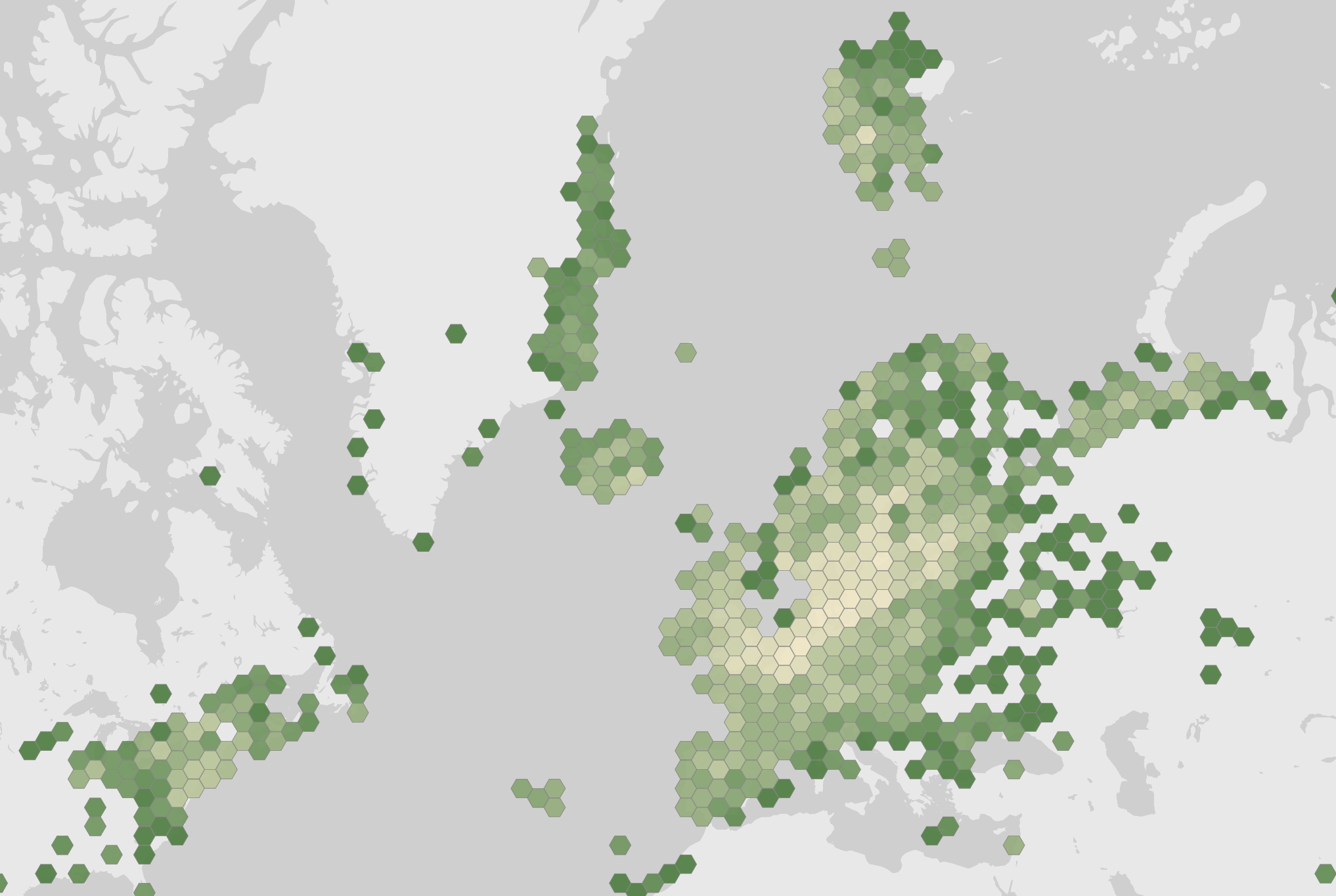
The barnacle goose is a waterfowl that breeds in the Arctic and winters farther south in the British Isles and western Europe. Its range covers about 179,000 km², and adults weigh about 1.69 kg. The IUCN lists it as Least Concern.
Its lifespan is also notable: the longest known life for the species is 28.2 years, usually recorded in captivity, which is far longer than most wild geese live.
Identification and Appearance
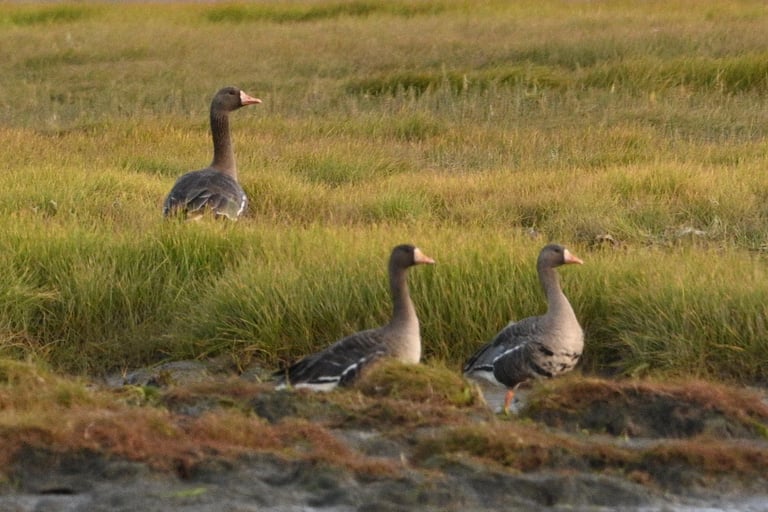
The most useful field mark is the white face set against a black head, neck and upper breast, with a white belly. Its wings and back are silver-grey, barred with black and white that seem to shine when light catches them.
The barnacle goose is a medium-sized goose, about 55 to 70 cm long, with a wingspan of 120 to 145 cm and a weight of 1.21 to 2.23 kg. It has black legs and a small, stubby black bill.
In flight, look for a V-shaped white rump patch and silver-grey underwing linings. Cackling geese look similar but have brown bodies rather than grey and white, and their heads show less white. Canada geese are larger and have bigger bills.
Juveniles resemble adults. Their mantle and flank feathers are rounded rather than square-ended, which separates them from adults.
A rare leucistic form has white plumage with black eyes, bill and legs. This morph has been reported in the Svalbard and Solway Firth population.
Distribution and Habitat
The barnacle goose breeds in Greenland, on Svalbard, on Novaya Zemlya and along the Russian Arctic coast. In winter it moves to the British Isles, the Wadden Sea coasts of the Netherlands, Germany and Denmark, and other parts of western Europe.
In the breeding season, the species favors tundra with abundant vegetation, coastal dunes and marshes. Females build nests on rocky hillsides and cliff edges. Outside the breeding season, it uses pasture land, salt marshes and grassy fields near the coast.
In winter, it has adapted to farmland and suburban areas. It grazes on fields and pastures near towns, which brings it close to people in these areas.
The species ranges from sea level up to about 40 m above sea level, with an average elevation near 15 m, which keeps it mostly in low coastal and lowland habitats.
Behavior and Lifestyle
Barnacle geese are migratory. They travel between their breeding and wintering grounds in spring and autumn, and they move as a flock. Flocks fly in closely packed lines during flight, though they sometimes form V-shapes. Their wingbeats are rapid, and the whole flock turns and twists together.
The species breeds colonially, so nesting pairs live close together and must defend their own nests against neighbors. Males vigorously defend the area around the nest during incubation. Territory size is unknown but likely changes with breeding density.
Some nests are placed on small islands and others high on mountain cliffs, up to 200 to 300 m above the surrounding terrain. These sites are safer from predators, though the nests can be up to a kilometre from the feeding areas on lakes and rivers.
Goslings leave the nest by jumping from the cliff, since they cannot fly. Their down and light weight usually protect them from injury, but some die from the impact. Afterward, the parents lead them to wetland feeding areas, where Arctic foxes stalk them. Because of these hazards, only about 50% of chicks survive their first month.
Young adults tend to stay near the adults in the flock, both while foraging and in flight. Family groups remain together until the following breeding season.
Communication
Barnacle geese give short, rapid, loud calls that warn nearby geese of approaching predators. The calls resemble the yapping of small dogs. They also call loudly to warn of aerial predators during flight.
Duets are most common during the mating season and strengthen pair bonds. The male usually starts a duet with short, rapid, loud calls, and an interested female replies with similar calls. Duets can also begin soon after young birds first choose mates.
Duets are often combined with visual displays. The male points his bill in alternating directions or holds his head close to the ground. If the female accepts, she lets him approach and touch her with his bill. Barnacle geese also perceive their surroundings through touch, sound, sight and chemical cues, and they are presumed to use magnetic fields to guide their migration.
Recordings
flight call, Wingbeats · Sweden · Jochem verweij · CC BY-SA
flight call · Netherlands · Joost van Bruggen · CC BY-SA
call · Netherlands · Joost van Bruggen · CC BY-SA
call, flight call · France · Sonothèque ADVL · Public domain
Diet and Nutrition
The barnacle goose is a herbivore that feeds mainly on grasses, aquatic vegetation and agricultural crops. Grasses of the order Poales make up the main part of its diet, and Poa nemoralis stands out among the grasses it eats. Its plant foods include leaves, roots and tubers.
On the breeding grounds, it eats whatever vegetation is available in the tundra. In winter, it grazes on grass in fields and farmland, which often leads to conflict with farmers.
Because it feeds in open fields, its diet shifts with habitat. In the Arctic it relies on tundra plants, and in wintering areas it switches to pastures and croplands.
Nesting and Breeding
Barnacle geese breed once a year, in spring, usually from late May to June. Birds that have reached sexual maturity choose their partners in early spring. Most mature at two years of age, though males occasionally breed at one year with older females. Some first mate at four years old, and maturity may depend on food supply and weather.
Pairs are monogamous and stay together for life. Courtship involves a ceremony in which the male calls loudly, changes his head angle and raises his wings. If the female responds with loud calls, the male moves closer and tries to touch her with his bill. Pairs may repeat the ceremony every year to strengthen their bond.
The female builds the nest, often on cliff edges, where it is safer from Arctic foxes. She uses mud and dead foliage, and before laying she lines the nest with down. She lays one egg a day until the clutch is complete, usually four or five pale grey eggs.
The female incubates the eggs for 24 to 26 days, while the male guards the nest and his mate. During incubation, both parents lose 30% to 40% of their body weight, because they cannot range far to feed.
The hatchlings are precocial and leave the nest as soon as their down dries. The parents lead them to marshes with abundant vegetation, but the young feed themselves. Both parents defend the brood fiercely until the young fledge at about 40 to 45 days old.
Population and Ecological Role
Barnacle goose populations have grown in recent decades. Each population has its own breeding and wintering range, and the sizes differ widely. The Greenland population rose from about 7,000 birds in the 1960s to 44,000 in 2011. The Russian population increased from about 70,000 in 1980 to 1.2 million in 2015.
The species plays a role in its ecosystem by dispersing seeds of many grasses. It is also prey for mammalian carnivores such as Arctic foxes and polar bears, for birds of prey such as peregrine falcons and buzzards, for corvids such as ravens and crows, and for storks.
Avian influenza viruses are its main known parasites. A highly pathogenic avian influenza outbreak in the early 2020s killed 11,400 birds in the 2021/22 winter, about 31% of the Svalbard population.
Conservation and Threats
The IUCN lists the barnacle goose as Least Concern, which means it is common and widespread. Its population and breeding range have grown in recent decades, and it is protected throughout its range. The species is also covered by the Agreement on the Conservation of African-Eurasian Migratory Waterbirds.
The main threat is conflict with farmers, who view the geese as pests on winter crops. The Barnacle Goose Management Scheme in Scotland helps farmers make their land more suitable for the birds and pays those who avoid disturbing them.
Highly pathogenic avian influenza is the most serious recent threat. The Svalbard population lost about 31% of its birds in the 2021/22 winter. Two highly productive breeding seasons then helped it recover to near its former level by the 2023/24 winter.
Vagrant birds have been recorded in eastern Canada, the northeastern United States and India. Observers should distinguish these wild birds from escaped captive individuals, since barnacle geese are popular with collectors.
Cultural Significance
For centuries, the barnacle goose was surrounded by a legend that it grew from driftwood on the sea shore. Writers repeated the story in medieval encyclopedias, and the name "barnacle" likely comes from the belief that the birds began as barnacles. Medieval authors such as Albertus Magnus criticized the legend.
Because the legend held that the geese were not born of flesh, some Irish clerics treated them as acceptable food on fast days. Pope Innocent III prohibited eating them during Lent at the Fourth Council of the Lateran in 1215, arguing that they lived and fed like ducks.
Jewish legal scholars also discussed whether the birds were kosher, and Rabbeinu Tam ruled that they were. A Jewish legend described the goose as attached to the tree from which it grew, much like the mythical Adne Sadeh.
Photos
Photographs from via iNaturalist, licensed under CC0 1.0., by Bernd De Bosscher via iNaturalist, licensed under CC BY 4.0., by Coralie via iNaturalist, licensed under CC BY 4.0., by Jess Hughes via iNaturalist, licensed under CC BY 4.0., by BlueKirby via iNaturalist, licensed under CC BY 4.0., by Edoardo Nardelli via iNaturalist, licensed under CC BY 4.0., by Zac Peterson via iNaturalist, licensed under CC BY 4.0., by Bevan Weir via iNaturalist, licensed under CC BY 4.0., by Robyn via iNaturalist, licensed under CC BY 4.0., by Олеся via iNaturalist, licensed under CC BY 4.0., by Michael Grundner via iNaturalist, licensed under CC BY 4.0., and by Martin Kalfatovic via iNaturalist, licensed under CC BY 4.0., credited on each photo.
Ecology and classification
Classification
- Phylum
- Chordata
- Class
- Aves
- Order
- Anseriformes
- Family
- Anatidae
- Genus
- Branta
- Species
- Branta leucopsis
Sources
- GBIF Species names and classification
- iNaturalist Photos
- Wikidata Common names and conservation status
- Wikipedia Summary extract
- Xeno-canto Audio recordings
- Animal Diversity Web Animal habitat, behavior and diet
- AnAge Longevity
- AVONET Bird mass, habitat, migration, diet and range size
- GloBI What it eats, what eats it, parasites and pollinators
- trophiCH
- Wardeh et al. 2015 (EID2)
- TETRA-EU