Named for its striking golden-yellow eyes, the common goldeneye is a medium-sized sea duck that spends most of its life diving beneath the surface of northern lakes, rivers, and coastal waters.
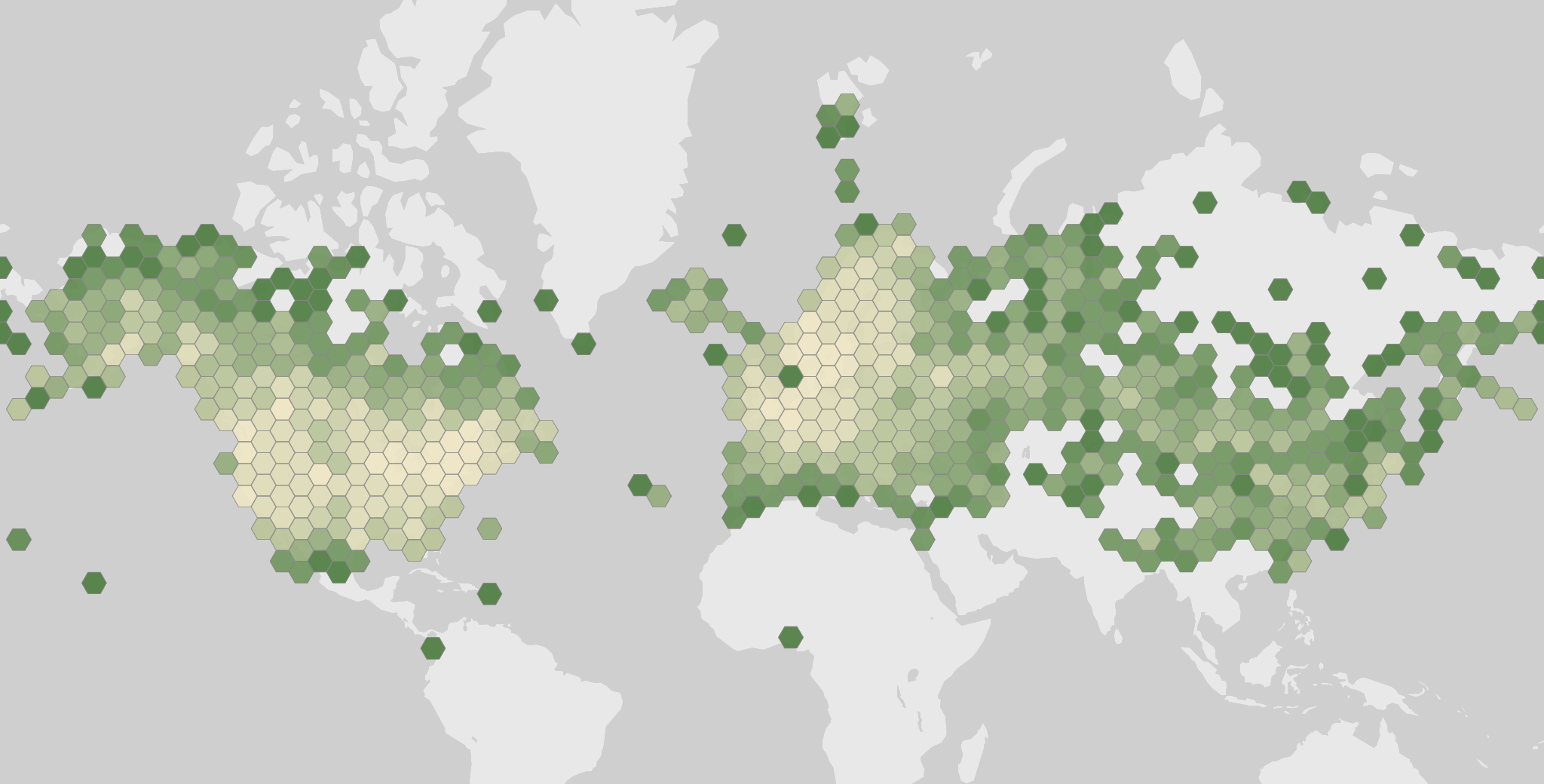
A member of the genus Bucephala within the waterfowl family Anatidae, this species breeds across the taiga of Canada, the northern United States, Scandinavia, the Baltic States, and northern Russia, then migrates south to winter on ice-free coastal and inland waters. The IUCN lists it as Least Concern, and its combination of striking plumage, elaborate courtship, and reliance on old-growth forest cavities makes it a distinctive bird to watch through the year.
Identification and Appearance
The golden-yellow eye set against a dark, glossy head is the single most reliable field mark of this species, giving the bird its name. Adult males measure 45 to 51 centimeters and weigh around 1,000 grams, while females are smaller at 40 to 50 centimeters and about 800 grams; wingspan ranges from 77 to 83 centimeters.
Males show a dark, greenish-glossed head with a distinctive round white patch below the eye, a dark back, and a white neck and belly. Females have a plainer brown head and mostly grey body, lacking the male's bold white facial patch. Both sexes show orange-yellow legs and feet.
The subspecies B. c. americana, found in North America, can be distinguished from the nominate B. c. clangula of Eurasia by its longer, thicker bill.
Distribution and Habitat
Common goldeneyes breed across the boreal taiga, on lakes and rivers of Canada, the northern United States, Scotland, Scandinavia, the Baltic States, and northern Russia, always close to mature forest where tree cavities are available for nesting. They favor clear lakes with little emergent vegetation, though stands of bulrush nearby are sometimes used for foraging, and they prefer lakes without predatory fish such as yellow perch, since these tend to hold more of the invertebrate prey the ducks depend on.
Outside the breeding season, the species shifts to coastal marine and estuarine waters and large interior lakes and rivers, favoring shallow water over sandy, gravel, or rocky bottoms. They are strong swimmers capable of foraging in strong currents but generally prefer slower-flowing water. During migration, large interior lakes and rivers serve as refueling stops on the journey toward coastal wintering grounds.
Monthly observation patterns show the species most frequently recorded from late autumn through winter and into early spring, consistent with its wintering presence on more temperate open waters, and lower counts in mid-summer when birds are dispersed on remote breeding lakes.
Behavior and Lifestyle
Common goldeneyes are diurnal, highly aquatic birds that spend nearly all their time on the water, walking only when moving broods between nest and water or overland to another lake. They are powerful fliers, reaching speeds up to 72 kilometers per hour with about nine wingbeats per second, flying low over water on short trips but higher when covering longer distances.
The species is migratory, among the last ducks to leave their breeding grounds in autumn and often wintering as far north as ice-free water allows. Northward migration in North America begins in February, while southward movement can start as early as July or run as late as October; birds typically travel in flocks of 4 to 40, sometimes merging into larger groups at stopover sites.
Social structure shifts with the season: females are largely solitary or accompanied only by their broods in summer, while foraging groups dive synchronously in search of prey at other times. Males defend small territories around the nest during breeding but abandon this defense once females begin incubating; females then defend both nesting and brooding territories, with territoriality varying by local population density. In Minnesota, breeding densities have been estimated at 0.5 to 3.5 pairs per kilometer of shoreline. Females also show strong natal philopatry, often returning to nest near where they themselves hatched.
Communication
Outside courtship and nest-searching, common goldeneyes are largely silent. During courtship, males give short, faint "peent" calls as part of elaborate visual displays, along with grunting sounds after copulation.
Females use harsh, croaking "gack" calls when searching for nest sites or when disturbed. Visual signals play a central role in both courtship and aggressive encounters, complementing the limited acoustic repertoire.
Diet and Nutrition
Common goldeneyes are aquatic predators that dive to hunt for prey in water less than 4 meters deep, favoring open water but sometimes hunting along vegetation edges. Dives typically last 10 to 55 seconds, and foraging flocks often dive synchronously before consuming prey underwater.
Diet shifts markedly with season and location. During the breeding season on boreal lakes, aquatic insects such as caddisfly larvae, water boatmen, dragonfly and damselfly nymphs, mayfly nymphs, and beetles dominate. In winter, the birds rely heavily on fish, crustaceans, and mollusks; a year-round study of 395 individuals found that crustaceans, insects, and mollusks together made up about 70% of the diet, with fish, eggs, and plant material making up the rest.
Important crustacean prey includes crabs, amphipods, shrimp, isopods, and barnacles, while mollusk prey spans genera such as Mytilus, Lymnea, and Macoma. Fish can be locally significant, for example salmon and their eggs in British Columbia, alongside sticklebacks, sculpins, minnows, and whitefishes. Plant matter, including pond weeds and spatterdock, forms a smaller part of the diet. Downy hatchlings feed at the surface for their first days before beginning short dives, favoring odonate nymphs, caddisfly larvae, and water boatmen more than adults do.
Nesting and Breeding
Courtship begins as early as December, when pair bonds form among groups averaging 4.4 males to 1.2 females. Males perform an elaborate repertoire of displays through March, most notably the "head-throw-kick," in which the male thrusts his head forward and back while calling, then flicks his head forward again as he kicks the water. Pairs remain monogamous until the male departs at the start of incubation.
Females nest in tree cavities, often those made by broken limbs or large woodpeckers such as pileated or black woodpeckers, lining them with down. Preferred sites are ones used successfully before, generally within 1.3 kilometers of water. Clutches average 8.7 eggs per season, though intraspecific nest parasitism is common and can inflate apparent clutch sizes, with some parasitized nests holding as many as 24 eggs. Eggs are greenish, weighing 61.2 to 66.6 grams, laid one every other day.
The female alone incubates for 28 to 32 days, leaving occasionally to forage, and eggs hatch within 12 hours of each other. Young are precocial, leaving the nest 24 to 36 hours after hatching and jumping to the ground while the mother waits at the cavity entrance below. She then leads the brood, sometimes up to 10 kilometers, to a brooding territory, defending and brooding them at night and in cold weather.
Females typically abandon their broods around 5 to 6 weeks of age, sometimes as early as one week, after which broods often mix with those of other females. Young fledge at 56 to 65 days old. Females first breed at 2 to 6 years old, averaging around 3.2 years, while males can breed from 2 years old.
Population and Ecological Role
Common goldeneyes play a role as both predator and competitor in their aquatic ecosystems, competing directly with fish for the same invertebrate prey. In Sweden, removal of river perch and roach from a lake led to increased use of that lake by goldeneyes, illustrating how fish presence can shape their habitat choices.
Intraspecific nest parasitism is widespread and variable, ranging from 0 to 77.8% of nests in British Columbia surveys, apparently driven more by local conditions than by year-to-year variation. Females accept a limited number of foreign eggs as their own but may abandon nests if too many are added quickly.
The species is vulnerable to diseases including botulism, avian cholera, and duck viral enteritis, and hosts various flukes, nematodes, and protozoan parasites. Predation pressure comes from hawks, owls, and eagles on adults, while broods and females face bears, weasels, mink, raccoons, and even northern flickers and red squirrels.
Conservation and Threats
The common goldeneye is classified as Least Concern by the IUCN, reflecting its large range, large population, and the absence of documented population declines, despite exposure to threats such as acid rain, contamination, and habitat destruction affecting both breeding and wintering waters. Population densities appear to be most limited by the availability of suitable nest cavities rather than food or other factors.
The species is protected under the U.S. Migratory Bird Act and falls under the Agreement on the Conservation of African-Eurasian Migratory Waterbirds. Hunting pressure has historically been notable: around 188,300 common goldeneyes were killed annually by duck hunters in North America during the 1970s, representing slightly less than 4% of total waterfowl killed in Canada during that period and less than 1% in the US.
Interestingly, populations in North America are known to derive short-term benefits from lake acidification, even as acidification and pollution more broadly degrade breeding and winter habitats over time.
Cultural Significance
In Norse mythology, the common goldeneye has been associated with the goddess Freyja, linked to themes of love, beauty, and fertility. Some traditions also count the species among the possible identities of the mythological "bird of beginning" credited with laying the world into existence, alongside other waterbirds like the mallard and black-throated loon.
Beyond myth, the species has practical significance to people as a game bird, hunted for food across much of its range.
Fun Facts
- The genus name Bucephala comes from the Ancient Greek for "bull-headed," a reference to the bulbous head shape shared by goldeneyes.
- During courtship, groups of goldeneyes gather with more males than females present, averaging about 4.4 males for every 1.2 females.
- In captivity, individuals have lived as long as 20.9 years, far beyond typical wild lifespans.
- Females can lead their newly hatched broods overland as far as 10 kilometers to reach a suitable brooding territory.
Photos
Photographs from via iNaturalist, licensed under CC0 1.0., by Martin Tremblay via iNaturalist, licensed under CC BY 4.0., by Ryan van Huyssteen via iNaturalist, licensed under CC BY 4.0., by Евгений Маринкин via iNaturalist, licensed under CC BY 4.0., by Алексей Логинов via iNaturalist, licensed under CC BY 4.0., by allan5519 via iNaturalist, licensed under CC BY 4.0., by Annie Bélair via iNaturalist, licensed under CC BY 4.0., by Robyn Perkins via iNaturalist, licensed under CC BY 4.0., by Nicole Kearney via iNaturalist, licensed under CC BY 4.0., by Константин Селивёрстов via iNaturalist, licensed under CC BY 4.0., by louisiv826 via iNaturalist, licensed under CC BY 4.0., by Jannik Scherer via iNaturalist, licensed under CC BY 4.0., and by Bevan Weir via iNaturalist, licensed under CC BY 4.0., credited on each photo.
Ecology and classification
Classification
- Phylum
- Chordata
- Class
- Aves
- Order
- Anseriformes
- Family
- Anatidae
- Genus
- Bucephala
- Species
- Bucephala clangula
Sources
- GBIF Species names and classification
- iNaturalist Photos
- Wikidata Common names and conservation status
- Wikipedia Summary extract
- Animal Diversity Web Animal habitat, behavior and diet
- AnAge Longevity
- AVONET Bird mass, habitat, migration, diet and range size
- GloBI What it eats, what eats it, parasites and pollinators
- trophiCH
- HWML Parasite Collection
- TETRA-EU