The American wigeon carries the nickname "baldpate" for the cream-colored stripe that runs from its crown to its bill, making the breeding male one of the more recognizable dabbling ducks in North America.
This species belongs to the family Anatidae within the order Anseriformes, and is the New World counterpart of the Eurasian wigeon. It breeds across much of Canada, Alaska, and the northern interior United States, wintering as far south as the Caribbean and northwestern South America. The IUCN lists it as Least Concern, and its combination of striking plumage, noisy calls, and opportunistic feeding habits makes it a distinctive presence on open wetlands.
Identification and Appearance
The most useful field mark is the round head, short neck, and small bill, a silhouette that sets the American wigeon apart from other dabbling ducks even at a distance. It measures 42 to 59 centimeters long, with a wingspan of 76 to 91 centimeters and a weight between 512 grams and 1,330 grams, placing it between a teal and a pintail in size.
The breeding male is unmistakable, with a green mask around the eyes and a cream-colored cap running from crown to bill, the feature that gives the species its "baldpate" name. His belly is white, and in flight a large white shoulder patch flashes on each wing as the bird banks and turns. In nonbreeding eclipse plumage, the drake resembles the female far more closely.
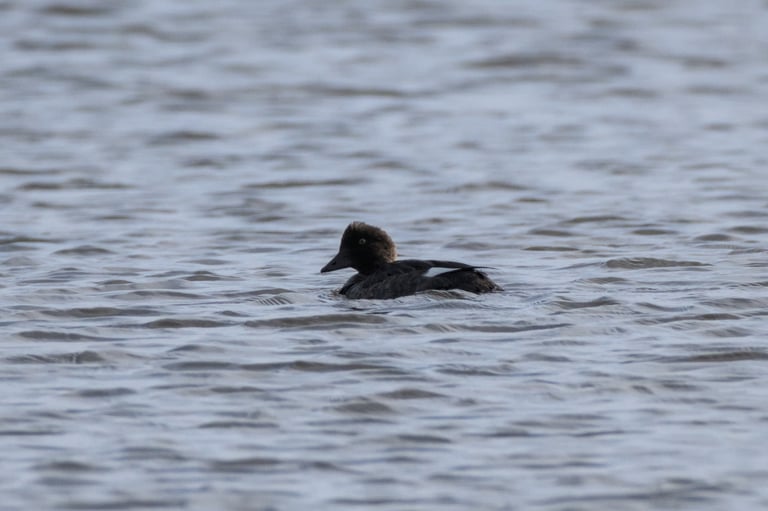
Females are far less conspicuous, showing mostly gray and brown plumage. Both sexes share a pale blue bill with a black tip, a white belly, gray legs and feet, and a gray wing patch behind the speculum.
The species most resembles the Eurasian wigeon, but that bird has a darker head and an all-gray underwing, while the female American wigeon differs from her Eurasian counterpart in head and neck coloring.
Distribution and Habitat
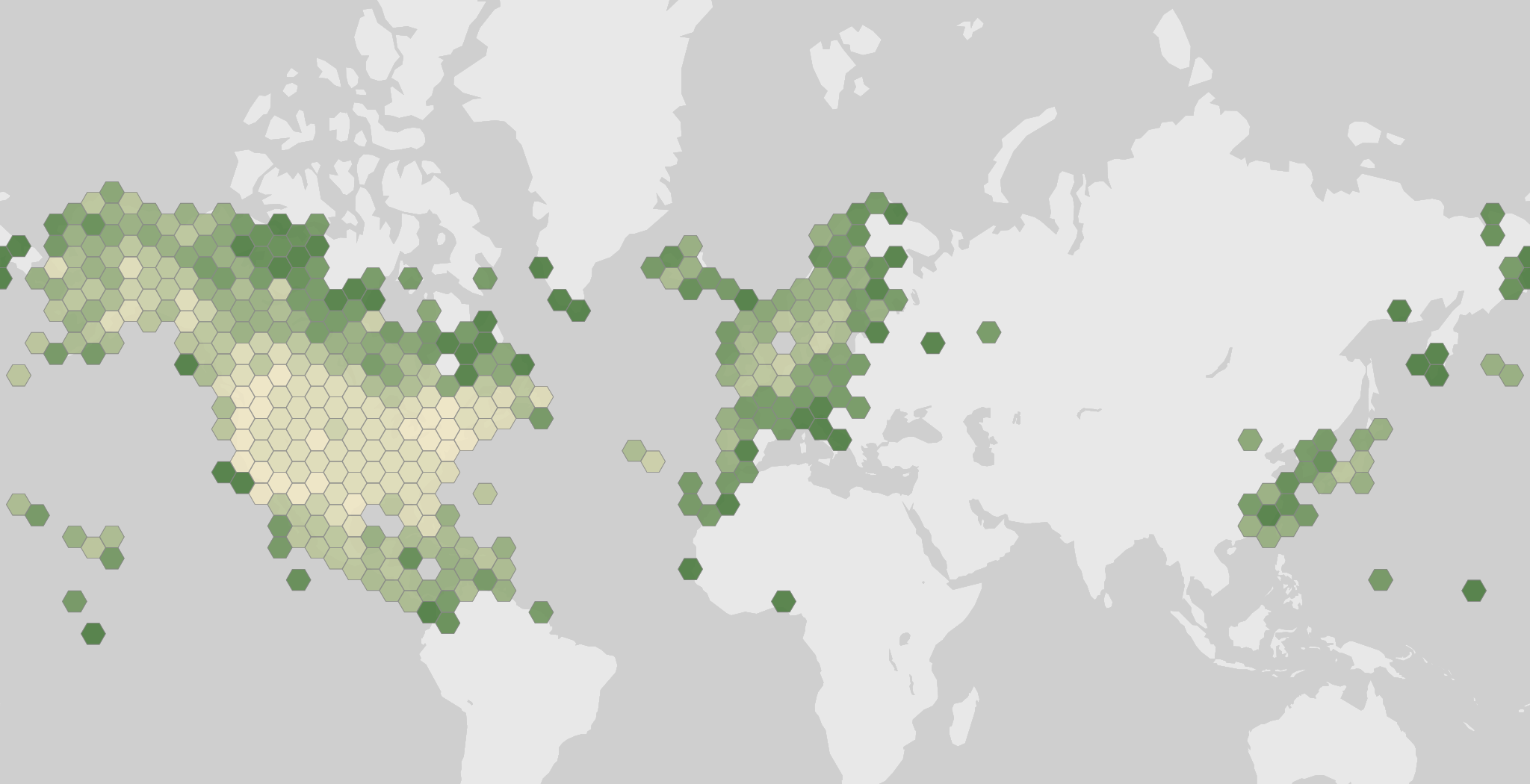
The American wigeon breeds across nearly all of Canada and Alaska except the extreme north, extending south through the Interior West into Idaho, Colorado, the Dakotas, and Minnesota, as well as eastern Washington and Oregon. Most of the population nests on wetlands in the boreal forest and subarctic river deltas, and the species uses open habitats such as wet grassland and marshes with taller vegetation throughout its range of roughly 8,980,000 square kilometers.
Wigeons occur in every North American flyway but reach their greatest numbers in the Pacific Flyway, where California's Central Valley and Washington's Puget Sound serve as key wintering areas. Farther east, the Texas Panhandle, the Gulf Coast of Louisiana and Texas, and the Caribbean also hold large wintering concentrations. The species winters south into Central America and northwestern South America, and it appears as a rare but regular vagrant in western Europe, with regular records in Great Britain and Ireland since at least 1958, mostly in autumn and winter.
Monthly observation patterns show wigeons present in high numbers from winter through spring, a dip through the summer breeding months, and a rise again beginning in autumn, consistent with a migratory species that disperses north to breed before returning south.
Behavior and Lifestyle
The American wigeon favors open wetlands such as wet grassland and marshes with patches of taller vegetation, feeding mainly by dabbling for plant material or by grazing on land. It readily forages alongside coots and diving birds, grabbing vegetation they bring to the surface, a habit behind its "poacher" and "robber" duck nicknames.
On dry land, wigeons eat waste grain in harvested fields and graze on pasture grasses, winter wheat, clover, and lettuce. Because its diet is largely vegetarian, the species tends to migrate south in fall well before northern marshes freeze over, avoiding the period when its food sources become locked in ice.
Outside the breeding season, the American wigeon is highly gregarious, gathering into large flocks that often mix with American coots and other waterbirds.
Nesting and Breeding
Breeding begins in April and May, when females select a nest site on dry ground, often well away from water, hidden in vegetation and lined with grass and down. The clutch numbers 7 to 9 cream-colored eggs, each averaging about 52.9 millimeters by 37.5 millimeters and weighing around 43 grams.
The female alone incubates the eggs for 23 to 25 days, and the male typically abandons her before incubation is complete. Once hatched, the precocial young leave the nest within 24 hours and are able to feed themselves immediately, needing little direct provisioning from the female.
The ducklings grow quickly and can fly at around 47 days of age, a rapid timeline that lets them become independent well before the approach of the following winter.
Fun Facts
- The genus name Mareca comes from the Brazilian-Portuguese word marréco, meaning a small duck, while americana simply refers to America.
- The species was formerly classified in the genus Anas before being placed with the other wigeons in Mareca.
- The oldest recorded American wigeon reached 21.3 years of age, though this is far beyond the typical lifespan expected in the wild.
Photos
Photographs from via iNaturalist, licensed under CC0 1.0., by Lauren McLaurin via iNaturalist, licensed under CC BY 4.0., by allan5519 via iNaturalist, licensed under CC BY 4.0., by Liam Steele via iNaturalist, licensed under CC BY 4.0., by Jay Brasher via iNaturalist, licensed under CC BY 4.0., by Eric Austin via iNaturalist, licensed under CC BY 4.0., by Robyn Perkins via iNaturalist, licensed under CC BY 4.0., by Kalvin Chan via iNaturalist, licensed under CC BY 4.0., by Benoit Renaud via iNaturalist, licensed under CC BY 4.0., by addiewillow via iNaturalist, licensed under CC BY 4.0., and by fallriver22 via iNaturalist, licensed under CC BY 4.0., credited on each photo.
Ecology and classification
Classification
- Phylum
- Chordata
- Class
- Aves
- Order
- Anseriformes
- Family
- Anatidae
- Genus
- Mareca
- Species
- Mareca americana
Sources
- GBIF Species names and classification
- iNaturalist Photos
- Wikidata Common names and conservation status
- Wikipedia Summary extract
- AnAge Longevity
- AVONET Bird mass, habitat, migration, diet and range size
- GloBI What it eats, what eats it, parasites and pollinators
- Wardeh et al. 2015 (EID2)
- HWML Parasite Collection