The red-breasted merganser is the most frequent member of the genus Mergus to spend its winters on saltwater, a habit that sets it apart from its close relatives. This duck breeds across much of the temperate-to-subarctic Northern Hemisphere and migrates each year between freshwater breeding lakes and rivers and mostly coastal wintering grounds.
Its worldwide population is stable and it carries a status of Least Concern, though some regional populations face pressure from habitat loss. Beyond its saltwater habits, the species is known for rapid flight and skilled underwater pursuit of fish, making it a distinctive presence wherever it occurs.
Identification and Appearance
The single best field mark is the male's combination of a dark, green-glossed head, spiky crest, white neck, and rusty-red breast, paired with a long thin red bill lined with fine serrations. Adults measure 51 to 64 centimeters long with a wingspan of 66 to 74 centimeters. Males are slightly heavier, weighing 950 to 1,350 grams, compared to 800 to 1,100 grams in females.
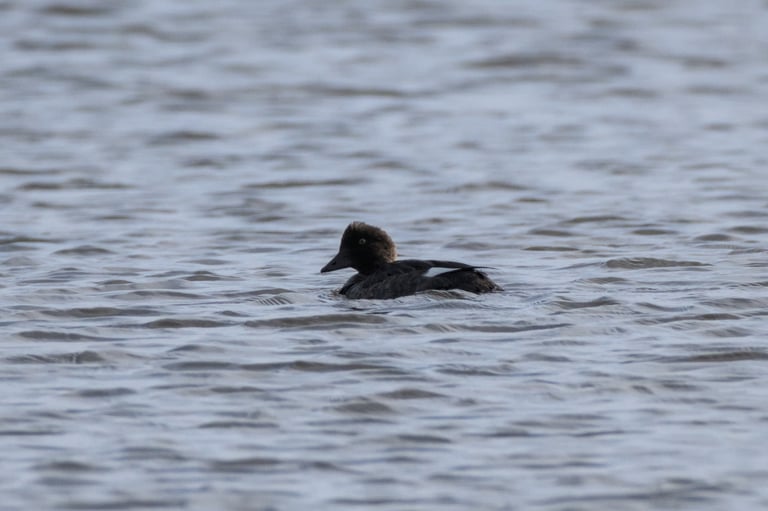
Females show a rustier head and a greyish-brown body rather than the male's bold breeding colors. Juveniles resemble females but carry a shorter crest and slightly smaller white wing patches.
The species overlaps broadly with the closely related common merganser, and the two can appear in the same waters at the same time, though red-breasted mergansers favor saltwater while common mergansers prefer freshwater. Breeding males are fairly easy to separate, but females, immatures, and non-breeding males are harder to tell apart: female common mergansers show sharper contrast between a darker head and lighter breast, and have a pale chin patch that red-breasted females lack.
Distribution and Habitat
The red-breasted merganser occupies a very large range, spanning tundra and boreal breeding grounds across northern North America, Greenland, and the Palearctic, and shifting to coastal and large inland waters for winter and migration. Breeding birds favor wetlands and open freshwater bodies in tundra and taiga zones, while migrants and wintering birds use sheltered sea coasts, brackish estuaries, large lakes, and fast-flowing rivers.
Foraging concentrates in shallow water with submerged vegetation, though the species also dives in deeper water wherever fish are abundant. Monthly observation patterns suggest much lower presence reports during mid-summer months, which may reflect the isolation of breeding pairs on remote northern waters during that period, with numbers rising again as birds gather for migration and winter.

Behavior and Lifestyle
Red-breasted mergansers are highly aquatic, diurnal birds that swim and dive with strong propulsion from feet set far back on the body, a trait that makes them clumsy walkers on land. Dives can last up to 44 seconds and reach depths of 9.2 meters, and the species spends roughly half its waking hours foraging, though this shifts with how much prey is available.
Outside the breeding season they are highly social, traveling in groups of 5 to 15 during migration and sometimes gathering into flocks of up to 15,000 during fall migration. Pairs separate from these groups only to mate and nest, and the species does not defend territories even while breeding.
Courtship itself is a striking group spectacle: males perform a stereotyped, metronomic display, stretching, bending, and contracting their necks, often in synchrony with several other males, fanning and straightening their crests as they compete for a female's attention. This display begins as early as mid-November and can continue into June or rarely July. Most populations are migratory, wintering south of their breeding range, though birds in oceanic climates such as Iceland, Ireland, Britain, Norway, and the Baltic islands are largely resident or move only short distances.
Communication
Courtship exchanges are vocal as well as visual: the female gives a rasping "prrak prrak" call, while the male responds with a catlike meow. In flight, females make a harsher "gruk" call, and alarm is signaled with a sharp "garr" or "grack." Outside of these contexts the species is largely silent.
Males add a non-vocal signal during copulation, producing a drumming sound with their wings, layering acoustic communication on top of the visual displays used during courtship.
Recordings
call, song · France · Sonothèque ADVL · Public domain
call, flight call, nocturnal flight call, Wingbeats · Sweden · Jochem verweij · CC BY-SA
Diet and Nutrition
Red-breasted mergansers hunt by diving from the surface, either floating and peering underwater before submerging or diving directly in shallow or deep water to pursue prey. They also cooperate: groups dive in formation to herd schooling fish, a strategy observed when hunting sheepshead minnows, which lets them corral prey that would otherwise scatter.
Small fish 10 to 15 centimeters long make up more than 75% of the diet, with crustaceans, insects, worms, and amphibians filling out the rest. Preferred fish include killifishes, sticklebacks, Atlantic salmon, sculpins, herring and their eggs, salmon eggs, silversides, and blueback herring. Shallow water with submerged vegetation is preferred, but the birds will hunt wherever prey concentrates, including in deeper water.
Amphibians such as frogs of the genus Rana turn up regularly among recorded prey, alongside fish more broadly, showing a diet that extends beyond fish alone when opportunity allows.
Nesting and Breeding
Courtship begins with an elaborate group display: several males gather around a single female, holding their heads close to the body with crest raised and bill pointed up, performing either a "head shake" or a "salute curtsy," the latter accompanied by a distinctive "yeow" call. Females respond with an inciting bobbing display, and pairs may form as early as November, though most bonds form during spring migration starting in March.
Mated pairs arrive at breeding grounds in May, with egg-laying beginning in early June in the northernmost parts of the range. Females choose ground nests close to water, usually within 23 meters and never more than 70 meters away, tucked into dense vegetation or under objects like driftwood or boulders with branches or grass forming a roof. The nest starts as a scrape and gains grass and feather lining as incubation proceeds.
Clutches range from 5 to 24 beige-to-gray eggs, averaging about 9.5, laid one every other day and incubated only once the last egg is laid. Incubation lasts 30 to 31 days, and the young hatch together and leave the nest within 24 hours. Fledging occurs 60 to 65 days after hatching, with hatching in July and fledging by September or October; because breeding starts so late, second clutches are unlikely.
Females handle all incubation and care for the young until abandoning them within a few weeks of hatching, while males leave the female soon after incubation begins. Most red-breasted mergansers breed for the first time in their third year, though they reach sexual maturity in their second.
Population and Ecological Role
As predators of small fish, red-breasted mergansers play a notable role in their wetland ecosystems, and their foraging benefits other birds as well: snowy egrets, Bonaparte's gulls, and ring-billed gulls take advantage of fish scared to the surface by merganser hunting, and the mergansers themselves are drawn to areas where gulls are already feeding on schooling fish.
The species carries a heavy parasite load, hosting at least 60 kinds of parasitic worms, including Eustrongylides species capable of causing die-offs, along with several species of lice. Among recorded predators, foxes, wolves, and birds of prey such as the white-tailed eagle, marsh harrier, and raven feature prominently, alongside storks like the white and black stork.
Conservation and Threats
The red-breasted merganser holds a status of Least Concern, reflecting its wide distribution and large overall population, and it is not currently considered threatened. Even so, some populations face pressure from wetland destruction and contamination by pesticides and lead, and the species is caught fairly often as bycatch in fishing nets.
It falls under the Agreement on the Conservation of African-Eurasian Migratory Waterbirds and is classed as a game bird under the Migratory Bird Treaty between the United States and Canada, giving it some legal protection even though hunting is permitted in certain seasons and places; few hunters target the species, however, so harvest numbers remain low. Illegal persecution by anglers and fish farmers who regard it as a competitor is a more significant concern in some regions, particularly in Scotland, though its overall population impact is unclear.
Cultural Significance
The species is occasionally hunted for food, though it is not a common game bird and draws little interest from most hunters. Its scientific name, serrator, directly references the saw-like edges of its bill, a naming choice that reflects the precision naturalists used when classifying the merganser group, distinguishing it from relatives like the smew, whose genus name reflects its smaller size.
Fun Facts
- Red-breasted mergansers can dive for nearly 44 seconds and reach depths of 9.2 meters while hunting fish.
- During fall migration, flocks can swell to as many as 15,000 birds, far larger than the groups of 5 to 15 typically seen during other migratory movements.
- Males perform a synchronized courtship display involving head shakes and a "salute curtsy," sometimes with several males performing together before a single female.
- The species hosts at least 60 kinds of parasitic worms, along with several species of lice, making it host to an unusually wide range of parasites.
- Its scientific name serrator refers to the saw-like serrations on its bill, used for gripping slippery fish.
Photos
Photographs from via iNaturalist, licensed under CC0 1.0., by louisiv826 via iNaturalist, licensed under CC BY 4.0., by R Clarke via iNaturalist, licensed under CC BY 4.0., by Полина Полежанкина via iNaturalist, licensed under CC BY 4.0., by Pavel Smirnov via iNaturalist, licensed under CC BY 4.0., by Newt Wheeler via iNaturalist, licensed under CC BY 4.0., by Corey Stafford via iNaturalist, licensed under CC BY 4.0., by Mitch Van Dyke via iNaturalist, licensed under CC BY 4.0., by Dmitry Mozzherin via iNaturalist, licensed under CC BY 4.0., and by Fionn Ó Marcaigh via iNaturalist, licensed under CC BY 4.0., credited on each photo.
Ecology and classification
Classification
- Phylum
- Chordata
- Class
- Aves
- Order
- Anseriformes
- Family
- Anatidae
- Genus
- Mergus
- Species
- Mergus serrator
Sources
- GBIF Species names and classification
- iNaturalist Photos
- Wikidata Common names and conservation status
- Wikipedia Summary extract
- Xeno-canto Audio recordings
- Animal Diversity Web Animal habitat, behavior and diet
- AnAge Longevity
- AVONET Bird mass, habitat, migration, diet and range size
- GloBI What it eats, what eats it, parasites and pollinators
- trophiCH
- Wardeh et al. 2015 (EID2)
- HWML Parasite Collection
- TETRA-EU