The greater white-fronted goose carries salt-and-pepper blotches across its breast, a pattern distinctive enough to earn it the nickname "specklebelly" in North America. It gets its formal name from the band of white feathers bordering the base of its bill, reflected in the Latin albifrons—"white forehead."
A member of the Anatidae family within Anseriformes, it is currently assessed as Least Concern by the IUCN. Its closely related, smaller cousin, the lesser white-fronted goose, shares the white facial blaze but lacks its larger size and yellow eye ring differences make the two easy to separate once seen side by side.
Identification and Appearance
The clearest field mark is the white patch bordering the base of the pink bill, paired with dark salt-and-pepper blotches and bars across an otherwise grey-brown breast. Birds measure 64 to 81 centimeters in length, span 130 to 165 centimeters across the wings, and weigh between 1.93 and 3.31 kilograms average weight sits around 2.68 kilograms. Bright orange legs and mouse-colored upperwing coverts complete the look, and the species is noticeably smaller than the greylag goose.
Males tend to run larger than females, but the sexes otherwise look alike: greyish-brown bodies, light grey breasts dappled with blackish markings, and pinkish bills in both. Compared with the lesser white-fronted goose, this species is bigger, lacks the yellow eye ring, and has a facial blaze that does not extend as far up the forehead.
Two subspecies wintering in the British Isles show consistent differences. A. a. flavirostris (Greenland birds) looks darker and more "oily" overall, with narrow, indistinct pale fringes on the mantle, scapulars, and wing coverts that create a more uniform appearance. Its bill is orange-yellow with a dark nail. A. a. albifrons (Russian/European birds), by contrast, shows broader white fringes creating obvious wing bars, a bright-pink bill with only a hint of dark on the nail, and a tail with a white tip and sides at least double the width of the Greenland form's.
Belly barring tends to be more extensive on average in flavirostris, though individual variation limits its usefulness for identification. The most recognizable vocal cue is a high-pitched cackle, often rendered as "he-he," with a distinct break between the two notes.
Distribution and Habitat
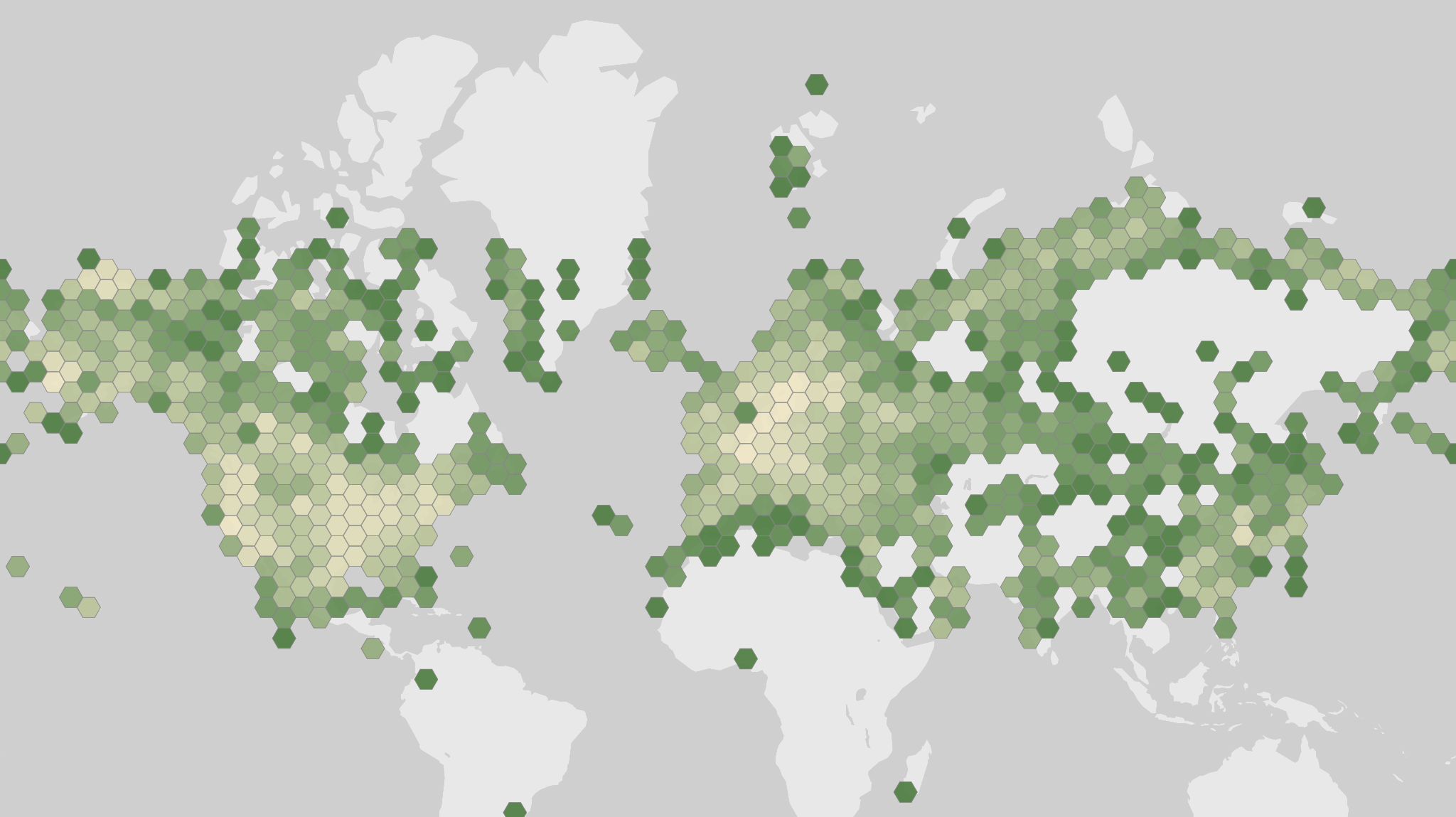
This goose occupies an enormous range, estimated at close to 5,890,000 square kilometers, stretching from Arctic tundra breeding grounds to temperate and subtropical wintering areas across three continents. Breeding habitat centers on the edges of shallow marshes and lakes, riverbanks, deltas, and dry knolls near water in the Arctic tundra, where nests are built in depressions in tall grass, sedge marshes, or hummocks, usually within about 91 meters of water.
In North America, the midcontinent population (subspecies A. a. gambeli) breeds from Alaska's North Slope across the western and central Canadian Arctic, while Pacific and tule geese nest in western Alaska. Midcontinent birds stage in fall on the prairies of western Saskatchewan and eastern Alberta before heading toward wintering grounds near the Gulf of Mexico and into northern Mexico. Pacific birds migrate down the coast, staging in the Klamath Basin of southern Oregon and northern California before wintering in California's Central Valley. The tule goose, rarer since the late 19th century, is thought to have suffered from the loss of wintering wetland habitat to human settlement.
In the British Isles, Greenland birds winter in Scotland and Ireland, and Russian birds in England and Wales, gathering at traditional farmland sites such as WWT Slimbridge in Gloucestershire. Ireland alone hosts nearly half of the Greenland population each winter. Both Eurasian subspecies fall under the Agreement on the Conservation of African-Eurasian Migratory Waterbirds.
Winter habitat centers on croplands, pastures, and shallow-water wetlands, with cropland and pastureland serving as primary habitat and freshwater marshes as secondary. Rice and soybean fields in southeastern Texas are notably preferred during winter, and flooded fields are commonly used during migration.
Behavior and Lifestyle
This is a deeply social bird, forming long-lasting family bonds that carry into cooperative breeding arrangements. After breeding, family groups stay under 30 individuals until molting, but outside the breeding and molting seasons they gather into flocks that can number up to 30,000 birds.
Migration happens mostly at night, and birds tend to stay close to their nesting and roosting sites when not migrating: foraging trips reach up to 20 kilometers from the roost, while birds generally remain within 4 kilometers of the nest itself.
Midcontinental populations in North America break into six distinct breeding groups spread across interior Alaska, the North Slope, and several regions of the Northwest Territories and Nunavut, each with its own migration timing. Birds from interior Alaska tend to leave earliest in autumn and travel farthest south to winter. This predictable movement has made the species a frequent target for waterfowl hunters across its range, and researchers have used stable isotope analysis from individual geese to trace migratory routes between breeding and wintering grounds.
Communication
Communication relies mainly on sound and sight. A series of honks serves as the primary acoustic signal, used to warn other birds of danger, alongside the distinctive "he-he" cackle used more generally.
Visually, postures and hisses come into play when defending territory or boundaries against rivals, signaling aggression without necessarily escalating to physical conflict.
Recordings
flight call · Sweden · Robert Petersen · CC BY-SA
call, flight call · France · Sonothèque ADVL · Public domain
call · Switzerland · Pascal Christe · CC BY-SA
Diet and Nutrition
This goose is primarily herbivorous, feeding on grasses, grains, and berries, though its diet shifts with the season. During the breeding season it supplements plant matter with mollusks and aquatic insects, taking advantage of protein-rich food while raising young.
In winter the diet becomes exclusively herbivorous. Early in the season, birds rely heavily on agricultural waste such as rice, soybeans, and other grains left in harvested fields. As winter progresses, the diet shifts toward newly sprouted grasses and forbs, including white clover, creeping buttercup, common dandelion, cockspur grass, meadow barley, ryegrass, bulbous foxtail, pendant grass, and marsh arrowgrass.
Broader plant material, including leaves, roots and tubers, stems, seeds, and fruit, rounds out the diet across the year.
Nesting and Breeding
Courtship and pair bonding happen in fall and continue into early spring, forming monogamous bonds that last a lifetime. Breeding itself takes place once a year in summer, beginning in late May or early June, within a narrow Arctic window of roughly three months between snowmelt and the need to depart for fall staging areas.
Clutches typically hold 4 to 7 eggs, averaging 5, though ranges as wide as one to eight eggs have been recorded. The white-to-tan eggs measure about 8 to 8.3 centimeters long and roughly 5.3 to 5.4 centimeters wide. Incubation lasts around 27 days on average, with a recorded range of 22 to 28 days, and chicks leave the nest within 24 hours of hatching. Fledging occurs at around 45 days of age.
Both parents share incubation duties and nest defense, then remain heavily involved in rearing chicks after hatching. Young stay with their parents for one to two years, during which time they are guided to wintering grounds, taught foraging techniques, and even allowed to help rear the next year's clutch, an unusual form of extended cooperative breeding. Maturity is reached at 3 years of age in both sexes.
Breeding success is closely tied to weather. A delayed snowmelt or a late spring storm in the Arctic can significantly cut into the number of chicks that survive to flight.
Population and Ecological Role
Eggs and yearlings serve as an important food source for a range of predators during the breeding season, including red foxes, golden jackals, gray wolves, white-tailed eagles, and corvids such as ravens, crows, and rooks; storks and gulls are also recorded taking them. This heavy predation pressure on young birds is balanced against the species' role in wetland ecology: geese ingest seeds continuously and carry them between wetlands during migration, making them contributors to seed dispersal and, by extension, wetland plant community structure.
Parasites recorded from the species include nematodes such as Amidostomum species, tapeworms in the genus Hymenolepis, and a trematode, Zygocotyle lunata, along with a recorded avian virus.
Conservation and Threats
The species carries an IUCN status of Least Concern, and overall populations are considered stable. This is not to say every population has fared equally well: in the 1970s, the Greenland-breeding population suffered a sharp decline tied to habitat loss.
That Greenland population recovered within about twenty years following the passage of protective legislation, and it is no longer considered a conservation concern. In the United States, the species is protected under the Migratory Bird Act, though it carries no special status under the US Federal List, CITES, or Michigan's state list.
Cultural Significance
In the United States, the greater white-fronted goose is a valued game species, sought after by waterfowl hunters across the country. That hunting tradition carries a conservation dimension: license and stamp purchases tied to the hunt help fund the preservation of wetland habitats the species depends on.
Beyond sport, the goose serves as a food source for humans, and its body parts are used as a source of material, reflecting a long-standing practical relationship between the species and the people who share its range.
Fun Facts
- Yearling geese take part in defending their parents' nest the following breeding season, an unusual case of cooperative breeding among waterfowl.
- The oldest recorded individual reached 47 years of age, though that is a maximum record rather than a typical lifespan.
- Researchers have used stable isotope analysis from individual birds to reconstruct the migratory routes geese travel between wintering and breeding grounds.
- Flocks outside the breeding and molting season can swell to as many as 30,000 birds.
Photos
Photographs from via iNaturalist, licensed under CC0 1.0., by Matt Berger via iNaturalist, licensed under CC BY 4.0., by Дарья Орлова via iNaturalist, licensed under CC BY 4.0., by Robyn Perkins via iNaturalist, licensed under CC BY 4.0., by Pete Lypkie via iNaturalist, licensed under CC BY 4.0., by Eric Lamb via iNaturalist, licensed under CC BY 4.0., by louisiv826 via iNaturalist, licensed under CC BY 4.0., by k7hpn via iNaturalist, licensed under CC BY 4.0., by Kevin Krebs via iNaturalist, licensed under CC BY 4.0., by allan5519 via iNaturalist, licensed under CC BY 4.0., by Pam Hardy via iNaturalist, licensed under CC BY 4.0., and by giantcicada via iNaturalist, licensed under CC BY 4.0., credited on each photo.
Ecology and classification
Classification
- Phylum
- Chordata
- Class
- Aves
- Order
- Anseriformes
- Family
- Anatidae
- Genus
- Anser
- Species
- Anser albifrons
Sources
- GBIF Species names and classification
- iNaturalist Photos
- Wikidata Common names and conservation status
- Wikipedia Summary extract
- Encyclopedia of Life Habitat, diet and behavior traits
- Xeno-canto Audio recordings
- Animal Diversity Web Animal habitat, behavior and diet
- AnAge Longevity
- AVONET Bird mass, habitat, migration, diet and range size
- GloBI What it eats, what eats it, parasites and pollinators
- trophiCH
- Wardeh et al. 2015 (EID2)
- HWML Parasite Collection
- TETRA-EU