The European garden spider is a web-building orb weaver whose common names include the cross orbweaver, diadem spider and crowned orb weaver. It is sometimes called the pumpkin spider, although that name also belongs to Araneus marmoreus.
The spider is native to Europe and was introduced to North America, where it is now established. It belongs to the family Araneidae within the order Araneae.
Its large, geometric orb webs make it one of the most recognizable spiders in gardens and meadows, and its habits show how a single web can serve as hunting ground, home and workspace.
Distribution and Habitat
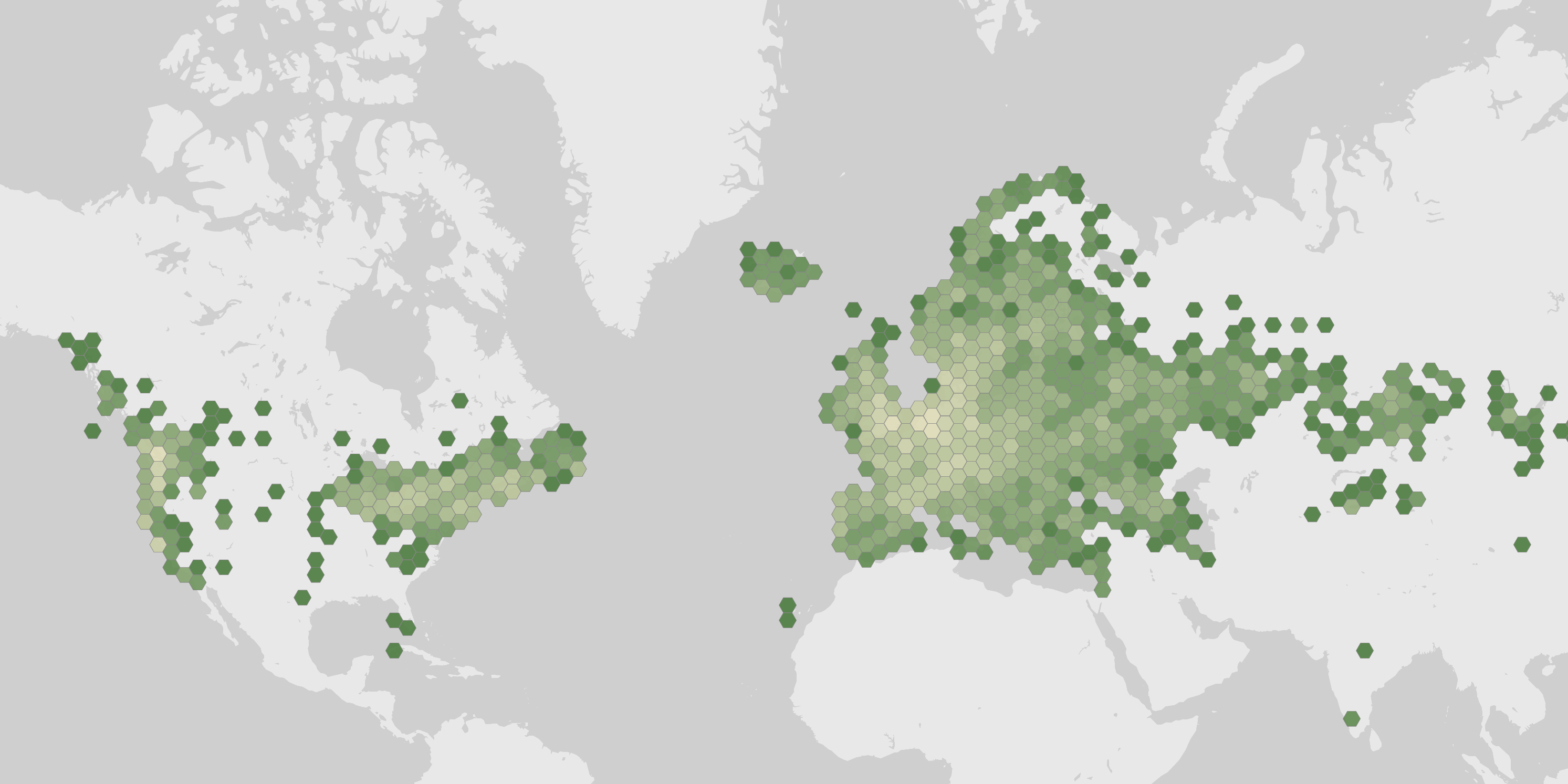
Araneus diadematus lives across Europe and throughout North America, from southern Canada to Mexico and from British Columbia to Newfoundland. It is native to Europe and was introduced to North America.
It occupies a very wide range of habitats, including gardens, meadows, woodland clearings and hedgerows. It favors grasslands that provide some moisture, along with plenty of anchor points for web scaffolding and open vertical space for the orb web.
Observation records peak from late summer into early autumn, with the highest counts in August and September. These records show when people most often see the spider, not how many spiders live in an area.
Behavior and Lifestyle
The spider rebuilds its web every day to improve its chances of catching prey. Before building a new web, it eats the old one and recovers the silk proteins.
A typical web has 25 to 30 radial threads set at regular angles of 12 to 15 degrees. Webs built by young spiders often have many more radii than those of adults.
The spider is solitary and sedentary, and it stays on its web for most of its life.
Communication
The spider relies mainly on vision and touch. Its main eyes help it see moving objects, and it turns its body so that a moving object lies at right angles to its body axis.
Secondary eyes can trigger a turn without visual feedback. A moving object seen only by the secondary eyes does not always draw a turn, so the spider depends on its main eyes for precise orientation.
Hunting and Diet
Orb webs are built to trap prey, and this spider is a hunter that waits at the hub of its web. Its hub sits slightly above the web's center, so it can drop down quickly when prey lands.
It spends most of its time at the hub, reading vibrations in the silk through its sensitive legs. Females rest on one side of the web and hold a signal thread to monitor it.
After killing prey, it wraps the victim in silk. It may not eat the prey right away, and it attacks fewer prey once it becomes satiated.
Its diet consists mainly of insects, including grasshoppers and other orthopterans, flies, true bugs and wasps. Its prey also includes other terrestrial arthropods.
Reproduction and Life Cycle
Males search for females and approach with caution, because a female may treat a male as prey. During copulation, the male embraces the female's abdomen and inserts one palp. Males can mate only a few times, since their life expectancy is shorter than that of females.
The spider breeds at the end of the warm season, and its young hatch the following spring. Females die a few days after building their egg sacs, which means each female breeds only once.
A female first withdraws for several days, then spins a thin basal plate and a cylindrical silk wall. After about two hours, the wall grows to 5 mm in height. She lays eggs inside, covers them with a tight pack of silk threads and adds layers to the cover plate.
The young develop inside the egg sac for a few months. They emerge in spring and release silk threads that carry them on the wind to new locations, a process called ballooning.
Population and Ecological Role
Populations are common across the range, and the spider contributes to natural pest control in gardens and meadows. Its prey includes insects that might otherwise damage crops and plants.
Several animals feed on the spider. Birds such as magpies, pheasants and waders are occasional predators, along with other spiders and wasps such as the yellow-legged hornet.
Conservation and Threats
The spider has no special conservation status. The IUCN Red List lists it as Least Concern, and it has no special status under US federal lists, CITES or the State of Michigan list.
The spider remains widespread across Europe and North America, and no protection programs are needed for it.
Cultural Significance
People have long valued the spider for its role in controlling insect pests. Its web has also been used on wounds to stop bleeding.
Photos
Photographs from via iNaturalist, licensed under CC0 1.0., by Gabriele Pradelli via iNaturalist, licensed under CC BY 4.0., by Claus Giloi via iNaturalist, licensed under CC BY 4.0., by Syd Cannings via iNaturalist, licensed under CC BY 4.0., by Stan Rullman via iNaturalist, licensed under CC BY 4.0., and by Tom Heijnen via iNaturalist, licensed under CC BY 4.0., credited on each photo.
Ecology and classification
Classification
- Phylum
- Arthropoda
- Class
- Arachnida
- Order
- Araneae
- Family
- Araneidae
- Genus
- Araneus
- Species
- Araneus diadematus
Sources
- GBIF Species names and classification
- iNaturalist Photos
- Wikidata Common names and conservation status
- Wikipedia Summary extract
- Encyclopedia of Life Habitat, diet and behavior traits
- Animal Diversity Web Animal habitat, behavior and diet
- GloBI What it eats, what eats it, parasites and pollinators
- trophiCH