The male Eresus sandaliatus wears a pattern that has nothing to do with hiding: a glossy orange back marked with four large and two small black spots, echoing the look of a ladybird beetle rather than blending into the heathland around it.
This spider belongs to the family Eresidae within the order Araneae, and it lives across northern and central Europe. Its rarity in places like Britain, combined with the sharp visual contrast between the sexes, makes it one of the continent's more distinctive and closely watched spiders.
Identification and Appearance
The clearest field mark is the male's back: bright orange with four large and two small ebony spots, set on a body just 6 to 9 millimeters long. This coloring, along with the small size, is what earns the species its "ladybird spider" name.
Females look nothing like their mates. They are jet-black over the entire body and considerably larger, reaching 10 to 16 millimeters, roughly double the length of a male.
Within the wider Eresus cinnaberinus species complex, from which E. sandaliatus was split, males can be told apart by what is absent rather than present: white hairs never appear on the back, and the legs never carry red hairs, features that distinguish it from its close relatives.
Distribution and Habitat
Eresus sandaliatus is native to Europe, with its range centered on the northern and central parts of the continent.
Monthly observation records compiled from GBIF show an unmistakable spike in spring: counts jump from single digits in January through March to 1,015 in April and 929 in May, before dropping sharply to under 70 by June and staying low the rest of the year, aside from a smaller rise in September. Because these figures reflect presence records rather than actual population size, they should not be read as a census. Still, the pattern points to a period, likely tied to adult activity or mating behavior, when the species becomes far easier for observers to detect.
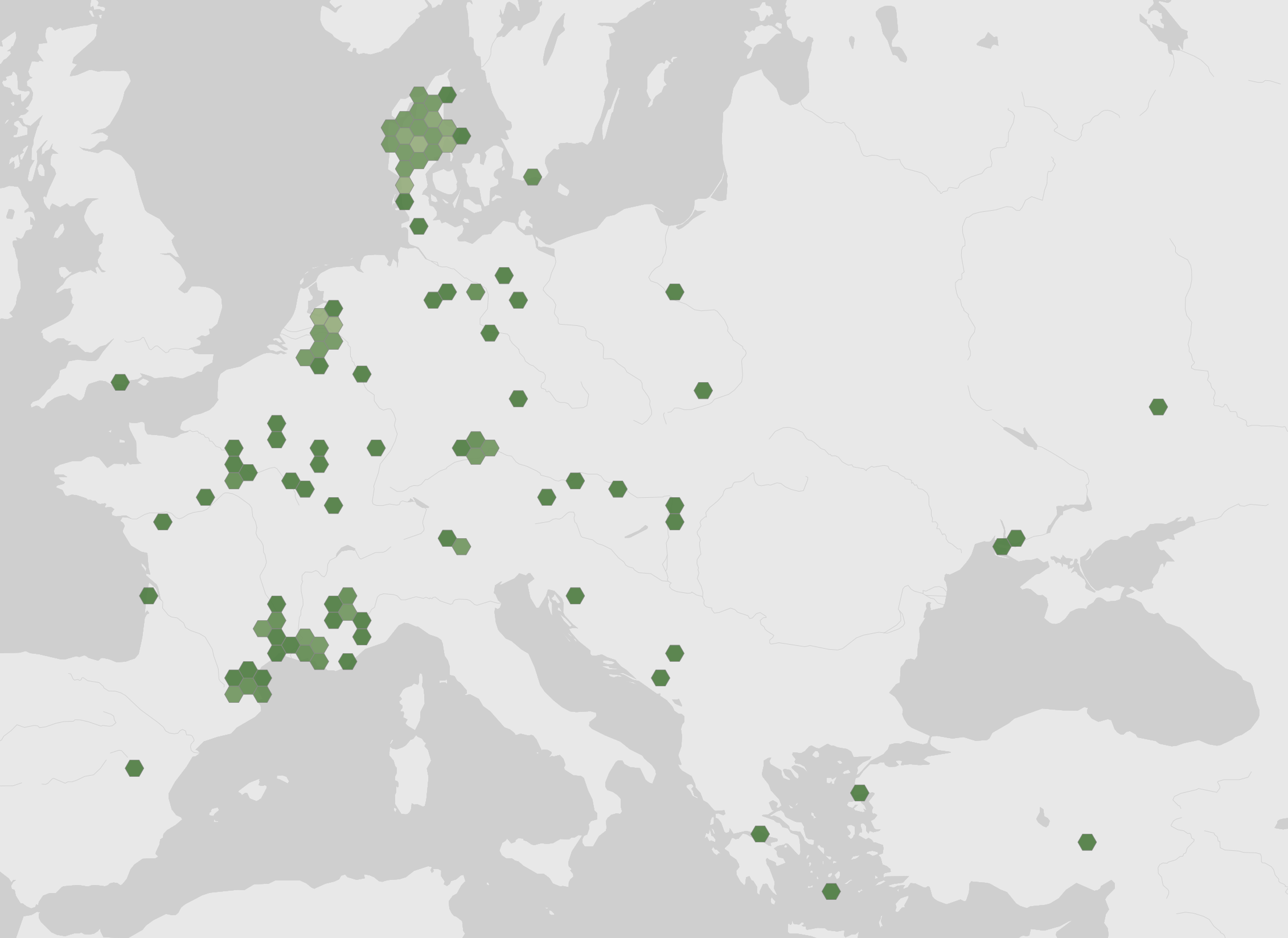
Conservation and Threats
In Britain, Eresus sandaliatus is classified as endangered under the British Red Data Book and is legally protected under the 1981 Wildlife and Countryside Act.
The species came close to disappearing from the country: an estimated 50 individuals remained in 1993, largely because suitable heathland habitat had been lost. Targeted habitat management under English Nature's Species Recovery Programme helped the population rebound to over 600 counted spiders by 2000. That recovery work continues today through the Back from the Brink project, which translocates spiders to establish new populations in additional sites.
Outside Britain, the picture varies by country: the spider is listed as near threatened in France, highly endangered in Germany, and vulnerable due to a high extinction risk in Sweden.
Fun Facts
- The common name "ladybird spider" comes entirely from the male's orange-and-black back, which mimics the look of a ladybird beetle.
- Eresus sandaliatus is one of three species carved out of what was once classified as a single species, Eresus cinnaberinus (also called Eresus niger).
- The species belongs to the family Eresidae, a group of spiders known as velvet spiders.
- The contrast between the sexes is extreme: males display bold orange-and-black coloring while females stay jet-black for their entire lives, with no color pattern at all.