The bronze mannikin is considered a pest in grain and rice fields in West Africa, yet it is also trapped locally for the pet bird trade.
The bronze mannikin, Lonchura cucullata, is a small passerine bird of the Afrotropics and a member of the estrildid finch family. It is a very social bird that is uncommon to locally abundant across much of Africa south of the Sahara Desert.
It is the smallest and most widespread of the four munia species on the African mainland. Its wide range and flexible movements make it one of the more adaptable seed-eating finches in the region.
Identification and Appearance
The most useful field mark is the black to brownish black head, chin, throat and centre of the chest, with purple-green iridescence on the face and sides of the breast.
The bronze mannikin is one of the smallest munias, measuring 9–10 cm in length and weighing 7–12 grams. It is a compact bird with a short black tail and stubby mandibles that are black and pale grey, not distinctly bluish.
The upper parts are greyish brown and the underparts are white, with irregular barring on the flanks and rump. A small green iridescent patch sits on the outer scapular feathers, and in the western race the sides of the lower breast also show green iridescence. The wing coverts and flight feathers are edged in a paler or warmer tone.
The sexes look alike. Immature birds are dun brown above, with buff head and underpart plumage, and they moult into full adult plumage by about six months of age. The eastern race scutata differs in having barred plumage at the junction of the lower breast and flanks, though these features vary somewhat.
Distribution and Habitat
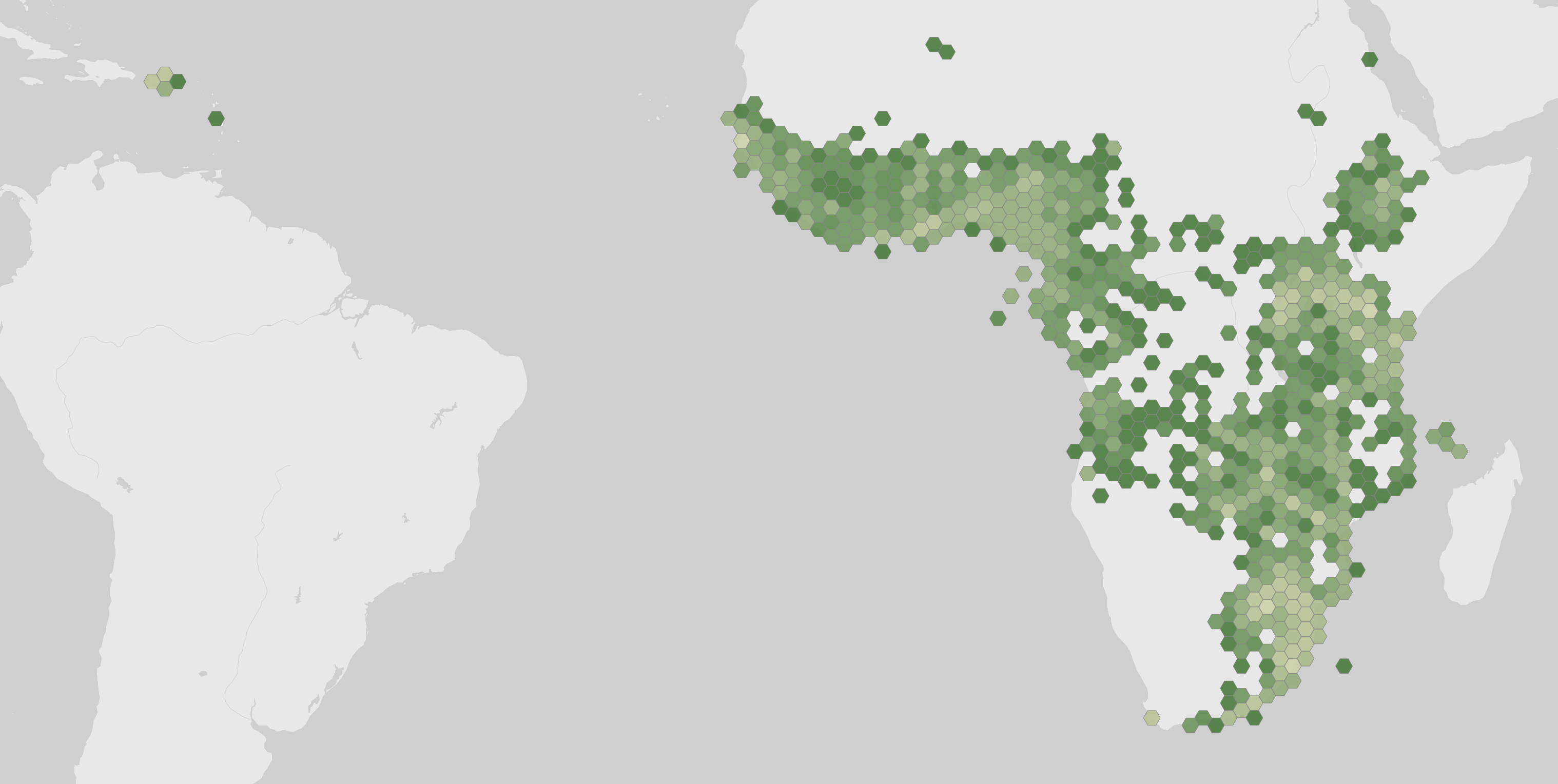
The bronze mannikin has a range of about 8,670,000 km² across mainland Africa. It is also found on Bioko, Pemba, Zanzibar, Mafia and the Comoro Islands.
The species was introduced to Puerto Rico, where it is now established. It is also found in the Comoros, where it co-occurs with the Madagascar mannikin.
It inhabits semi-open habitats, mainly woodland, savanna and forest margins. Across much of its range it uses mesic savanna and forest edges.
Around the upper Nile River, the two accepted races meet, and birds there show intermediate features.
Behavior and Lifestyle
The bronze mannikin is a terrestrial and sedentary bird that lives in gregarious flocks. Each flock, or party, numbers 8 to 20 birds and is usually dominated by a single adult male.
Before going to roost at nightfall, the birds usually visit a watering hole where vegetation hangs over the water. At night they roost in ball-shaped communal nests. Outside the breeding season these nests are built only for roosting.
The roosting nests are dismantled so the material can be reused, and rebuilt almost daily at the same or a new site. The whole flock works together on this task.
The flock defends the area around a nest against intruders, but newcomers are readily accepted. The birds may associate with waxbills and other mannikins and may use their vacated nests. Pairs often allopreen.
Nesting and Breeding
Bronze mannikins are persistent nest builders and can raise up to four broods a year when conditions are favourable.
The nest is a large domed structure of grass built in a tree. The female lays 4 to 8 small, white eggs in it.
Incubation takes 12 days. The chicks fledge after about three weeks and become independent about three weeks later. The young are reared on soft green seeds and insects.
Photos
Photographs from via iNaturalist, licensed under CC0 1.0., by Timothy Whitehead via iNaturalist, licensed under CC BY 4.0., by Cricket Raspet via iNaturalist, licensed under CC BY 4.0., by Stefan Wolmarans via iNaturalist, licensed under CC BY 4.0., by Kobus Meyer via iNaturalist, licensed under CC BY 4.0., by Mark Clarke via iNaturalist, licensed under CC BY 4.0., by Kimberly via iNaturalist, licensed under CC BY 4.0., by Lukas Zangl via iNaturalist, licensed under CC BY 4.0., and by Haneef Tayob via iNaturalist, licensed under CC BY 4.0., credited on each photo.
Ecology and classification
Classification
- Phylum
- Chordata
- Class
- Aves
- Order
- Passeriformes
- Family
- Estrildidae
- Genus
- Lonchura
- Species
- Lonchura cucullata
Sources
- GBIF Species names and classification
- iNaturalist Photos
- Wikidata Common names and conservation status
- Wikipedia Summary extract
- AVONET Bird mass, habitat, migration, diet and range size
- GloBI What it eats, what eats it, parasites and pollinators
- SquamataBase