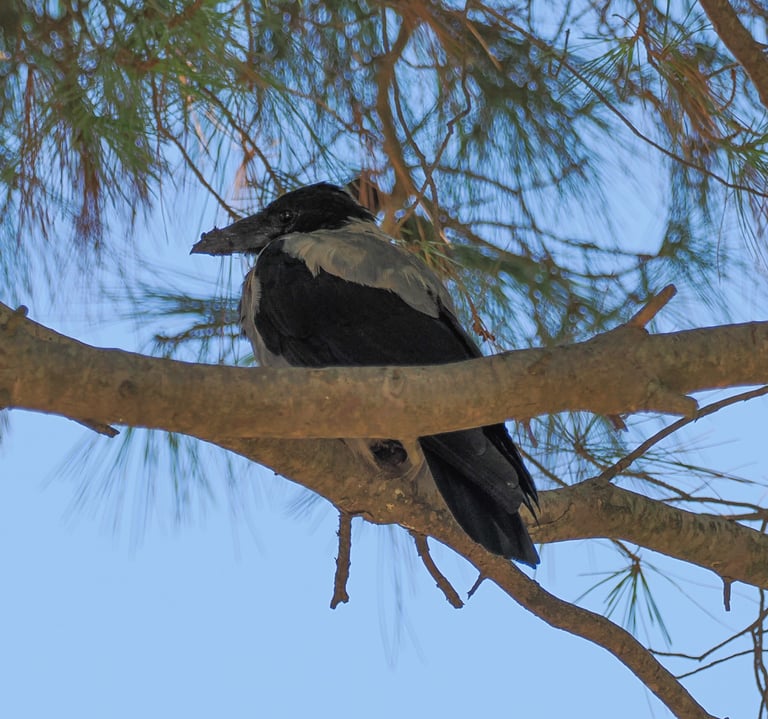
Less than 0.28% of the genome separates the carrion crow from the hooded crow, yet one is all black and the other wears a pale grey mantle. That tiny genetic difference, confined to a single region on avian chromosome 18, is enough to keep the two populations from blending where their ranges meet.
The carrion crow is a passerine of the family Corvidae, native to western Europe and stretching east across the Palearctic to Japan. The IUCN lists it as Least Concern, and its population is thought to be increasing rather than declining.
What makes the species worth a closer look is less its appearance than its mind: carrion crows use tools, cache food across thousands of remembered locations, and recognize individual humans who share their territory.
Identification and Appearance
The single best field mark is the plumage itself: a uniform, glossy black with a green or purple sheen, noticeably more colorful than the duller gloss of the rook (Corvus frugilegus). The bill, legs and feet are also solid black, giving the bird an entirely dark silhouette at any distance.
Adults measure roughly 48 to 52 cm in length with a wingspan of 84 to 100 cm and a weight around 400 to 600 g, making them noticeably larger and stockier than the American crow, which occupies a similar niche in North America. They are, however, distinctly smaller than the common raven, which averages about 63 cm in length.
Juveniles look quite different from adults: their plumage has a brownish cast and their eyes are blue, both features that darken to the adult's black plumage and brown eyes as the bird matures. There is no marked difference in appearance between males and females.
Where ranges overlap, the carrion crow is separated from the hooded crow by its solid black body rather than the hooded crow's grey torso, and from the raven by its smaller size and less deep, more clipped call.
Distribution and Habitat
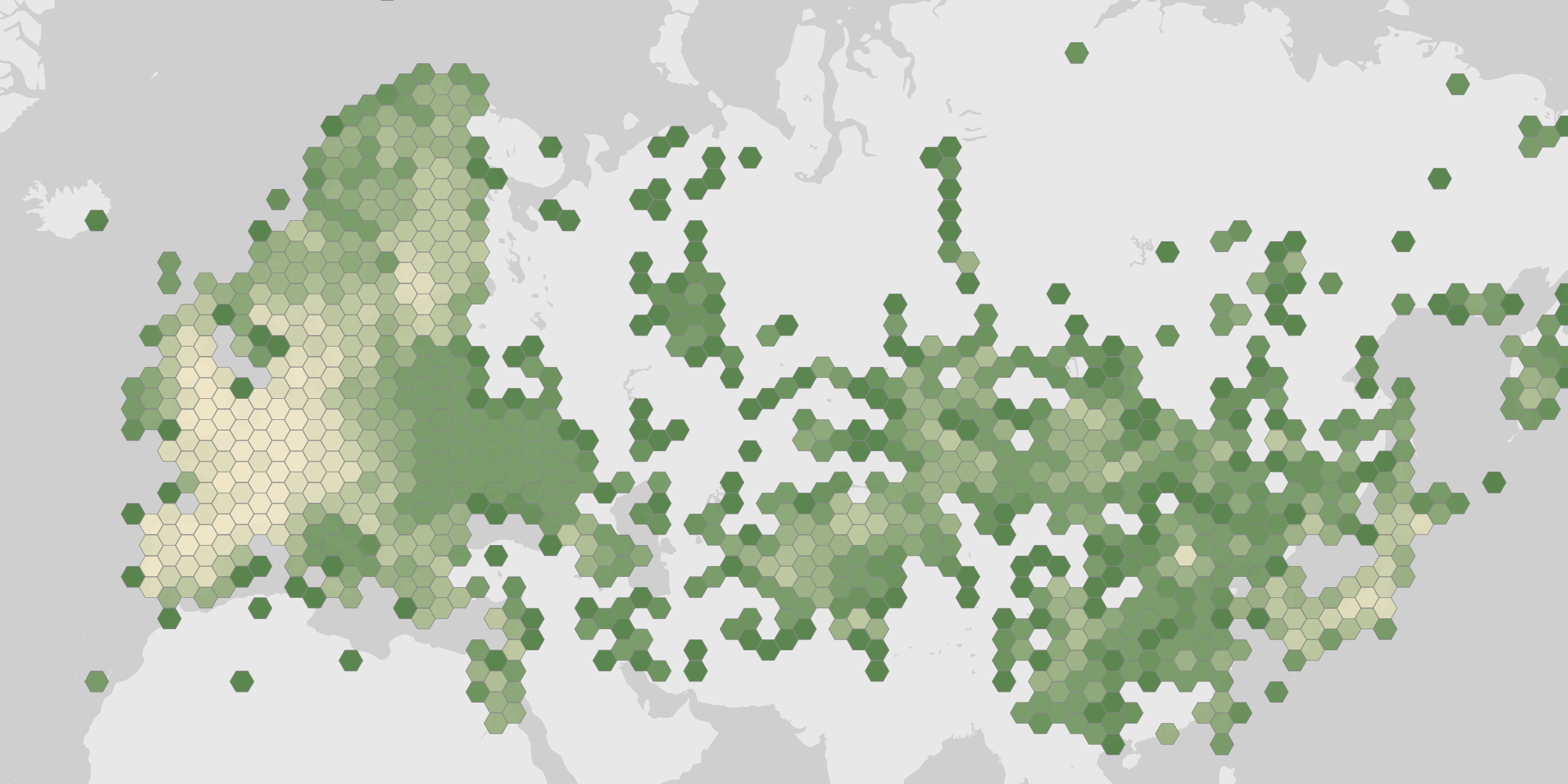
The carrion crow's native range spans western Europe eastward through the Palearctic, reaching as far as the forests, mountains and cities of Japan. Across this range it occupies an unusually broad set of habitats: historically marshland, lightly wooded farmland and coastlines, and increasingly suburban and urban environments, where it nests on buildings and forages in parks, landfills and dumpsters.
The species is not restricted by elevation, occurring from sea level up into mountainous terrain, and it nests in trees or on cliff ledges depending on what is available locally. Urban populations forage about as successfully as rural ones, though their overall nutritional health tends to be somewhat lower.
Monthly observation counts show a rise through the first half of the year, peaking in April and May before falling off through summer and settling into a lower, fairly steady level for the rest of the year. Because these figures are presence records rather than population counts, they point to seasonal detectability rather than a change in numbers.
Across Europe, the carrion crow's range meets that of the hooded crow along a contact zone shaped by Pleistocene glaciation cycles that split and later reunited their ancestral population. The two forms hybridize there, but on either side of the zone, all-black carrion crows mate almost exclusively with other all-black birds.
Behavior and Lifestyle
Carrion crows spend their early years in flocks called murders, groups of five to twenty birds often built from members of a few related families that roam widely and use their numbers to secure food and resources. Once a bird finds a mate, the pair leaves the flock, claims a territory of roughly 200 to 500 square meters (averaging about 475 square meters), and defends it year-round in most populations, though crows in colder regions may migrate south for winter.
Only breeding pairs hold and defend territory; non-breeding birds keep roaming in flocks in search of food. Like other corvids, carrion crows actively mob predators and competitors that threaten their territory or offspring, ganging up to drive off the intruder.
The species shows unusually sophisticated behavior for a bird. Individuals have been recorded using sticks to reach food in laboratory tests, and wild birds have been seen dropping hard nuts in front of moving cars to crack shells too tough for their beaks. Carrion crows can also become familiar with specific humans, and captive birds perform better on cognitive tests when tested by a person they already know.
Their intelligence extends to discriminating between numbers up to 30, flexibly switching between task rules, and recognizing individual human and crow faces, abilities that are notable given how differently a crow's brain is organized compared to a primate's.
Communication
Vocal calls are the carrion crow's most recognizable signal: a harsh, guttural "kraa" delivered in bursts of three or four calls, often from a vantage point such as a rooftop or treetop, with the bird raising its shoulders and bowing its head and neck downward with each caw. This deeper, more vibrant croak distinguishes it from the higher-pitched call of the rook.
Beyond sound, carrion crows rely heavily on vision and scent. They can track an object's location even after it disappears from sight, succeeding at shell-game-style tests and locating items deliberately hidden from view after only brief learning periods. They also respond more strongly to familiar scents than unfamiliar ones, using odor cues in foraging, avoiding predators, and recognizing partners and kin.
Some individuals can mimic sounds, including human speech, though this is not part of their typical wild repertoire, which remains the harsh crow call described above.
Scavenging and Diet
Carrion crows find much of their food simply by searching and scavenging across whatever ground is available, from farmland and marsh to landfills and dumpsters, and carrion makes up a notable part of what they eat, though how much it contributes to their overall diet is not well quantified. Beyond dead animals, they take a wide range of foods: living invertebrates, amphibians, reptiles, fish, bird eggs, seeds, grains, nuts and fruit, and they will raid human crops, corn in particular.
Their foraging goes beyond simple scavenging in some striking ways. Crows have been seen pulling in baited fishing lines with beak and feet to steal the catch, and using passing cars to crack nuts too hard for their beaks alone.
When food is abundant, carrion crows often gather far more than they need and cache it for later, a habit that intensifies under competition from other birds. Studies show they can remember hundreds or even thousands of cache locations along with what they stored in each one, and they preferentially return to eat the most perishable items first, before the food that keeps longer.
Nesting and Breeding
Carrion crows form monogamous pairs that stay together for life and typically defend the same territory year-round. Courtship leads to nesting in early spring, from March to April, when the bulky stick nest is built, usually high in a tree but sometimes on a cliff ledge, an old building or a pylon, and occasionally near the ground. Both members of the pair take part in building the nest.
Each pair lays a single clutch of four to five brown-speckled blue or greenish eggs. The female alone incubates them, over 17 to 20 days, while the male defends the territory and provisions her with food.
After hatching, the altricial nestlings are fed and defended by both parents and fledge at about 28 to 30 days old. Some offspring stay with their parents for up to two years, feeding alongside them after fledging and sometimes helping raise the next brood; around 3% of pairs breed cooperatively, and in one population in northern Spain, cooperative breeding involves the majority of nests, occasionally forming groups of up to fifteen related birds tending nestlings from multiple pairs.
Both males and females typically take about three years to reach breeding maturity. In parts of Spain, carrion crows share breeding grounds with hooded crows and interbreed with them, producing hybrid offspring that show reproductive success similar to that of non-hybrid birds.
Population and Ecological Role
Population trend data cited for the species points to a growing population overall, alongside a marked ecological effect on the birds around it. By preying on the eggs of other bird species, carrion crows appear to act as a control on local breeding populations, likely reducing brood sizes across the communities they share.
Their role as consumers of carrion is well documented, but how much this scavenging contributes to nutrient cycling or carcass turnover in their ecosystems remains unclear. The species also supports its own set of dependents: the great spotted cuckoo lays its eggs in carrion crow nests as a brood parasite, and the crows host several roundworm parasites, including Aprocta matronensis, Acuaria anthuris, Acuaria depressa and Roberdollfusa paradoxa.
Conservation and Threats
The carrion crow is assessed as Least Concern by the IUCN, reflecting its large range and increasing population, and it holds no special protective status under the US Migratory Bird Act, the US Federal List, CITES or Michigan state law.
The main pressure the species faces is direct persecution by people, driven largely by an overestimation of the damage crows cause to livestock rather than by documented harm on a large scale. No dedicated conservation programs are currently in place for the species, a reflection of its stable and expanding status rather than a lack of concern.
Cultural Significance
The species' scientific epithet traces back to the Ancient Greek word korōnē, meaning crow, a word also attached in Greek and Roman mythology to Corone, a princess associated with Poseidon and Athena whose story ends in her transformation into a crow, an origin that mirrors the bird's later namesake.
Corvids generally, ravens and crows alike, have held a long-standing place in the mythology and imagination of many cultures, feeding into works from Edgar Allan Poe's writing to James O'Barr's graphic novel "The Crow" and its film adaptation, a fascination that has not faded in modern times.
People have also drawn a practical, if lightly studied, benefit from carrion crows: there is anecdotal evidence that they help suppress pest species by feeding on insect larvae and small bird eggs, though no dedicated research has confirmed the scale of this effect.
Fun Facts
- The name Corone comes from the Ancient Greek korōnē, meaning crow, the same word tied to a Greek mythological princess who was transformed into a crow.
- Carrion crows can discriminate between quantities up to 30, a numerical ability rarely documented outside primates.
- Where their ranges meet the hooded crow's, carrion crows can interbreed and produce fully viable hybrids with reproductive success similar to non-hybrid birds, despite looking completely different.
- In parts of northern Spain, cooperative breeding groups of up to fifteen related crows have been recorded tending nestlings from more than one pair at a single nest site.
- Juvenile carrion crows have blue eyes and brownish plumage that darken to adult black and brown as they mature.
- The great spotted cuckoo is a brood parasite that lays its eggs directly in carrion crow nests.
- Carrion crows host several species of roundworm parasites, including Aprocta matronensis and Acuaria anthuris.
Photos
Photographs from via iNaturalist, licensed under CC0 1.0., by Ирина Хохрякова via iNaturalist, licensed under CC BY 4.0., by Cajá-manga via iNaturalist, licensed under CC BY 4.0., by Kostas Zontanos via iNaturalist, licensed under CC BY 4.0., by Dmitry Ivanov via iNaturalist, licensed under CC BY 4.0., by Maaike Verschueren via iNaturalist, licensed under CC BY 4.0., by Kate Senatskaya via iNaturalist, licensed under CC BY 4.0., by Vitaly Radionov via iNaturalist, licensed under CC BY 4.0., by Константин Селивёрстов via iNaturalist, licensed under CC BY 4.0., and by Philip Schaffer via iNaturalist, licensed under CC BY 4.0., credited on each photo.
Ecology and classification
Classification
- Phylum
- Chordata
- Class
- Aves
- Order
- Passeriformes
- Family
- Corvidae
- Genus
- Corvus
- Species
- Corvus corone
Sources
- GBIF Species names and classification
- iNaturalist Photos
- Wikidata Common names and conservation status
- Wikipedia Summary extract
- Encyclopedia of Life Habitat, diet and behavior traits
- Animal Diversity Web Animal habitat, behavior and diet
- AnAge Longevity