The scientific name Pica serica means "silky" or "Chinese," a fitting nod to the sheen of this bird's plumage and its wide range across East Asia.
The Oriental magpie is a species of magpie in the crow family, Corvidae, found from southeastern Russia to eastern China, Korea, Taiwan, and northern Indochina and Myanmar, with a naturalized population in Japan. It goes by several regional names, including Korean magpie, Chinese magpie, and Asian magpie.
Beyond its wide distribution, the species stands out for its close but distinguishable relationship to the more familiar Eurasian magpie, and for the prominent place it holds in Korean culture as a symbol of good fortune.
Identification and Appearance
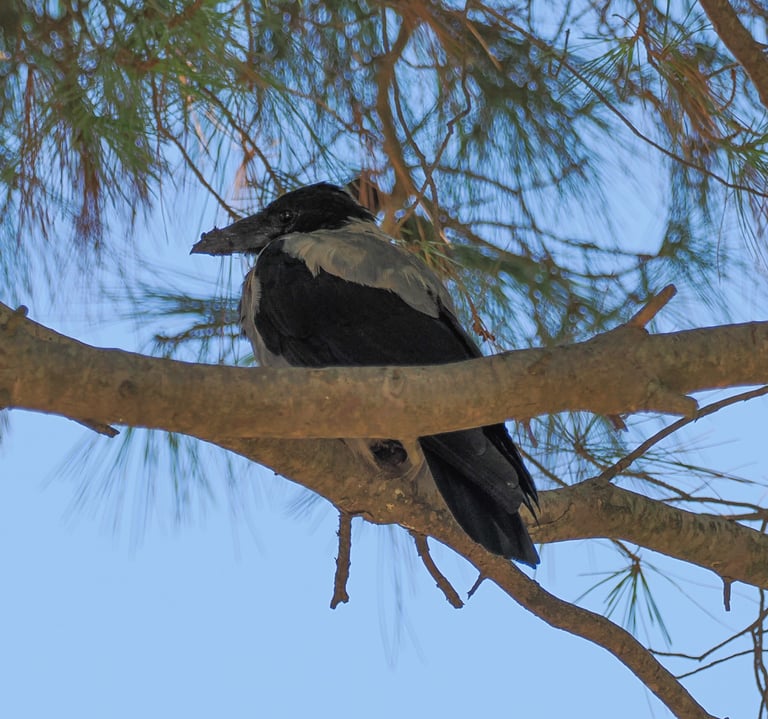
The most useful field mark separating the Oriental magpie from its close relative, the Eurasian magpie, is its darker overall plumage with less white, paired with a proportionally shorter tail and a longer bill and tarsi.
At about 45 centimeters long, it is slightly smaller than the Eurasian magpie. The back, tail, and remiges show iridescence that observers have described inconsistently, some finding it bluer and less green than the Eurasian magpie, others finding the opposite, suggesting real variation in how the sheen appears under different light.
The rump is mostly black, crossed by a narrow, often greyish-white band that connects the white shoulder patches typical of magpies in the genus Pica. Its call matches that of the Eurasian magpie but comes across as somewhat softer.
Distribution and Habitat
The Oriental magpie ranges across a broad swath of East Asia, from southeastern Russia through eastern China, Korea, Taiwan, and northern Indochina into Myanmar, with an additional naturalized population established in Japan.
Observation records collected across the year show counts that stay fairly high through most months, dip noticeably between June and August, and rise again toward the end of the year. Since these figures come from presence observations rather than measures of abundance, the pattern hints at some seasonal shift in detectability or activity rather than a confirmed population change, and should be read cautiously.

Cultural Significance
In Korea, the Oriental magpie holds deep symbolic weight as a harbinger of good luck, often regarded as a messenger bringing joyful news or auspicious events. This association has made the bird a lasting symbol of Korean identity, and it has been adopted as an official bird in parts of the country.
More broadly across the region, magpies in folklore and legend are often linked to cleverness and adaptability, with their acrobatic flight and playful social interactions reinforcing this reputation among observers.
The species has even reached popular culture recently, appearing as the basis for a fictional six-eyed magpie character in the film KPop Demon Hunters, though real Oriental magpies have the same two eyes as any other bird.
Fun Facts
- The scientific name serica means "silky" or "Chinese," and is sometimes mistakenly "corrected" to sericea.
- A fictional six-eyed version of this species appears in the film KPop Demon Hunters, despite real Oriental magpies having ordinary two-eyed vision.
- The species has established a naturalized population in Japan outside its native range across mainland East Asia.
Photos
Photographs from via iNaturalist, licensed under CC0 1.0., by Wang (Tom) ZiYi via iNaturalist, licensed under CC BY 4.0., by Yi CHEN via iNaturalist, licensed under CC BY 4.0., by Neil Birrell via iNaturalist, licensed under CC BY 4.0., by 祐 via iNaturalist, licensed under CC BY 4.0., by 胡正恆(Jackson Hu) via iNaturalist, licensed under CC BY 4.0., by 雲一百香果 via iNaturalist, licensed under CC BY 4.0., by Gabriel via iNaturalist, licensed under CC BY 4.0., by 振远 王 via iNaturalist, licensed under CC BY 4.0., and by Martin Kalfatovic via iNaturalist, licensed under CC BY 4.0., credited on each photo.
Ecology and classification
Classification
- Phylum
- Chordata
- Class
- Aves
- Order
- Passeriformes
- Family
- Corvidae
- Genus
- Pica
- Species
- Pica serica
Sources
- GBIF Species names and classification
- iNaturalist Photos
- Wikidata Common names and conservation status
- Wikipedia Summary extract