The western jackdaw pairs for life and can gather in winter roosts of tens of thousands of birds, one of the largest social congregations among corvids.
A member of the crow family (Corvidae), the Coloeus monedula is found across Europe, western Asia and western North Africa, favoring open country mixed with trees and buildings. It is mostly a resident species, though northern and eastern populations migrate south for winter.
What makes the jackdaw worth a closer look is its complex social life: lifelong pair bonds, cooperative nest defense, and food-sharing behavior recorded at levels higher than those seen in chimpanzees.
Identification and Appearance
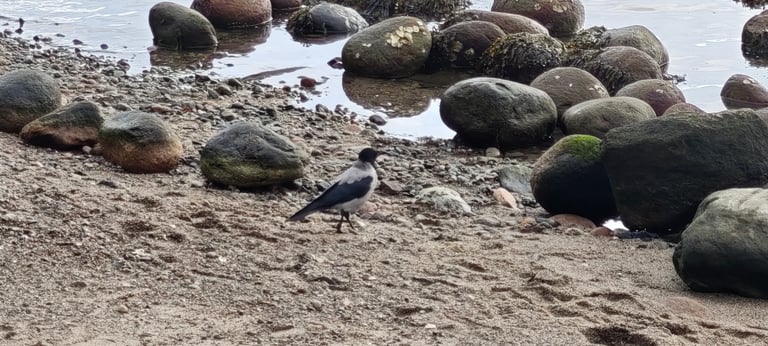
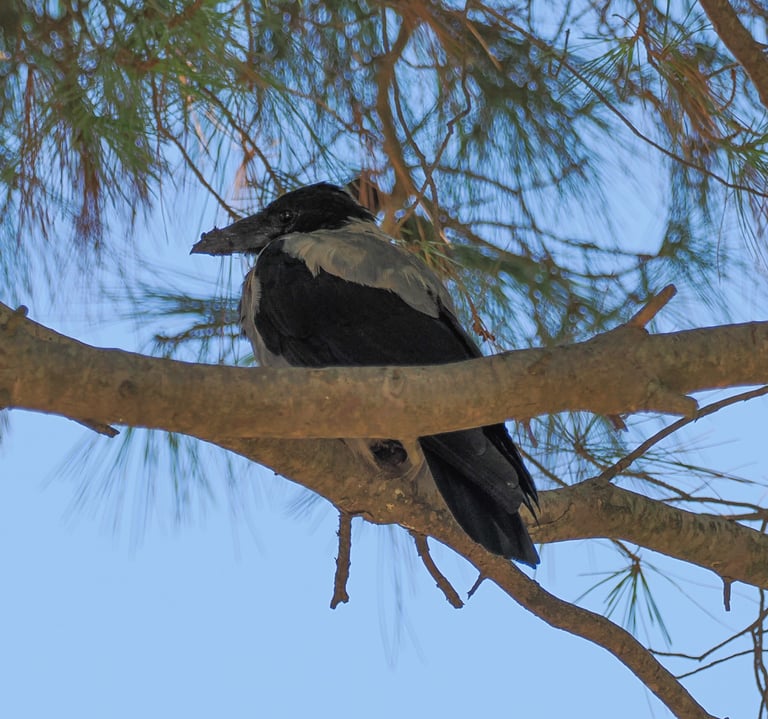
The short, stout black bill and pale grey nape are the jackdaw's most distinctive features, setting it apart from all other corvids within its range. It measures 34 to 39 centimeters in length and weighs around 240 grams.
Most of the plumage is glossy black, showing a purple or blue sheen on the crown, forehead and secondaries depending on subspecies, and a green-blue sheen on the throat, primaries and tail. The cheeks, nape and neck are light grey to silvery-grey, contrasting with slate-grey underparts and black legs and bill. Rictal bristles cover part of the bill base. Adults have pale greyish or silvery-white irises, while juveniles start with light blue eyes that darken to brown before whitening around one year of age.
The sexes look alike, though males show more faded head and neck plumage with age, especially before molting. Immature birds are duller overall, with sooty-black heads, dark grey necks and greenish-tinged tails with narrower feathers. Geographic variation is slight: central Asian birds have marginally longer wings, western birds slightly heavier bills, and body color darkens in humid, northern or mountainous areas.
In flight, jackdaws show jerky wingbeats and can be told from rooks, pigeons or choughs by their smaller size, faster deeper wingbeats, narrower wingtips, shorter thick necks and short bills. They differ from choughs by uniformly grey underwings and black bills and legs. The closest look-alike is the Daurian jackdaw, whose adults show pied plumage but whose immatures, being dark-eyed and dark-plumaged, closely resemble young western jackdaws; the Daurian tends to be darker overall with less contrast on the nape.
Distribution and Habitat
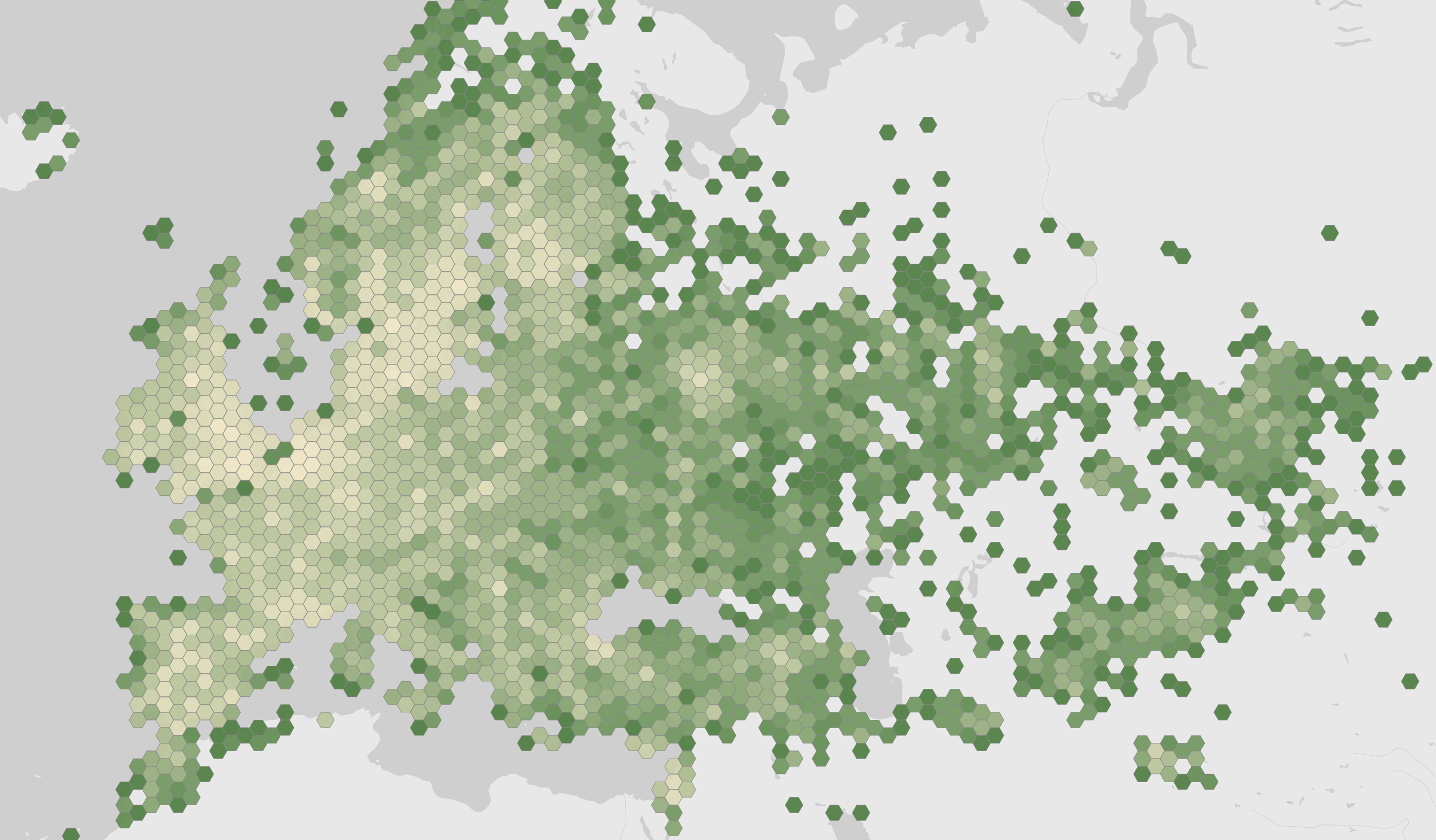
The western jackdaw ranges from Northwest Africa through nearly all of Europe, except the subarctic north, and east through central Asia to the eastern Himalayas and Lake Baikal, reaching Turkey, the Caucasus, Iran, Iraq, Afghanistan, Pakistan and northwestern India. It has gone regionally extinct in Malta and Tunisia, though its overall range spans an estimated 1 to 10 million square kilometers and supports a large population estimated at 15.6 to 45 million individuals in Europe alone.
Most populations are resident, but northern and eastern birds migrate to wintering grounds between September and November, returning between February and early May, with the breeding range pushing north into Siberia each summer. Wintering concentrations occur in the Ural Valley of northwestern Kazakhstan, the northern Caspian, and the Tian Shan region of western China, with occasional vagrancy as far as the Faroe Islands, Iceland, Japan, and even northeastern North America.
Jackdaws favor wooded steppe, pastures, cultivated land, coastal cliffs and towns, thriving wherever forests give way to open fields dotted with trees and buildings. They tend to leave fully open fields to rooks and denser woodland to the Eurasian jay, instead favoring a mix of large trees, structures and open ground. Urban parks host growing wintering populations in some cities, a pattern recorded over several decades in Warsaw, where wintering numbers increased roughly fourfold between the late 1970s and early 2000s.
Behavior and Lifestyle
Jackdaws are highly gregarious, living in flocks that swell in autumn and gather by the thousands at communal roosts, with as many as 40,000 birds recorded at a single Swedish roost. Despite this crowding, mated pairs remain bonded for life and often roost together within the larger group.
Within flocks, a strict linear social hierarchy governs access to food and shelter, with paired birds sharing rank and unmated females sitting at the bottom. Status is settled through postures such as the bill-up and bill-down displays, forward- and defensive-threat postures, and outright fights where birds grapple feet-first while other jackdaws gather and call noisily. Young males establish their status before pairing, after which a female immediately takes on her mate's social rank.
Jackdaws often mix with hooded crows and rooks, especially while migrating or roosting, and forage alongside starlings, lapwings and gulls. They mob larger birds such as magpies, ravens or Egyptian vultures when alerted by an alarm call, sometimes even turning on a sick or injured flockmate until it dies.
Communication
Jackdaws are vocal birds whose main call, a metallic chyak-chyak or kak-kak, functions as a contact or greeting signal, often given in flight. Adults use a kiaw or kyow call to summon young or offer food to mates, while begging females answer with a longer kyaay or giaaaa.
Perched flocks chatter constantly, and roosting groups produce a cackling chorus before settling for the night. A harsh, drawn-out arrrrr or kaaaarr serves as an alarm call, used both to warn of predators and to rally flockmates for mobbing.
Nestlings begin with soft cheeping around a week old, building to a penetrating screech by day 18 before the voice deepens; by day 25 they fall silent in response to unfamiliar sounds. Jackdaws can also be trained to imitate human speech.
Recordings
call, flight call · France · Philippe Grange · Public domain
call, drumming · France · Philippe Grange · Public domain
song · France · Philippe_Grange · Public domain
call, flight call · France · Philippe Grange · Public domain
call, flight call · France · Philippe Grange · Public domain
Diet and Nutrition
Jackdaws forage mostly on the ground in open areas, using jumping, pecking, clod-turning, scattering and probing to uncover food, with occasional digging. They visit landfills, bins, streets and gardens, often early in the morning before crowds appear, and will ride on sheep and other mammals to pick off ticks or gather wool for nesting material.
Small invertebrates up to about 18 millimeters long make up much of the animal diet, including beetles such as cockchafers, weevil larvae, flies, moths, snails and spiders, along with small rodents, bats, bird eggs and chicks, and carrion like roadkill. Plant food includes cereal grains such as barley, wheat and oats, weed seeds, elderberries, acorns and cultivated fruits; overall the diet averages 84% plant material except during the breeding season, when insects dominate to meet the demands of raising young.
The species is highly opportunistic, adjusting its diet to whatever is available, including raiding the nests of skylarks, Manx shearwaters, razorbills, guillemots, herons and doves for eggs and chicks. At refuse sites, jackdaws forage at dawn and dusk and sometimes steal food from other birds, while they themselves have been recorded losing food to saker falcons.
Unusually for a bird, jackdaws practice active food sharing among flockmates regardless of kinship or sex, favoring preferred foods over less desirable ones, at levels documented as higher than in chimpanzees. The purpose of this generosity beyond courtship and parental care remains unclear, though it may relate to mutual benefit or avoiding conflict.
Nesting and Breeding
Jackdaws reach sexual maturity in their second year and typically pair for life, with genetic studies finding no evidence of extra-pair mating and little tendency toward separation even after failed breeding attempts. Pairs that stay together past six months almost always remain bonded until one partner dies, and widowed birds often struggle to keep their nest site or raise young alone.
Breeding usually happens in colonies, with pairs cooperating to find and defend a nest site for most of the year. Nests are built in cavities in trees, cliffs, ruined or occupied buildings, and chimneys, sometimes reaching great size as pairs drop sticks into a crevice to build a platform. Nests are lined with hair, wool and dead grass, and jackdaws have been known to outcompete tawny owls for cavities or take over old woodpecker and stock dove nests.
Eggs are pale blue or blue-green with dark speckling, smaller and lighter-colored than those of other corvids, averaging around 35 by 25 millimeters and 11 to 11.5 grams depending on subspecies. Clutches usually contain four or five eggs, though as many as nine have been recorded. The female incubates for 17 to 18 days, and chicks hatch naked and fully dependent on their parents.
Because incubation begins before the clutch is complete, hatching is asynchronous and the last-hatched chick often dies, especially when food is scarce and parents limit investment in unlikely survivors. Chicks fledge after 28 to 35 days and continue receiving parental food for about another four weeks. The great spotted cuckoo parasitizes jackdaw nests in Spain and Israel, while ravens, tawny owls, weasels, rats and pine martens raid nests, with isolated nests more vulnerable than those within colonies.
Population and Ecological Role
Jackdaws play a role in disturbing carrion, invertebrates and farmland pests, and their opportunistic foraging brings them into close contact with people, sometimes with public health consequences. In parts of England, jackdaws learned to peck open foil caps on doorstep milk bottles, and the bacterium Campylobacter jejuni isolated from their beaks and cloacae was linked to cases of gastroenteritis in Gateshead, prompting health authorities to recommend discarding pecked-open milk.
In Spain, an outbreak of gastrointestinal illness causing human deaths was linked to jackdaws, with a previously undescribed polyomavirus, provisionally named crow polyomavirus, isolated from an affected bird's spleen alongside a Salmonella co-infection. Predators recorded taking jackdaws include various rat snakes, whip snakes, vipers and the beech marten.
Cultural Significance
The species name monedula derives from Latin words for money and eating, a name tied to old Greek mythology rather than any logical description of the bird. In Aristophanes' The Birds, a character addresses his pet jackdaw in the opening line, and an ancient adage held that "the swans will sing when the jackdaws are silent," meaning the wise wait for fools to quiet down.
Greek folklore held that a jackdaw could be lured into a dish of oil, vain enough to fall in while admiring its own reflection, while the myth of Princess Arne told of her transformation into a jackdaw as punishment for greed, forever drawn to shiny objects. The Roman poet Ovid called jackdaws harbingers of rain, and Pliny recorded that Thessalians, Illyrians and Lemnians prized them for destroying grasshopper eggs.
Across Europe, jackdaws carried strong superstitions: one on a roof could predict a new arrival or, alternatively, foretell death if it flew down a chimney. In Welsh folklore, the bird was considered sacred for nesting in church steeples, said to be shunned by the Devil for that very reason, while in the Fens, spotting a jackdaw on the way to a wedding was a good omen for the bride. The Ukrainian town of Halych bears a jackdaw on its coat of arms, and Franz Kafka's father used a jackdaw image on his shop sign, since "kavka" means jackdaw in Czech.
Fun Facts
- The name Coloeus monedula stems from Latin words for money and eating, linked to old Greek myth rather than any real behavior around money.
- Jackdaws have been recorded foraging alongside common starlings, northern lapwings and common gulls in northwestern England.
- A field study at a large dump near León, Spain, found jackdaws practicing kleptoparasitism, stealing food from one another at dawn and dusk.
- Gilbert White recorded jackdaws nesting in crevices beneath the lintels of Stonehenge, and once using a rabbit burrow as a nest site.
- The Roman poet Ovid described jackdaws as harbingers of rain in his work Amores.
Photos
Photographs from via iNaturalist, licensed under CC0 1.0., by Константин Селивёрстов via iNaturalist, licensed under CC BY 4.0., by Bevan Weir via iNaturalist, licensed under CC BY 4.0., by Tim via iNaturalist, licensed under CC BY 4.0., by Linna Gurova via iNaturalist, licensed under CC BY 4.0., by Ксения Волянская via iNaturalist, licensed under CC BY 4.0., and by Richard Nuttall via iNaturalist, licensed under CC BY 4.0., credited on each photo.
Ecology and classification
Classification
- Phylum
- Chordata
- Class
- Aves
- Order
- Passeriformes
- Family
- Corvidae
- Genus
- Coloeus
- Species
- Coloeus monedula
Sources
- GBIF Species names and classification
- iNaturalist Photos
- Wikidata Common names and conservation status
- Wikipedia Summary extract
- Xeno-canto Audio recordings
- AnAge Longevity
- AVONET Bird mass, habitat, migration, diet and range size
- GloBI What it eats, what eats it, parasites and pollinators
- Wardeh et al. 2015 (EID2)
- TETRA-EU