The American dipper is North America's only truly aquatic songbird, able to walk along the bottom of a stream as if it were dry land.
This stocky gray bird, also called a water ouzel, belongs to the family Cinclidae within the order Passeriformes. It ranges through the mountainous regions of western North America, from Alaska to Panama, and is currently listed as Least Concern by the IUCN. Its tight bond with clean, swift streams makes it a useful indicator of water quality, and its unusual aquatic lifestyle sets it apart from almost every other bird on the continent.
Identification and Appearance
The most distinctive field mark of the American dipper is the white feathers on its eyelids, which flash visibly each time the bird blinks. Combined with its habit of rhythmically bobbing its body up and down, this makes the species easy to recognize even at a distance along a stream.
It is a stocky, medium-sized bird, measuring about 16.5 centimeters (6.5 inches) in length with a wingspan of roughly 23 centimeters (9.1 inches) and a weight around 46 grams (1.6 ounces). Its plumage is overall gray, with the head sometimes showing a brownish tinge.
The short tail and compact build give it a chunky silhouette well suited to life clinging to wet rocks and diving into fast water.
Distribution and Habitat
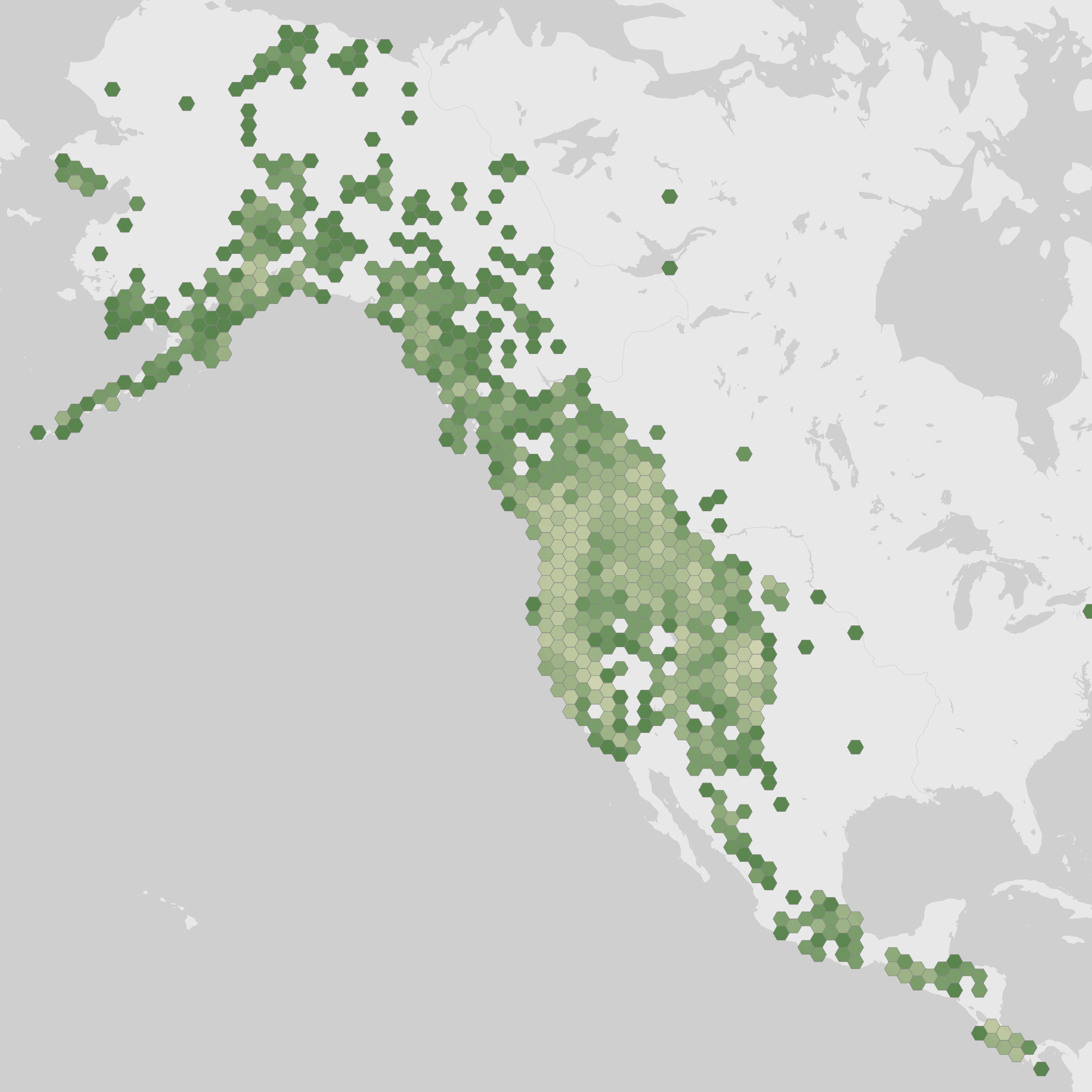
The American dipper occupies mountainous streams from Alaska south through western North America to Panama, favoring swift, clear, cold, permanent waterways. It particularly favors streams with large boulders, tumbling waterfalls, and steep cliffs or ledges that offer sheltered nest sites, often tucked beneath waterfalls themselves.
The species also makes use of man-made structures such as culverts, bridges, and small dams for nesting, and it forages along the edges of lakes and ponds where clear streams feed into them. Its elevation range runs from sea level along the coast up to over 9,000 feet in the central Sierra Nevada, and as high as 10,000 feet in California's White Mountains, with occasional wanderers exceeding 12,000 feet.
Most populations are permanent residents, though individuals may shift slightly south or downslope in winter to find food or unfrozen water. Because the dipper depends so closely on clean streams, its presence is considered a sign of good water quality, and it has disappeared from some locations following pollution or increased silt loads.
Behavior and Lifestyle
The American dipper defends a linear territory stretched along a stream rather than a rounded patch of land, reflecting its total dependence on flowing water for food and shelter. Mating pairs actively drive off other dippers that intrude on this stretch of stream.
It feeds by diving into the water or walking along the streambed to catch prey, and it can dive as deep as 20 feet in pursuit of food. Some individuals have been observed washing food before feeding it to their young.
The species is sedentary and behaves as a generalist within its aquatic niche, closely resembling its European relative, the white-throated dipper. Its habit of bobbing its body rhythmically up and down, the likely source of its common name, is one of its most recognizable behaviors.
Communication
The American dipper relies on visual, tactile, acoustic, and chemical channels to communicate, though the acoustic and visual signals are the most apparent to observers along a stream. Its repeated body-bobbing behavior likely serves as a visual signal between individuals sharing the same stretch of water.
During courtship, the male performs a song-and-display combination, stretching his neck upward with his bill held vertical and wings partly spread while singing to the female, an acoustic and visual signal combined that can lead into a shared duet ending with the pair's breasts touching.
Diet and Nutrition
The American dipper hunts by diving into fast-moving streams or walking along the streambed to seize prey directly from the current. This active pursuit underwater, rather than surface feeding, is central to how it makes a living.
Its diet consists mainly of freshwater invertebrates, especially insect larvae, supplemented by very small fish. It has also been recorded feeding on small aquatic plants. As an aquatic predator, it depends entirely on the health of the stream ecosystem it hunts within.
Nesting and Breeding
Courtship begins with the male stretching his neck upward, bill held vertical, wings lowered and partly spread, strutting and singing before the female. If his display succeeds, the pair performs together, ending the sequence with their breasts touching.
The nest is a globe-shaped structure with a side entrance, built close to water on a rock ledge, riverbank, behind a waterfall, or under a bridge. Clutches contain about two to five white eggs, roughly 26 by 19 millimeters, incubated solely by the female for about 15 to 17 days.
After hatching, the young remain under parental care for roughly 20 to 25 days before fledging, with the male helping to feed them alongside the female. The oldest dipper recorded through ring-recovery data reached 8 years and 1 month, banded and later recovered in South Dakota.
Population and Ecological Role
The American dipper occupies a large range of about 4,910,000 square kilometers across western North America's mountain streams. Within its stream ecosystems, it acts as a predator of aquatic invertebrates and small fish, while itself occasionally falling prey to predatory fish such as brook, bull, or Dolly Varden trout.
It also hosts a range of internal and external parasites, most notably tapeworms (Cestoda) and digenean flukes, along with smaller numbers of acanthocephalans and other parasite groups, reflecting its close ties to aquatic food webs.
Conservation and Threats
The American dipper is classified as Least Concern by the IUCN Red List, reflecting its currently stable status across its wide mountain-stream range. Its close dependence on clean, swift, permanent streams makes water quality the key factor underlying its continued presence in any given location.
Cultural Significance
There is little documented tradition or symbolism specifically tied to Cinclus mexicanus in human culture. It has not become a widely recognized figure in folklore, art, or cuisine in the way some more conspicuous species have.
Its main significance tends to be among birdwatchers and naturalists, who prize it as a distinctive songbird of fast-flowing streams rather than as a subject of myth or symbolism.
Fun Facts
- The American dipper was first described in 1827 by English zoologist William Swainson, based on a specimen collected in Mexico by naturalist William Bullock.
- It has been recorded preying on the larvae of tailed frogs (Ascaphus truei) in addition to its usual invertebrate diet.
- During winter, American dippers sometimes become more noticeable as they concentrate along the stretches of stream that remain unfrozen.
Photos
Photographs from via iNaturalist, licensed under CC0 1.0., by Mara Christensen via iNaturalist, licensed under CC BY 4.0., by Matt Berger via iNaturalist, licensed under CC BY 4.0., by Ernesto Fernandez Polcuch via iNaturalist, licensed under CC BY 4.0., by Aliya Hoff-Vanoni via iNaturalist, licensed under CC BY 4.0., by Kalvin Chan via iNaturalist, licensed under CC BY 4.0., by Oliver Stringham via iNaturalist, licensed under CC BY 4.0., by tcantrell52 via iNaturalist, licensed under CC BY 4.0., by Laura Maskell via iNaturalist, licensed under CC BY 4.0., by ayden via iNaturalist, licensed under CC BY 4.0., by Daniel S. Katz via iNaturalist, licensed under CC BY 4.0., by Eric Klug via iNaturalist, licensed under CC BY 4.0., and by Fue Her via iNaturalist, licensed under CC BY 4.0., credited on each photo.
Ecology and classification
Classification
- Phylum
- Chordata
- Class
- Aves
- Order
- Passeriformes
- Family
- Cinclidae
- Genus
- Cinclus
- Species
- Cinclus mexicanus
Sources
- GBIF Species names and classification
- iNaturalist Photos
- Wikidata Common names and conservation status
- Wikipedia Summary extract
- Animal Diversity Web Animal habitat, behavior and diet
- AnAge Longevity
- AVONET Bird mass, habitat, migration, diet and range size
- GloBI What it eats, what eats it, parasites and pollinators
- HWML Parasite Collection