The gum rockrose covers itself in a sticky, fragrant resin so pervasive that its leaves are used to produce labdanum, a substance long valued in perfumery and herbal medicine.
Native to the western Mediterranean, this flowering shrub belongs to the family Cistaceae and is also known as labdanum, common gum cistus, and brown-eyed rockrose. Beyond its resin, the plant's large white flowers and ability to dominate disturbed ground make it a distinctive presence across its native range.
Identification and Appearance
The most reliable field mark is the plant's sticky, resin-coated foliage, which gives off a strong, fragrant odor when touched. This gum rockrose grows as a shrub 1 to 2.5 meters tall and equally wide, with evergreen, lanceolate leaves 3 to 10 centimeters long and 1 to 2 centimeters broad, dark green above and paler beneath.
Its flowers are large and conspicuous, measuring 5 to 8 centimeters across. Each has five papery white petals, usually marked with a red to maroon spot at the base, surrounding a cluster of yellow stamens and pistils at the center.
The whole plant's resinous coating, combined with its broad white blooms and dark maroon petal spots, sets it apart from other rockroses lacking both the sticky exudate and the distinctive basal markings.
Distribution and Habitat
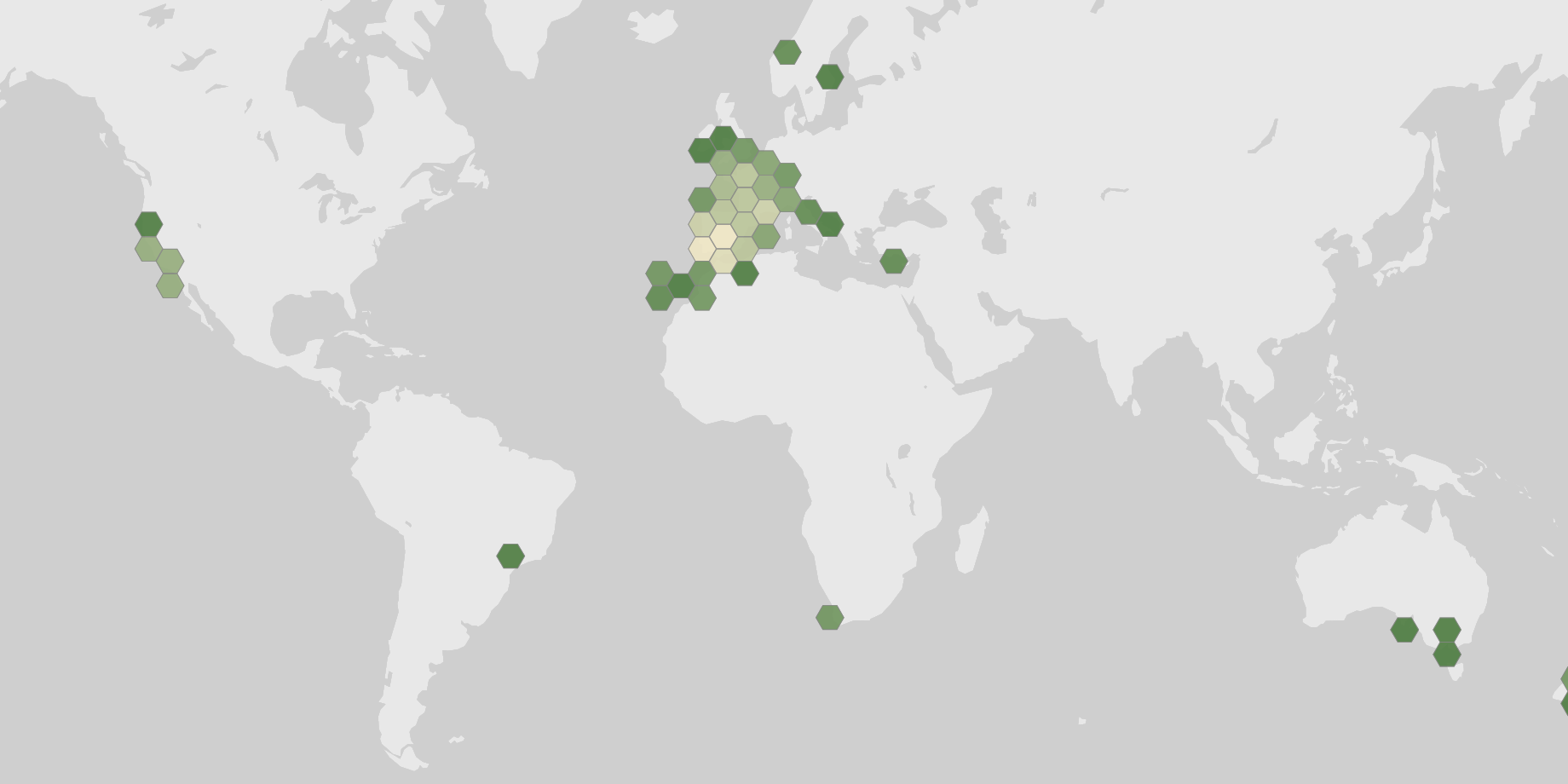
Cistus ladanifer is native to the western Mediterranean, occurring in Algeria, France, Morocco, Portugal, and Spain within a subtropical climate zone. It has also been introduced well beyond this native range, establishing in California, the Canary Islands, Cyprus, Madeira, and the South Island of New Zealand.
Observation records peak sharply in the spring months, especially April and May, suggesting this is when the plant is most conspicuous and frequently noted, likely coinciding with its flowering period, though these counts reflect reporting patterns rather than actual abundance.
Growth and Form
Cistus ladanifer grows as a shrub, reaching 1 to 2.5 meters in both height and width. Its evergreen habit means the foliage persists year-round, with resin-coated leaves remaining a constant feature of the plant rather than being shed seasonally.
Ecology and Relationships
Cistus ladanifer is exceptionally well adapted to the Mediterranean climate, tolerating both long summer droughts and cold winter conditions. This resilience has made it an aggressive colonizer, and it has taken over large areas of former farmland and grassland in the mountains of central Spain and much of southern Portugal, earning it the Spanish name jara pringosa, or "sticky shrub," and the Portuguese name esteva.
The plant forms mycorrhizal associations with several fungi, including Boletus edulis, Boletus rhodoxanthus, and Laccaria laccata, linking it into the below-ground fungal networks of the habitats it colonizes.
Its flowers attract a wide range of visitors, most notably the honeybee Apis mellifera, along with various beetles such as Oxythyrea funesta and Chasmatopterus, hoverflies like Eristalis, and numerous solitary bees including Andrena tenuistriata and Lasioglossum species.
Uses and Human Relationships
Cistus ladanifer is a popular ornamental plant, grown for its resin-scented foliage and conspicuous white flowers, and it has received the Royal Horticultural Society's Award of Garden Merit. Its leaves yield a fragrant oleoresin called labdanum, long used in perfumes, particularly as a fixative to help other scents last longer.
In folklore and mythology, rockroses have carried symbolic associations with protection and renewal, and traditional knowledge about this species has been passed down through generations in the regions where it grows.
Fun Facts
- The name labdanum traces back to the Greek word kísthos, the root of "cistus," and several related rockrose species, including Cistus creticus and Cistus incanus, have historically been sources of the same fragrant resin.
- In regions with a strong Christian tradition, the maroon spots on the base of each flower petal have been popularly associated with the five wounds of Christ.
Photos
Photographs from via iNaturalist, licensed under CC0 1.0., by Javier Sánchez Álvarez via iNaturalist, licensed under CC BY 4.0., by zebedeugalinha via iNaturalist, licensed under CC BY 4.0., by Teo Albert via iNaturalist, licensed under CC BY 4.0., by Barry Stewart via iNaturalist, licensed under CC BY 4.0., by Duarte Frade via iNaturalist, licensed under CC BY 4.0., and by Vítor Jorge via iNaturalist, licensed under CC BY 4.0., credited on each photo.
Ecology and classification
Habitat
Growth habit
- Shrub
Classification
- Phylum
- Tracheophyta
- Class
- Magnoliopsida
- Order
- Malvales
- Family
- Cistaceae
- Genus
- Cistus
- Species
- Cistus ladanifer
Sources
- GBIF Species names and classification
- iNaturalist Photos
- Wikidata Common names and conservation status
- Wikipedia Summary extract
- Plants of the World Online Native range, life form and climate (WCVP)
- GloBI What it eats, what eats it, parasites and pollinators
- EuPPollNet