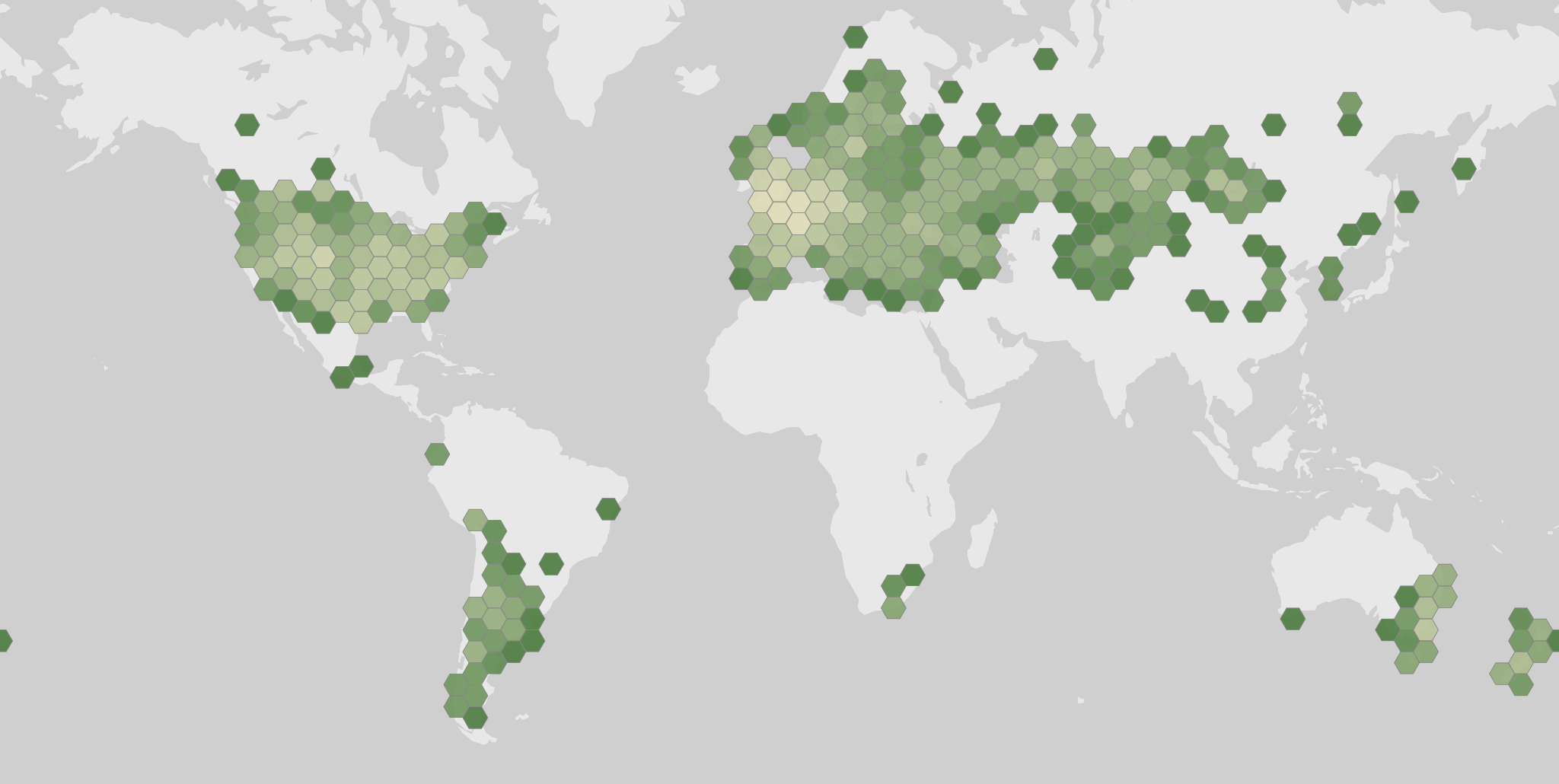
Musk thistle has spread far beyond its homeland, and it is now invasive in North America, Australia, New Zealand and South Africa. In its native range across Europe, Central Asia and North Africa, it grows as a scattered plant of pastures.
Carduus nutans is a biennial herb in the daisy and sunflower family, Asteraceae. It goes by the common names musk thistle, nodding thistle and nodding plumeless thistle.
The species is worth reading about because its spread shows how a pasture plant from the Old World can become established across very different landscapes.
Identification and Appearance
The most useful field mark is the combination of prickly, deeply lobed leaves and a nodding flower head. The dark green leaves are coarsely bipinnately lobed, with sharp yellow-brown to whitish spines at the tips of the lobes. The upper surface is smooth and waxy, while the veins on the underside are woolly.
The stem is cottony or hairy and has thin ribs running along it. Leaves can reach about 40 cm (16 in) long, and the plant develops a rosette of these large leaves before it sends up its flowering stems.
The flower heads are large and globose, usually 3 to 5 cm (1 1/4 to 2 in) across and occasionally up to 7 cm (2 3/4 in). Each head holds hundreds of tiny flowers and sits at the tip of a stem. Most flowers are a deep rose to violet, and white ones are rare.
When mature, the heads commonly droop to an angle of 90° to 120° from the stem. This drooping habit is what gives the plant its alternate name, nodding thistle.
Distribution and Habitat
Carduus nutans is native to Europe, Western Siberia, Central Asia and North Africa. In North America it is abundant in the Rocky Mountains, and it has also established in many U.S. states and Canadian provinces, including Ontario, Alberta, British Columbia and Quebec.
The plant tolerates a wide range of conditions. In the Intermountain region of western North America, it grows from saline soils in low valleys to acidic soils at 2,400 m (8,000 ft). In Colorado it is found between 2,700 and 3,000 m (9,000 and 10,000 ft), and it can grow at least to 1,830 m (6,000 ft) elsewhere.
It typically grows in meadows and grasslands, in heavily grazed pastures, and on open disturbed soil such as roadsides and building sites. It is found in neutral to acidic soils, and in Ohio it is common on high, dry ridges where limestone bedrock lies close to the surface.
Observations peak in June and July, which suggests the plant is most visible in early summer.
Growth and Form
Carduus nutans is a monocarpic herb, meaning each plant flowers once and then dies. It is classed as a biennial, but its life cycle is flexible. Depending on climate and habitat, it can also behave as a summer or winter annual, or as a perennial.
Mature plants can reach 2.7 m (9 ft) tall, with several branched stems. Before that stage, the plant builds a low rosette of large, spiny leaves that can be up to about 40 cm (16 in) long.
The timing of growth shifts with local conditions, so the plant's full cycle can vary from site to site.
Ecology and Relationships
Insects make up much of the plant's feeding community. Beetles, moths and butterflies, true bugs, grasshoppers and flies all feed on it, and the painted lady butterfly (Vanessa cardui) is one of its main feeders. Songbirds are the main birds that eat it, and the skylark (Alauda arvensis) and common redpoll (Acanthis flammea) are among them.
Its flowers draw bees, butterflies and moths, along with some flies and beetles. Bumblebees visit only occasionally. A fly, Xyphosia miliaria, is among its parasites.
The plant does best in moist soil and spreads quickly in areas that experience frequent disturbances, such as landslides and flooding. It does not grow well in excessively wet, dry or shady conditions.
Uses and Human Relationships
Herbal remedies have historically included musk thistle. In Turkish folk medicine, parts of the flowering branches have been used to treat prostate disease. Traditional use has also included liver disease, malaria, constipation and kidney stones.
These traditional uses reflect long-standing herbal practice rather than modern medical use, and the plant's ordinary role in people's lives today is mainly as a widespread weed of pastures and disturbed land.
Photos
Photographs from via iNaturalist, licensed under CC0 1.0., by Brooke Smith via iNaturalist, licensed under CC BY 4.0., by Eric Schmidt via iNaturalist, licensed under CC BY 4.0., by Daughter Dad via iNaturalist, licensed under CC BY 4.0., by Bill Keim via iNaturalist, licensed under CC BY 4.0., and by Martin Purdy via iNaturalist, licensed under CC BY 4.0., credited on each photo.
Ecology and classification
Growth habit
- Herb
Classification
- Phylum
- Tracheophyta
- Class
- Magnoliopsida
- Order
- Asterales
- Family
- Asteraceae
- Genus
- Carduus
- Species
- Carduus nutans
Sources
- GBIF Species names and classification
- iNaturalist Photos
- Wikidata Common names and conservation status
- Wikipedia Summary extract
- Encyclopedia of Life Habitat, diet and behavior traits
- Plants of the World Online Native range, life form and climate (WCVP)
- USDA Plants US plants: growth habit and growing conditions
- GloBI What it eats, what eats it, parasites and pollinators
- trophiCH
- Wardeh et al. 2015 (EID2)
- DoPI
- Schwarz et al. 2021
- EuPPollNet