The common sunflower supplies the fourth most used vegetable oil on Earth, a remarkable feat for a plant that only a few centuries ago grew wild across the American prairies. Today it feeds people as a snack and baking ingredient, livestock as fodder, and birds at backyard feeders, all from a single genus that Indigenous farmers first tamed thousands of years ago.
This is a large annual forb in the daisy family Asteraceae, order Asterales, native to the Americas and now cultivated on nearly every continent outside the tropics, deserts, and tundra. The IUCN lists it as Least Concern, reflecting its abundance rather than any fragility. Few plants blend deep agricultural history, striking geometry, and everyday usefulness as thoroughly as this one.
Identification and Appearance
The most useful field mark is the flower head itself, technically a pseudanthium: a disc 7.5 to 12.5 centimeters wide packed with two kinds of florets. Sterile, petal-like ray flowers form the yellow, orange, or red rim, while the fertile disk flowers spiral across the center and mature into the familiar seeds.
The plant grows on an erect, rough-hairy stem that typically reaches about 3 meters, though the tallest sunflower on record climbed to 10.9 meters. Leaves are broad, coarsely toothed, rough to the touch, and mostly alternate along the stem, with the largest and most heart-shaped leaves near the base.
Wild plants branch and bear multiple smaller heads, while cultivated sunflowers usually grow a single unbranched stem crowned by one large head. The closely related prairie sunflower, Helianthus petiolaris, looks similar but can be told apart by the white hairs tipping the scales of its central disk.
A long-standing myth holds that mature sunflower heads swivel to track the sun all day. In fact, only young, immature buds do this, reorienting from east to west and back again overnight in a circadian rhythm tied to blue light. Once the flower head matures, it locks into a fixed easterly orientation that helps it warm quickly each morning and draw more pollinators. The English botanist John Gerard disputed the sun-tracking myth as early as 1597, noting he never observed it despite trying.
Distribution and Habitat
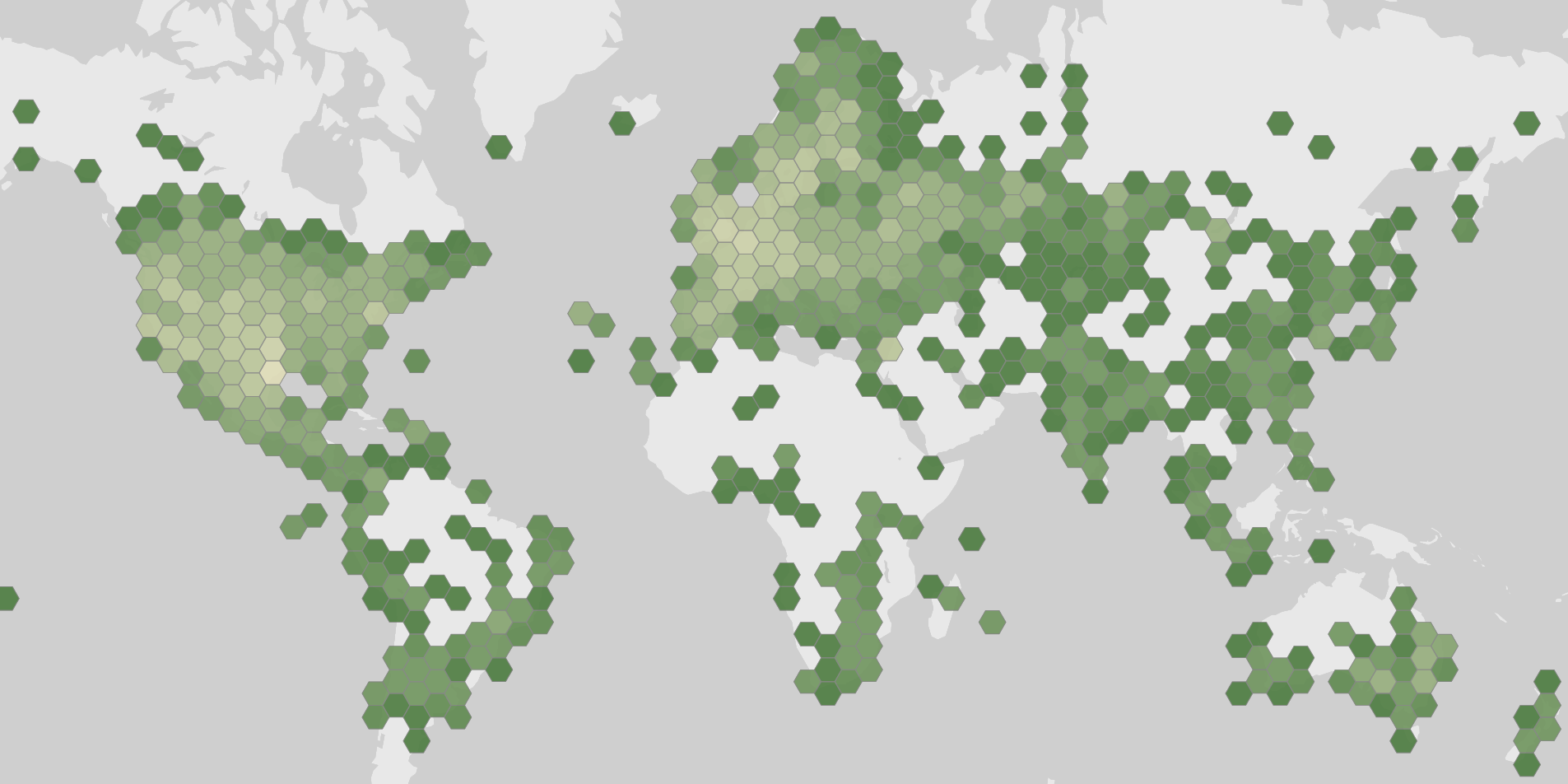
Helianthus annuus is native to the central and western United States, southern Canada, and northern Mexico, but cultivation has carried it to almost every non-tropical, non-desert, non-tundra region of the world. Wild populations favor clay-based soils that stay wet in spring and dry out by summer, along with dry open areas and foothills, while cultivated plants thrive in fertile, moist, well-drained soil under heavy mulch.
Industrial-scale production has shifted heavily toward Eastern Europe: as of 2020, Russia and Ukraine together grew more than half of the world's sunflower seed supply. Monthly observation data show a sharp seasonal peak from June through August, climbing from under 1,000 sightings in the winter months to over 17,000 in August, consistent with the plant's summer flowering period. These figures record presence, not population size, so they say more about when sunflowers are visible and being noted than about how many actually grow in a given place.
Uses and Human Relationships
Sunflowers have fed and adorned human communities for millennia. Domesticated in North America as part of the Eastern Agricultural Complex alongside goosefoot, little barley, and squash, evidence points to cultivation in Tabasco, Mexico around 2600 BCE, with fully domesticated examples appearing in Tennessee by roughly 2300 BCE. Aztec, Otomi, and Inca cultures treated the sunflower as a symbol of their solar deities, a fitting role given a name built from the Greek words for sun and flower.
Spanish explorers carried sunflower seeds to Europe in 1510, and the crop found its greatest commercial success in Russia. Eighteenth-century members of the Russian Orthodox Church favored sunflower oil during Lent because only plant-based fats were permitted, and in the early 19th century the merchant Daniil Bokaryov, working in the village of Alexeyevka in Voronezh Governorate, developed large-scale extraction methods that spread the crop's use so widely that the town still bears a sunflower on its coat of arms. Russia later reintroduced industrial oilseed cultivation to North America in the mid-20th century.
Today farmers plant seeds about 45 centimeters apart, rotate sunflower crops with cereals, soybean, or rapeseed to boost profitability, and rely heavily on hybrid varieties bred from cultivated and wild lines. Beyond food and oil, sunflowers have been planted for rhizofiltration, drawing radioactive cesium-137 and strontium-90 out of contaminated water after both the Chernobyl and Fukushima nuclear disasters.
Conservation and Threats
The IUCN classifies the common sunflower as Least Concern, meaning the species as a whole faces no significant risk of extinction in the wild. The greater pressures fall on cultivated crops rather than wild populations, and they can be severe. Fusarium, a soil-borne fungal pathogen, has caused crop losses reaching 80% in affected fields, making it one of the most damaging threats to sunflower agriculture.
Downy mildew poses a related risk, worsened by the crop's own growth habit: seeds are typically planted only about an inch deep, and in moist, waterlogged soil this shallow planting raises the odds of infection. Broomrape, a family of parasitic plants that attach to sunflower roots, can be even more destructive, with losses recorded as high as 100% in heavily infested fields.
No formal wild-population conservation programs are described for this species, consistent with its Least Concern status and broad cultivated range across six continents.
Conservation status
- LC
- NT
- VU
- EN
- CR
Least Concern
Fun Facts
- The plant's scientific name, Helianthus annuus, comes from the Greek words "helios" (sun) and "anthos" (flower).
- In Chinese culture, sunflowers are said to symbolize good luck, long life, and lasting happiness, while many Native American traditions connect them to harvest and provision.
- The sunflower holds a place in Iroquois mythology, one of several Indigenous traditions in which the plant carries symbolic meaning beyond its use as a crop.
Ecology
Habitat
- Grassland
- Disturbed Ground
Growth habit
- Herb