A single bitter bush plant can produce between 80,000 and 90,000 seeds, and under favorable conditions the stems can grow more than 3 centimeters in a single day.
Chromolaena odorata, also called jack in the bush, is a tropical and subtropical flowering shrub in the daisy family, Asteraceae. It is native to the Americas, ranging from Florida and Texas south through Mexico, the Caribbean, and into South America, but it has since been introduced to tropical Asia, West Africa, and parts of Australia. Its combination of rapid growth, prolific seeding, and adaptability to disturbed ground makes it one of the more widely recognized invasive shrubs across the tropics.
Identification and Appearance
The most useful field mark is the pungent, aromatic smell released when its hairy, glandular leaves are crushed. The plant is a multi-stemmed, perennial shrub that reaches up to 2.5 meters tall in open areas, with soft stems rising from a woody base.
In shadier settings, bitter bush behaves quite differently: it becomes etiolated and grows as a creeper over other vegetation, reaching as much as 10 meters in length as it clambers upward. The leaves are opposite, triangular to elliptical in shape, with serrated edges, measuring 4 to 10 centimeters long and 1 to 5 centimeters wide, carried on petioles 1 to 4 centimeters long.
Flowers are white to pale pink and tubular, arranged in panicles of 10 to 35 blooms at the ends of branches. The seeds are somewhat hairy achenes, dispersed mainly by wind but also able to cling to fur, clothing, and machinery, which helps the plant travel long distances. Seeds require light to germinate, and the plant can also regenerate from its roots after being cut back.
Distribution and Habitat
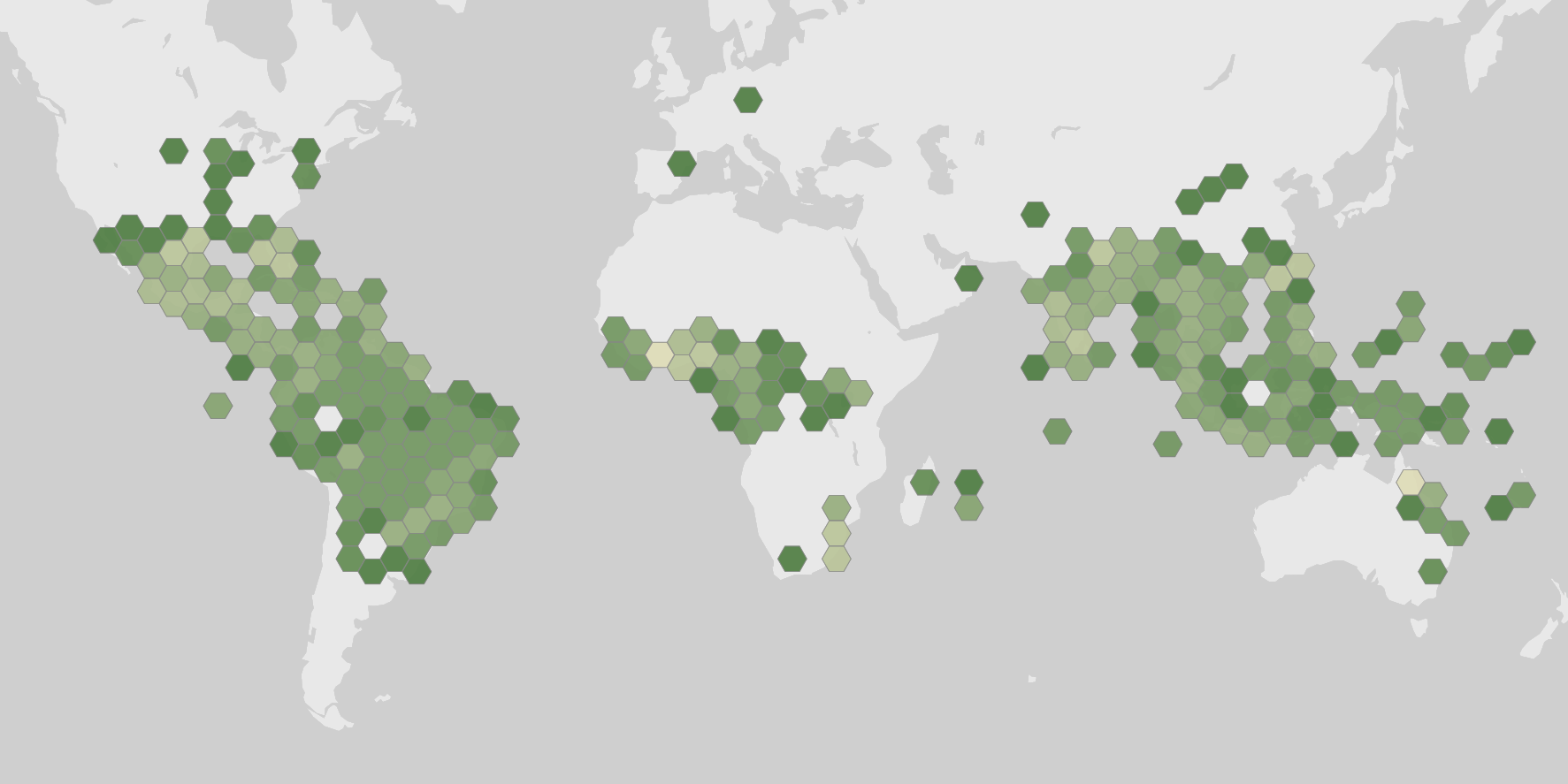
Bitter bush is native across a broad swath of tropical and subtropical America, from Florida and Texas through Mexico, Central America, the Caribbean islands, and much of South America, including Argentina, Brazil, Peru, Venezuela, and the Guianas. Its native climate is described as subtropical, and it grows in these regions under a wide range of conditions.
Outside its native range, the species has been introduced widely across tropical Asia, from India, Bangladesh, and Sri Lanka through Myanmar, Thailand, Vietnam, Cambodia, Laos, southern China, and the Philippines, as well as across island groups like the Andaman Islands and the Marianas. It has also been introduced to West and Central Africa, including Nigeria, Cameroon, Gabon, the Republic of Congo, and the Democratic Republic of Congo, and to parts of southern Africa such as KwaZulu-Natal, along with Queensland in Australia.
The species favors disturbed ground, roadsides, wasteland, and forest edges or clearings, forming dense thickets in such settings. Monthly observation counts show a peak in June, which may reflect a period of greater visibility or activity, though these figures record presence rather than actual abundance or the plant's complete range.
Growth and Form
Bitter bush is a perennial shrub capable of markedly fast growth, with stems extending more than 3 centimeters in a single day under favorable conditions. This growth rate, combined with its perennial habit, allows it to establish quickly and persist on a site once it takes hold, regenerating from its roots even after being cut back.
Ecology and Relationships
Bitter bush attracts some pollinating insects, including the honey bee Apis mellifera, though a flower visit alone does not confirm that pollination occurs. Among organisms recorded in association with the plant, the whitefly Bemisia tabaci stands out as an insect pest, while bacteria such as Pseudomonas aeruginosa and Ralstonia solanacearum have also been recorded in connection with it.
The plant's dense thickets in wasteland, forest edges, and scrubland create conditions that favor its own spread over that of native vegetation, particularly in disturbed sites such as roadsides and forest clearings.
Uses and Human Relationships
Despite its reputation as an invasive plant, bitter bush has a long history in traditional medicine, where it has been used to treat a range of ailments across tropical regions worldwide. Ethnobotanical use of the species reflects a broader pattern of indigenous communities drawing on locally available plants for therapeutic purposes.
The plant also has documented biological effects beyond human medicine: it is larvicidal against all major mosquito vectors, a property that has drawn interest for its practical applications.
Fun Facts
- The plant is known by many regional names beyond bitter bush, including jack in the bush, Siam weed, rouge plant, Christmas bush, triffid, and jack in the box.
- In Mauritius, bitter bush is abundant on roadsides and invades wasteland and forest clearings in the driest parts of the island, while in South Africa it forms thickets in wooded wasteland, scrubland, and forest edges.
- On Réunion, by contrast, the species is reported to be absent altogether, a striking difference from its behavior on nearby Mauritius.
Photos
Photographs from via iNaturalist, licensed under CC0 1.0., by Rohit Naniwadekar via iNaturalist, licensed under CC BY 4.0., by Robert Benson via iNaturalist, licensed under CC BY 4.0., by xanderferret via iNaturalist, licensed under CC BY 4.0., by Mario Guzmán via iNaturalist, licensed under CC BY 4.0., by P Jeganathan via iNaturalist, licensed under CC BY 4.0., by Raúl A. Ruiz M. via iNaturalist, licensed under CC BY 4.0., by Paulmathi Vinod via iNaturalist, licensed under CC BY 4.0., by Nina Kerr via iNaturalist, licensed under CC BY 4.0., by Benjamin Fredlund via iNaturalist, licensed under CC BY 4.0., by sielt via iNaturalist, licensed under CC BY 4.0., by Mark Clarke via iNaturalist, licensed under CC BY 4.0., and by Ravuri Krishna Chaitanya via iNaturalist, licensed under CC BY 4.0., credited on each photo.
Ecology and classification
Growth habit
- Shrub
Classification
- Phylum
- Tracheophyta
- Class
- Magnoliopsida
- Order
- Asterales
- Family
- Asteraceae
- Genus
- Chromolaena
- Species
- Chromolaena odorata
Sources
- GBIF Species names and classification
- iNaturalist Photos
- Wikidata Common names and conservation status
- Wikipedia Summary extract
- Plants of the World Online Native range, life form and climate (WCVP)
- GloBI What it eats, what eats it, parasites and pollinators
- Wardeh et al. 2015 (EID2)
- Cyrille et al. 2026