One of history's most consequential fungi, Claviceps purpurea produces toxic alkaloids that have triggered mass poisonings and, according to some scholars, may have fueled the ecstatic rites of ancient Greece through a natural precursor to LSD.
Claviceps purpurea is an ascomycete fungus in the order Hypocreales and family Clavicipitaceae, within the class Sordariomycetes. It grows on the ears of rye and related cereal and forage grasses, replacing developing grain with a hardened survival structure called the ergot sclerotium.
Consumption of grain or seed contaminated with this sclerotium can cause ergotism in humans and other mammals, a disease that has shaped centuries of agricultural and medical history. Its dual identity, as both a devastating crop pathogen and a source of pharmacologically active compounds, makes it one of the more consequential organisms ever to infect a food crop.
Fruiting Body and Identification
The most reliable sign of infection is the ergot itself: a hard, dark purple-to-black sclerotium that replaces a normal grain kernel inside the husk of an infected floret. Shaped like a small curved spur, it protrudes visibly from the ear of rye, triticale, wheat, or barley once mature.
Before hardening, the infection passes through a soft white stage known as Sphacelia segetum, which oozes a sugary, spore-laden fluid called honeydew. This fluid carries millions of asexual conidia that spread the infection to other florets. Over time this tissue converts into the hard, dry sclerotium, accumulating alkaloids and lipids such as ricinoleic acid as it matures.
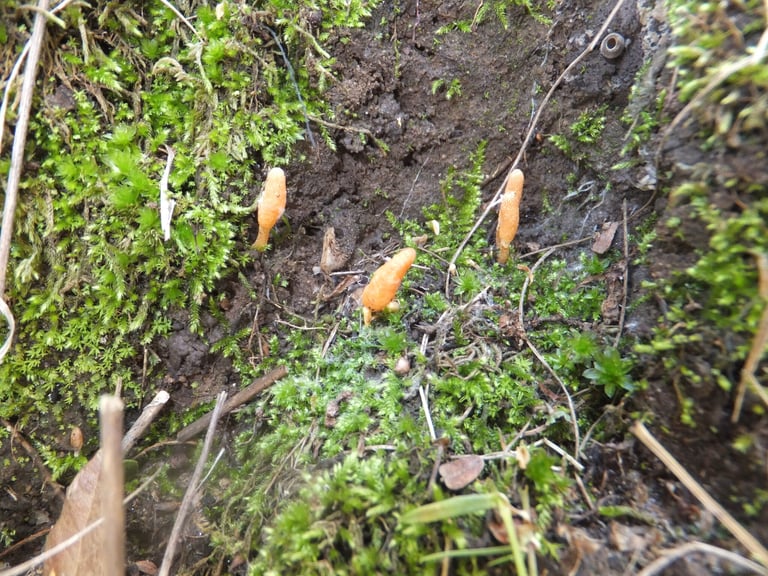
When a fallen sclerotium germinates the following season, it produces one or several small fruiting bodies with a distinct head and stipe, resembling a tiny mushroom and variously colored. Inside the head, threadlike sexual spores called ascospores form within structures called perithecia and are released simultaneously when host grasses come into flower.
Distribution and Habitat
Claviceps purpurea infects a wide range of grasses and cereals, most commonly outcrossing, open-flowering species such as rye (Secale cereale), along with triticale, wheat, and barley; oats are affected only rarely. Beyond cultivated cereals, it has been recorded on numerous wild and forage grasses, including species of Agrostis, Alopecurus, Bromus, Elymus, Poa, Phleum, Phalaris, Nardus, Danthonia, Molinia, Rytidosperma, and Setaria.
A distinct variety associated with salt-marsh grasses such as Spartina and Distichlis shows how the fungus extends beyond ordinary farmland into coastal wetland habitats. Overall, the fungus tracks the distribution of its many grass hosts, from cultivated cereal fields and hay meadows to wild grasslands and marshes.
Monthly observation counts show a sharp seasonal pattern, rising from a few hundred records in winter and spring to a peak above 4,800 in August, with high counts continuing through July and September before falling off toward winter. This pattern likely reflects the timing of cereal and grass flowering, when the fungus's fruiting structures and honeydew stage are most visible, rather than a true measure of its abundance or complete range; these figures are presence records only.

Life Cycle
Infection begins when an airborne ascospore lands on the stigma of a flowering grass floret, mimicking a pollen grain in the fertilization process. Because this route requires access to the flower's stigma, the fungus mainly infects outcrossing species with open flowers, such as rye and Alopecurus. Once established, the fungal mycelium destroys the plant's ovary and taps into the vascular bundle meant to feed the developing seed.
This produces a soft white tissue, Sphacelia segetum, that oozes sugary honeydew loaded with millions of asexual conidia, which insects and rain carry to other florets. The tissue then hardens into the dark sclerotium, Sclerotium clavus, inside the husk, accumulating alkaloids and lipids such as ricinoleic acid. Infection reduces both the yield and quality of the grain or hay produced, and can make it dangerous if fed to livestock.
When a mature sclerotium falls to the ground, it stays dormant until conditions such as the onset of spring or a period of rain trigger germination into small fruiting bodies bearing perithecia, which release ascospores just as host grasses begin to flower again. The social wasp Polistes dorsalis has been documented picking up conidia on its body while foraging and carrying the infection between plants; flies and moths have also been shown to carry conidia, though their role in spreading the fungus between infected and healthy plants remains unconfirmed.
Uses and Cultural History
Claviceps purpurea holds a documented place in the history of medicine; specimens tied to its study appear in collections such as the Smithsonian's Medicine and Science holdings. Its toxic alkaloids and their derivatives have made it an object of pharmacological interest well beyond its role as a crop disease.
Some scholars propose that the ecstatic rituals of ancient Greece were fueled by ergot-contaminated grain, since ergot infection produces LSA, a chemical precursor to lysergic acid (LSD). This remains a historical hypothesis rather than settled fact, but it illustrates how a fungus best known for poisoning grain has also been tied to altered states of consciousness in human ritual.
Fun Facts
- A distinct variety, Claviceps purpurea var. spartinae, infects salt-marsh grasses such as Spartina and Distichlis.
- Sclerotium shape and size are unreliable identifiers because they depend heavily on the size and shape of the host floret.
- The size of conidia can hint at variety, but it varies significantly with osmotic pressure, making it a weak diagnostic trait on its own.
- Humans have suffered ergot poisoning since they first began cultivating wheat, rye, barley, and oats.
- The social wasp Polistes dorsalis has been recorded carrying the fungus's conidia on its body while foraging, spreading infection between plants.
Ecology
Habitat
- Wetland
- Grassland