Bright orange clubs pushing up through soil or moss, each one rooted in the mummified body of an insect pupa buried below, make Cordyceps militaris one of the more visually startling fungi found across the Northern Hemisphere. It is the type species of Cordyceps, a genus that now includes hundreds of insect-parasitizing fungi, and it was first described by Carl Linnaeus in 1753 under the name Clavaria militaris before being reclassified into its current genus by Elias Fries.
Beyond its unsettling life strategy, the species is notable for producing cordycepin, a compound that has drawn scientific and commercial interest, and for its long history in traditional Chinese medicine. That combination of striking biology and practical use makes it one of the more studied entomopathogenic fungi in the world.
Fruiting Body and Identification
The most reliable identifying feature of Cordyceps militaris is its fruiting body: a club-shaped, orange to red structure standing 1 to 8 centimeters tall that emerges from a dead, buried insect pupa. The surface of the club is covered by the stroma, into which the true fruiting structures - the perithecia - are embedded, giving the outer surface a roughly punctured or pimpled texture. Cut open, the inner tissue is whitish to pale orange, in contrast with the vivid exterior.
The spores are smooth, translucent (hyaline), long and thread-like (filiform), and often divided into segments (septate); at maturity they break down into smaller sub-spores measuring roughly 3 to 7 by 1 to 1.2 micrometers. These are produced within long, cylindrical asci. In some cases an anamorphic (asexual) state resembling the genus Isaria appears instead of or alongside the typical club form. Masses of white mycelium often surround the parasitized insect beneath the fruiting body, though this webbing is not always produced by C. militaris itself and can belong to a different fungus entirely.
Distribution and Habitat
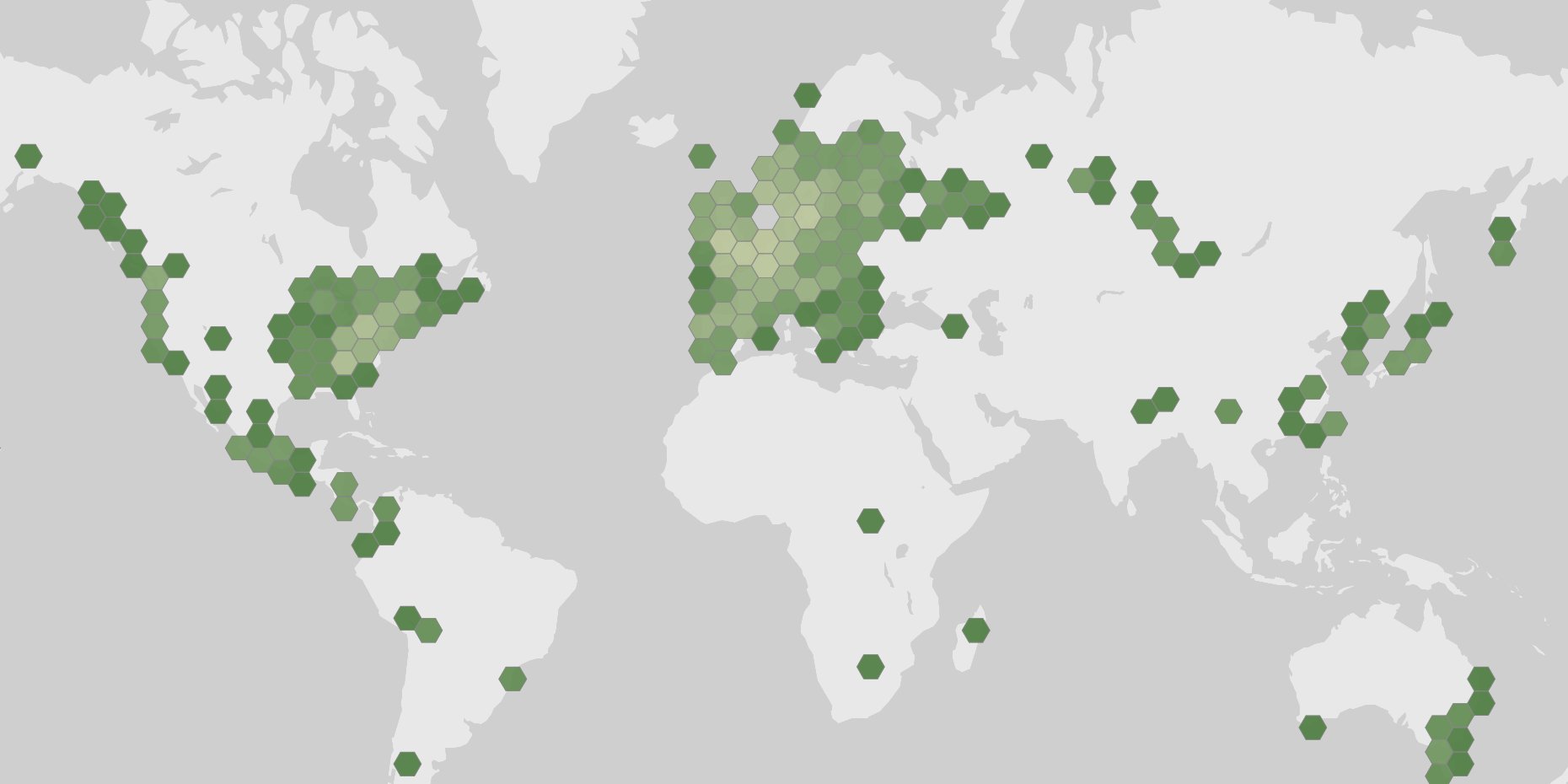
Cordyceps militaris is widely regarded as common and is spread throughout the Northern Hemisphere. In Europe, fruiting bodies typically appear from August through November, coinciding with the cooler, damper conditions of late summer and autumn.
Monthly observation data compiled from citizen-science records show a sharp rise in sightings from July onward, climbing from 542 observations in July to a peak of 4,732 in October, before falling back to 925 by December. Counts stay low through the winter and spring months, bottoming out at 67 in March. Because these figures come from presence observations rather than systematic surveys, they should be read as evidence of when and where the fungus is being noticed rather than as a measure of its actual abundance or the full extent of its range.
The strong autumn peak lines up with the fruiting window reported for Europe, suggesting that most sightings across its range cluster in the same late-summer-to-fall period rather than being spread evenly through the year.
Uses and Cultural History
In much of Asia, Cordyceps militaris is treated as food: the fruiting body is cooked in dishes such as chicken soup, pork bone soup, and hot pot, and it has been approved as a novel food in China. North American field guides take a more cautious view, generally describing it as inedible or only "probably edible."
Its larger cultural weight comes from traditional Chinese medicine, where it has historically been used in support of respiratory ailments, fatigue recovery, libido, and general vitality. Folk stories from Himalayan and Chinese traditions describe herders discovering cordyceps fungi in high pastures, though C. militaris itself played a smaller role in older herbal writings than its more famous relative, Ophiocordyceps sinensis.
Commercially, C. militaris is cultivated on media such as silkworm pupae, rice, and liquid nutrient broths in China, Vietnam, Taiwan, and Indonesia, and it is widely sold as a dietary supplement, though the evidence for its health claims is limited and product quality varies with processing. The fungus produces cordycepin, an adenosine-like compound protected in the fungus by a second compound called pentostatin; pentostatin itself is used medically, under the name Nipent, in chemotherapy for hairy cell leukemia. Researchers have even engineered a transgenic strain of C. militaris capable of growing on cellulose-rich waste to produce cordycepin more efficiently.
Fun Facts
- Cordyceps militaris is the type species of the genus Cordyceps, which now contains several hundred described species.
- It was first named by Carl Linnaeus in 1753 as Clavaria militaris, decades before it was placed in its current genus.
- The fungus sometimes produces an alternate, asexual form resembling the genus Isaria instead of its typical orange club shape.
- Its chemical defense system pairs cordycepin with a second compound, pentostatin, which protects cordycepin from being broken down - and pentostatin itself is used as the chemotherapy drug Nipent for hairy cell leukemia.
- While its relative Ophiocordyceps sinensis became famous enough to be dubbed "Tibet's Golden Worm" by National Geographic, C. militaris held a comparatively minor place in older herbal traditions.
- Scientists have engineered a transgenic strain of C. militaris that can grow directly on cellulose-rich agricultural waste to produce cordycepin.