Coleosporium campanulae is a rust fungus that lives as a plant pathogen, spending its life cycle attached to host plants rather than growing freely in soil or wood. It belongs to the family Coleosporiaceae, within the order Pucciniales, a group of fungi known almost exclusively for causing rust diseases on plants.
As a member of the class Pucciniomycetes within the phylum Basidiomycota, this species is part of a large and specialized lineage of obligate plant pathogens. Its story is tied closely to its host: the campanula, or bellflower, whose bell-shaped blooms have made it a garden favorite across Europe and North America.
Fruiting Body and Identification
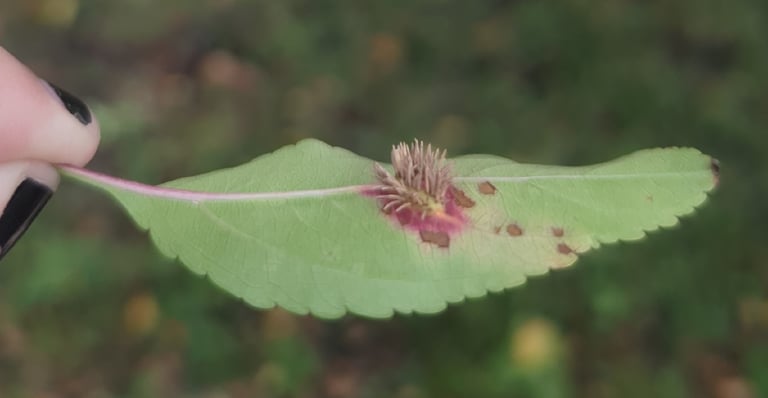
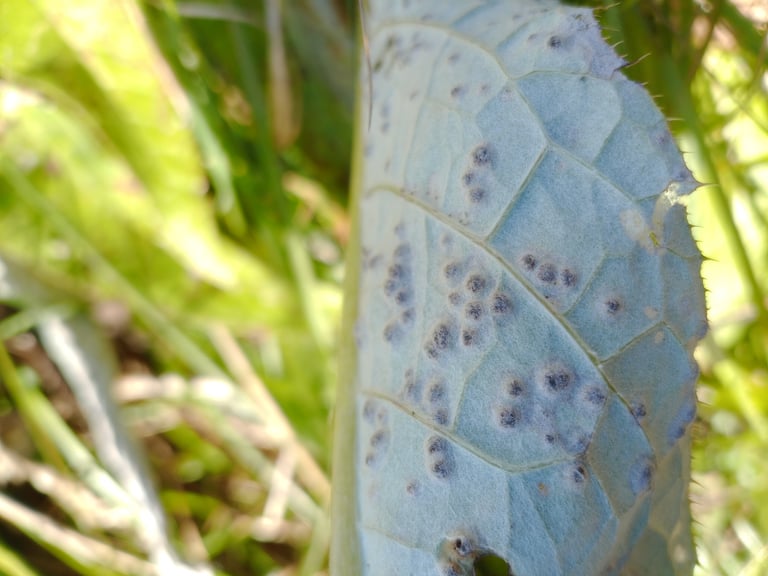
Coleosporium campanulae is identified primarily by its distinctive rust-fungus fruiting structures rather than by a conventional cap-and-stem mushroom body. Instead of gills or pores, this species produces small, powdery pustules that erupt through the surface of host leaves.
These pustules typically appear in clusters and carry a characteristic orange to rust-colored hue, a hallmark of the Coleosporium genus. The powdery texture comes from the mass of spores released from within each pustule as it matures.
As with other rust fungi, the appearance of these structures can shift somewhat as the fruiting bodies age, often becoming more diffuse or duller in color as spores disperse.
Distribution and Habitat
Observation records show Coleosporium campanulae appearing across a wide span of months, but with a pronounced seasonal pattern. Counts rise sharply from spring into early summer, peaking during what appear to be the warmer months, before tapering off through autumn and remaining low over winter.
This pattern likely reflects the growing season of its host plant, the bellflower, since as a rust pathogen the fungus depends on living plant tissue to develop and produce visible signs of infection. The scarcity of records in the coldest months is consistent with a fungus that becomes active and detectable mainly while its host is actively growing.

Uses and Cultural History
The uses associated with Coleosporium campanulae are tied entirely to its host plant rather than the fungus itself. The campanula, or bellflower, originated in southern Europe and has since become widely cultivated as an ornamental plant across North America and other parts of Europe, valued for its distinctive bell-shaped blossoms.
The bellflower carries its own cultural history apart from the rust that infects it. It is sometimes called "Venus's Looking Glass," a name tied to a myth describing a mirror owned by Venus that let her see reflections of beautiful things.
Fun Facts
- In Iceland, the bellflower species Campanula rotundifolia has been found to host at least three different pathogenic fungi, including Coleosporium tussilaginis, alongside Puccinia campanulae and Sporonema campanulae.
- The genus Coleosporium contains roughly 100 species of rust fungi within the family Coleosporiaceae, making it a sizable group among plant pathogens.
Photos
Photographs from via iNaturalist, licensed under CC0 1.0., by carnifex via iNaturalist, licensed under CC BY 4.0., by Aleksei Baushev via iNaturalist, licensed under CC BY 4.0., by Senna Bryce Robeson via iNaturalist, licensed under CC BY 4.0., by Jamie O'Neill via iNaturalist, licensed under CC BY 4.0., by yellowplant via iNaturalist, licensed under CC BY 4.0., by Cole Wolf via iNaturalist, licensed under CC BY 4.0., by Andrey Polstianoi via iNaturalist, licensed under CC BY 4.0., by Михаил Языков via iNaturalist, licensed under CC BY 4.0., and by Jake Dalzell via iNaturalist, licensed under CC BY 4.0., credited on each photo.
Ecology and classification
Classification
- Phylum
- Basidiomycota
- Class
- Pucciniomycetes
- Order
- Pucciniales
- Family
- Coleosporiaceae
- Genus
- Coleosporium
- Species
- Coleosporium campanulae
Sources
- GBIF Species names and classification
- iNaturalist Photos
- Wikidata Common names and conservation status
- Wikipedia Summary extract