A blur of electric blue and orange, gone almost before the eye can register it, is usually the only sign that a common kingfisher has passed by. This small, jewel-toned bird belongs to the kingfisher family Alcedinidae and ranges across Eurasia and North Africa, favoring clear rivers, lakes, and coastal waters. It is resident through much of that range but abandons regions where rivers freeze solid in winter, and the IUCN lists it as Least Concern.
Beyond its speed and color, the species has quietly become a benchmark for river health and a fixture of European myth, its name echoing an ancient Greek legend about calm seas. Few birds pack so much biology and folklore into such a small frame.
Identification and Appearance
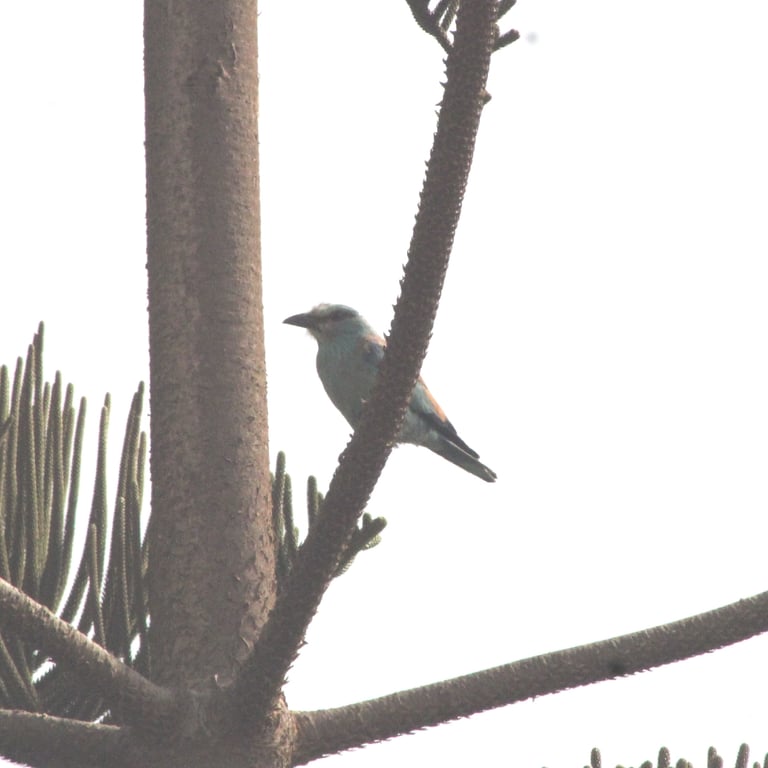
The clearest field mark is not a color or a shape but a flash: in flight, the kingfisher's back throws off an electric-blue shimmer as its short, rounded wings whirr rapidly over the water. Caught still, the bird shows the classic kingfisher build, short-tailed, dumpy-bodied, large-headed, and long-billed, measuring about 16 cm (6.5 in) long with a 25 cm (10 in) wingspan and weighing between 34 and 46 g.
Adult males of the western European subspecies A. a. ispida have green-blue upperparts with a paler azure back and rump, a rufous patch at the base of the bill, and a rufous ear patch. A green-blue stripe runs down the neck, set off by a white neck blaze and throat, while the underparts are rufous. The bill is black with some red at the base, and the legs and feet are bright red. Females look identical except for an orange-red lower mandible tipped in black, a reliable way to sex a bird in the hand or at close range.
Juveniles are duller and greener above, paler below, with an all-black bill and black legs that redden with age. Feathers molt gradually between July and November, and birds that molt late may pause the process during cold winter spells.
Across North Africa, Europe, and Asia north of the Himalayas, no other small kingfisher shares this combination of blue upperparts and rufous underparts. Farther south and east, six similar blue-and-rufous kingfishers occur, but the rufous ear patch separates the common kingfisher from all of them except the juvenile blue-eared kingfisher, where head-pattern details are needed to be certain. Seven subspecies are recognized, differing in the intensity of blue and rufous tones and varying in size by up to 10 percent.
Distribution and Habitat
The common kingfisher occupies a vast range across Europe, Asia, and North Africa, mostly south of 60°N latitude. It breeds commonly through much of Eurasia, while in North Africa it is chiefly a winter visitor, with only a scarce breeding presence along coastal Morocco and Tunisia.
In temperate zones it favors clear, slow-flowing streams and rivers and lakes edged with dense vegetation, hunting from scrub and overhanging branches near shallow open water. In winter it shifts toward the coast, feeding in estuaries, harbors, and along rocky shorelines when inland waters freeze. Tropical populations occupy slow rivers, mangrove creeks, and swamps, as seen in Bangladesh.
Where winters bring prolonged freezing, birds migrate, mostly at night, wintering within the southern part of the breeding range; smaller numbers cross the Mediterranean into Africa or pass over Malaysia's mountains into Southeast Asia. Some Siberian breeders travel at least 3,000 km (1,900 mi) between nesting grounds and wintering sites.
Monthly observation counts, which reflect presence rather than true abundance, peak in September and January (around 292,000 and 297,000 records) and dip sharply in June, near 112,000. That pattern likely reflects reduced visibility of birds tied to nest burrows during the breeding months rather than a real population dip.

Behavior and Lifestyle
Territoriality dominates the common kingfisher's life, driven by the need to consume roughly 60 percent of its body weight in food daily. A bird will defend its stretch of water even from its own mate and grown offspring, and for most of the year individuals live and roost alone in heavy cover close to a favored hunting perch.
When a rival enters its territory, two kingfishers will perch some distance apart and display beak and plumage at one another; disputes occasionally escalate into fights where one bird grabs the other's bill and tries to hold it underwater. Flight is fast and direct, low over the water, with wingbeats rapid enough to blur into a haze of blue.
Survival is precarious. Fledglings risk drowning during their first dives, only about four days after leaving the nest, and many die before mastering fishing; roughly half of young birds survive more than a week or two after being driven from their parents' territory. Only about a quarter of juveniles live to breed the next year, and adult survival between breeding seasons is similarly around one in four, though the oldest recorded bird reached 21 years. Cold winters, summer floods that wreck nests or hamper fishing, collisions, predation by cats and rats, and pollution from industrial and agricultural runoff all take a toll, the last of these excluding kingfishers from otherwise suitable rivers.
Historically, the species also suffered direct persecution: Victorians killed birds for stuffing in display cases and for hat-making, anglers targeted them for feathers used in fishing flies, and one English folk custom involved hanging a dead kingfisher by a thread to predict wind direction. These practices have largely ended.
Communication
The common kingfisher's signature sound is a short, sharp whistled chee, repeated two or three times, most often heard as a flight call announcing its presence along a waterway. It has no true song. An anxious bird gives a harsher shrit-it-it, while nestlings beg for food with a churring call.
During courtship, a male whistles loudly and repeatedly while chasing a female through the trees, a display that combines vocal and visual signaling. Territorial encounters rely on visual display as well, with rivals showing off beak and plumage from separate perches before any physical confrontation.
The species' most striking communication tool, though, is sensory rather than vocal: its eyes can polarize light to cut reflection off water and compensate for refraction, sharpening its view of prey below the surface. At the instant of a dive, a membrane covers the eyes entirely, and the bird relies on touch alone to time the snap of its bill shut on the fish.
Hunting and Diet
Hunting begins from a fixed perch, anywhere from a few centimeters to several meters above the water, from which the kingfisher watches for movement below. On spotting prey it plunges in, seizes the fish, and flies straight back out; where no perch is available, it will instead hover over the water to search. Back on its perch, it kills or stuns the catch by whacking it repeatedly against the branch, tail-first, an important step when the prey has spines, then swallows it head-first and later regurgitates a pellet of indigestible bone.
Fish make up the bulk of the diet, 60 to 67 percent by most estimates, supplemented by aquatic crustaceans such as Gammarus fasciatus, which contribute 5 to 33 percent, along with small arthropods and other marine invertebrates. In winter, when inland waters may freeze, birds shift toward coasts and estuaries and add crabs and other small marine animals to the menu.
Nesting and Breeding
Courtship opens with the male chasing the female through the trees while whistling continuously, followed by ritual feeding before mating occurs. Pairs form in autumn but each bird keeps a separate territory, at least 1 km (0.6 mi) long and sometimes up to 3.5 km (2.2 mi), only merging them once breeding begins in spring, typically around mid-March.
Both members of the pair excavate the nest burrow together, favoring steep banks along a water source and digging into clay, rock, or sandy soil. The straight, gently sloping tunnel usually runs 60 to 90 cm (25 to 35 in) long, though depths up to 1.2 m have been recorded, ending in an unlined chamber that gradually fills with fish remains and cast pellets. Nest entrances sit anywhere from 0.5 to 37 meters above the water.
A clutch numbers two to ten glossy white eggs, typically six or seven, each about 2.2 cm long and weighing roughly 4.3 g. Both parents incubate by day, but only the female does so at night, and the eggs hatch after 19 to 21 days. The altricial chicks are fed by both parents, with the female doing most of the work, each fish delivered head-first and sized precisely for the chick swallowing it. Young fledge after 23 to 27 days, coming to the burrow entrance to be fed as they near departure, and pairs typically raise two to three broods between April and October.
Population and Ecological Role
Common kingfisher numbers fluctuate sharply from year to year, driven mainly by winter severity rather than any long-term decline. A Belgian census illustrates the swing well: a severe winter left only eight breeding pairs, which rebounded to 45 pairs five years later before settling back to 25 the following year. In Europe alone, the population is estimated at 160,000 to 320,000 individuals, and global trends, while not precisely quantified, appear stable.
Ecologically, the species sits high in freshwater food chains as an important predator of small fish, and its presence or absence is treated as a practical gauge of water quality: because kingfishers feed directly on aquatic animals, they are quickly affected by toxins building up in a river system, so a healthy population usually signals a healthy waterway.
Conservation and Threats
The IUCN rates the common kingfisher as Least Concern, reflecting an enormous global range, estimated at 10,000,000 km2 (3,900,000 sq mi) of extent of occurrence, and a large population that shows no sign of approaching the 30 percent decline over ten years or three generations that would trigger a higher threat category.
The most severe pressure remains weather-driven mortality, with hard winters capable of wiping out most of a local population in a single season, though numbers typically recover within a few years given suitable habitat. River pollution from industrial and agricultural sources poses a more persistent threat, building up in the fish the birds eat and excluding them from otherwise suitable stretches of water. Habitat engineering is another concern: replacing natural banks with artificial hard confinement, done to improve water flow, sharply reduces populations of fish, amphibians, and reptiles the kingfisher depends on, and displaces the birds along with them. Direct persecution, once significant through Victorian-era hunting for feathers and taxidermy, has largely disappeared, and the species carries no special protective status under CITES or the US Migratory Bird Act, needing none given its current numbers.
Conservation status
- LC
- NT
- VU
- EN
- CR
Least Concern
Cultural Significance
The bird's scientific name carries an old tragedy: in Greek mythology, Alcyone, daughter of the wind-king Aeolus, was transformed into a kingfisher after her husband Ceyx drowned on a sea voyage. From that story comes the English phrase "halcyon days," describing periods of calm the kingfisher was once believed to bring over the water, an association with peace and tranquility that still clings to the species today.
That symbolism has carried into modern institutions as well: the European Central Bank's Motifs Advisory Group shortlisted a "kingfisher in a waterfall or run-pool" as a potential design for the redesigned €10 banknote of the 2020s, pairing the bird with an image of the European Commission building on the reverse. Beyond imagery, parts of the bird have historically been valued as a source of material, one of the more practical ways humans have made use of the species.
Fun Facts
- The genus name Alcedo traces back to the Greek myth of Alcyone, a woman transformed into a kingfisher after her husband Ceyx drowned at sea.
- The English phrase "halcyon days" comes from that same legend, evoking the calm waters kingfishers were once believed to summon.
- Seven subspecies of the common kingfisher are recognized across its Eurasian and Southeast Asian range, with plumage brightness and body size varying by as much as 10 percent between them.
- A translucent membrane slides over the kingfisher's eyes the instant it plunges underwater, so it must time the snap of its bill by touch alone.
- The European Central Bank shortlisted a "kingfisher over a waterfall" design as a possible motif for the redesigned €10 banknote.
- Feathers from this bird were once used to tie fishing flies and to stuff for Victorian display cases, practices that have since largely ended.
Ecology
Habitat
- Wetland
- Marine
- Coastal
- Freshwater
Behavior
- Predator
- Solitary
- Territorial
- Diurnal
Diet
- Piscivore
Photos
SourcesGBIFiNaturalistWikidataWikipediaEncyclopedia of LifeAnimal Diversity WebAnAge