The violet webcap owes its name to a coloration so dark and saturated that it looks almost artificial against the forest floor: a near-black violet that sets it apart from every other mushroom it grows beside. Few fungi carry a single hue as dominant as this one, from the cap's downy surface down through the gills and into the flesh of the stalk.
First described by Carl Linnaeus in 1753, Cortinarius violaceus (commonly the violet webcap or violet cort) belongs to the family Cortinariaceae within the order Agaricales. It is a fungus of forest floors across the Northern Hemisphere, forming partnerships with trees rather than living independently. Taxonomists have long debated its boundaries: populations favoring pines are sometimes split off as C. hercynicus, and several other lookalike populations in the Americas, Australia, and Southeast Asia have since been described as distinct species entirely. That ongoing taxonomic untangling is part of what makes this mushroom worth a closer look.
Fruiting Body and Identification
The single most reliable clue to this species' identity is its color: a dark violet to blue-black shade that runs through nearly every part of the fruiting body, cap, gills, stalk, and even the inner flesh. The cap itself starts convex and broadens with age to become flat or umbonate, spanning 3.5 to 15 centimeters across, with an incurved margin and a covering of fine, downy scales called the pileipellis. Unlike many of its Cortinarius relatives, this cap surface is neither sticky nor slimy, though it can feel slightly greasy.
The stipe stands 6 to 18 centimeters tall and 1 to 2 centimeters thick, swelling at the base to as much as 4 centimeters wide. It shares the cap's dark violet tone and is covered in wool-like fibrils, sometimes with purple mycelium visible at the base. Young specimens carry a veil, but it disappears quickly as the mushroom matures. The flesh is violet throughout, darkening further just beneath the cap surface and inside the stem, with a mild taste and a faint, pleasant smell reminiscent of cedar wood.
The gills are dark violet when young, fading to purplish-brown with age, and attach to the stalk in an adnate fashion. A distinctive chemical reaction helps confirm identification: the mushroom's flesh stains red when touched with potassium hydroxide (KOH). Under the microscope, the spore print is rust-colored, with rough, elliptical to almond-shaped spores measuring 12 to 15 by 7 to 8.5 micrometers. This species is unique within Cortinarius for having cystidia on both the faces and edges of its gills, flask-shaped structures with purplish contents measuring 60 to 100 by 12 to 25 micrometers.
Distribution and Habitat
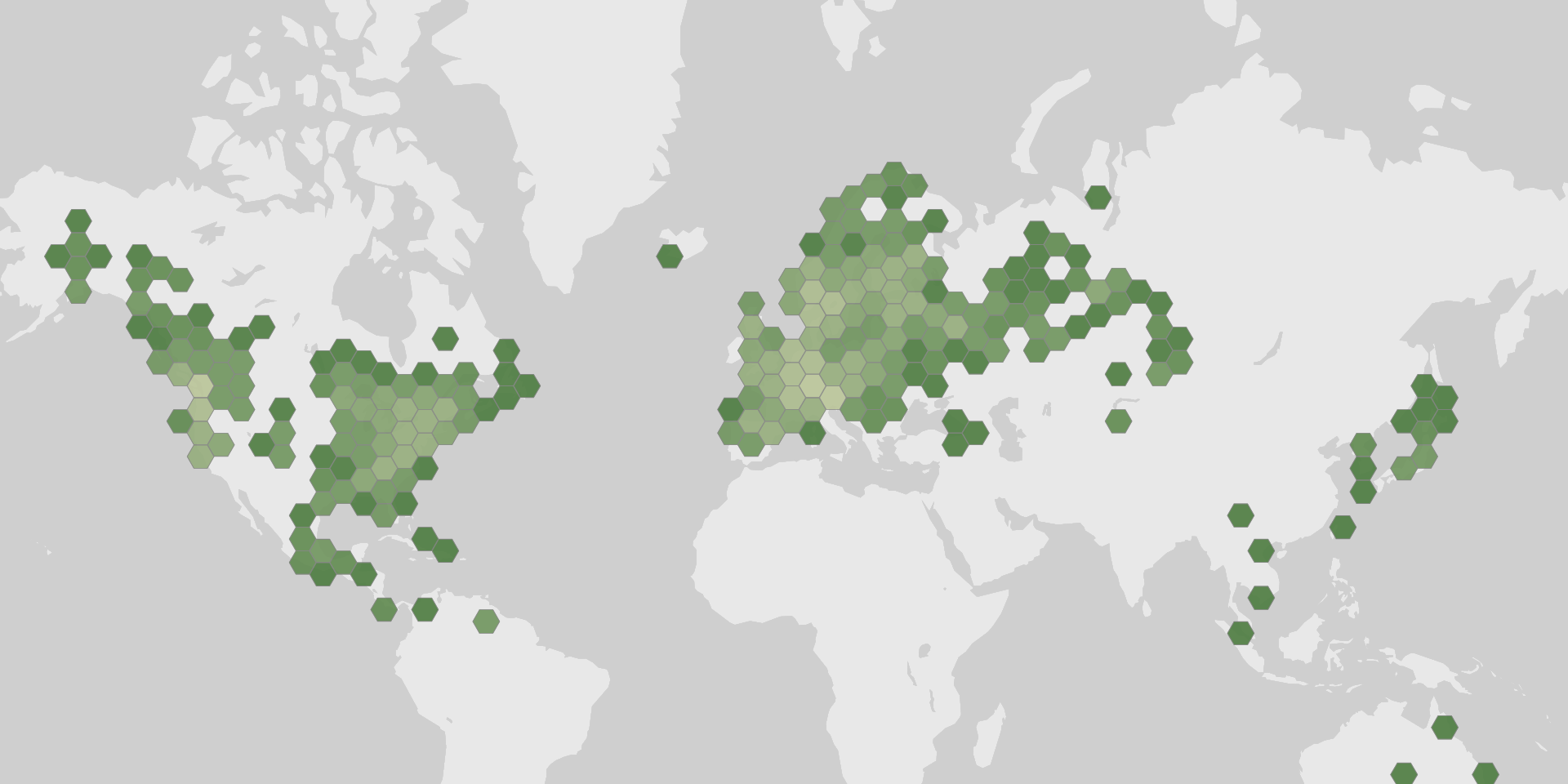
The violet webcap grows across North America, Europe, and Asia, but its abundance varies sharply by region. It is widespread yet uncommon throughout Europe and is listed as endangered in the British Isles, while forming only a rare component of subarctic habitat in western Greenland. In North America, it favors conifer forests and is rare over most of the continent, though it turns up more reliably in old-growth stands of the Pacific Northwest, including Mount Rainier and Olympic National Parks.
In Europe, the species fruits during autumn in deciduous woodland, especially among oak, birch, and beech, and occasionally alongside conifers or on treeless heathland with bracken. It prefers acidic soil and forms mycorrhizal partnerships with its host trees, exchanging carbon from the plant for minerals from the soil. In Nordic countries, its known hosts include white birch, silver birch, European aspen, and rarely European beech, with no confirmed oak associations recorded there; in Central and Southern Europe it also partners with hazelnut. Some populations described as ssp. hercynicus grow with Norway spruce in more alkaline soils alongside mosses such as Hylocomium and Pleurozium.
In North America, fruit bodies appear singly, in small groups, or occasionally in fairy rings, often near rotting wood, and have colonized regrowth forest of fir, pine, aspen, and alder around the Great Lakes region. GBIF observation data show a strong seasonal peak, with counts climbing from a few dozen in midwinter to well over 4,000 in September and October before dropping off sharply by December, a pattern consistent with a late-summer to autumn fruiting season, though these figures reflect observation activity rather than true population size. Closely related, lookalike species occupy similar niches in Central and South America, Australia, New Zealand, Papua New Guinea, and Malaysia.
Fun Facts
- Cortinarius violaceus serves as the type species for the entire genus Cortinarius, meaning it is the reference species against which the whole genus is defined.
- Its cap can grow from as small as 5 centimeters up to 15 centimeters across, making it one of the larger and more conspicuous mushrooms in its genus.
- In some cultures, the mushroom's uncommon violet coloring has inspired myths linking it to mystical forest spirits.
- Despite widespread occurrence across the Northern Hemisphere, the species has proven difficult to classify consistently, leading to repeated splits into new species such as C. hercynicus, C. palatinus, and C. neotropicus.
Ecology
Habitat
- Forest
- Woodland