Agaricus bitorquis is strong enough to push its way up through asphalt and paving slabs, often maturing underground before it ever breaks the surface. This habit has earned it the common names pavement mushroom, urban agaricus, and torq.
It is an edible white mushroom in the family Agaricaceae, closely related to the common button mushroom sold in supermarkets. The IUCN lists it as Least Concern. Beyond its toughness, the species is notable for its unusual double-ringed stem and its long history as a candidate for commercial cultivation.
Fruiting Body and Identification
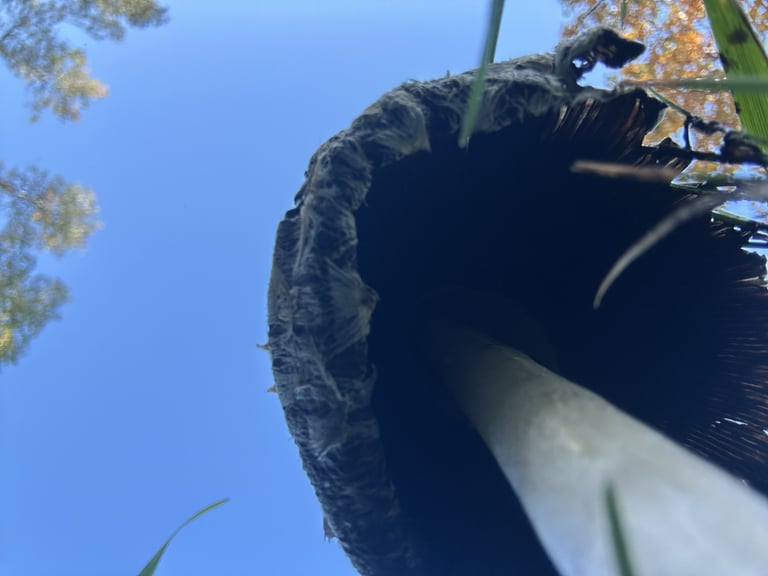
The most distinctive identifying feature of Agaricus bitorquis is its stem, which carries two separate rings: a thick, funnel-shaped ring higher up and a thinner, skirt-like ring below it. This double-ring arrangement is unusual among Agaricus species and gives the mushroom its name, bitorquis, meaning "twice-belted."
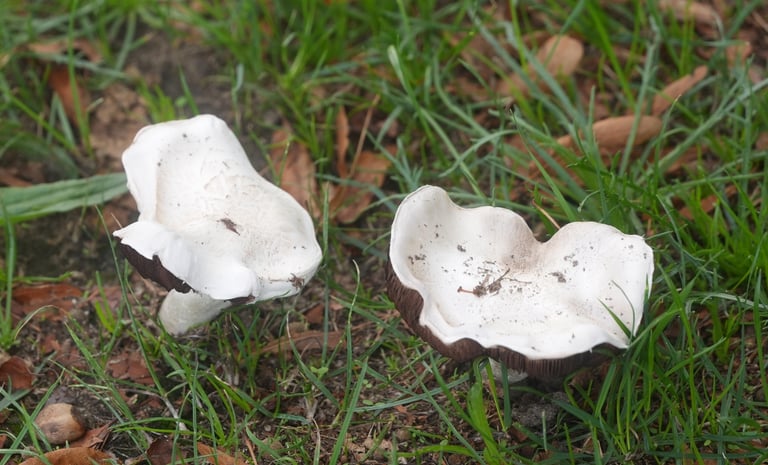
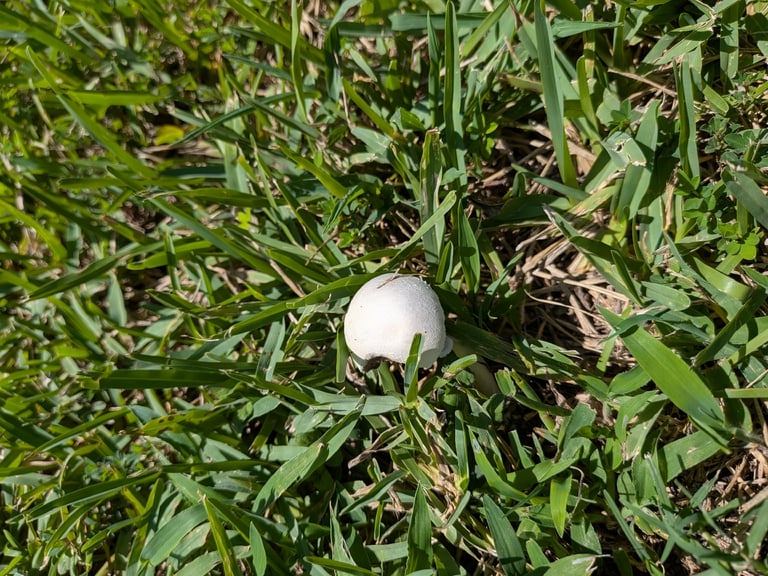
The cap is dry, smooth, and white, though it stains yellowish with age. It measures 4 to 18 centimeters across and ranges from convex to flat, frequently carrying flecks of soil since the mushroom often pushes up through hard ground. The gills underneath are free, narrow, and closely spaced, starting light pink in young specimens and darkening to a deep reddish-brown as the spores mature; the spore print itself is chocolate brown.
The stipe is 3 to 11 centimeters long and 1 to 4 centimeters thick, cylindrical to club-shaped and stout, white and smooth, with a thick sheath of white mycelium near the base in addition to its paired rings. The flesh is solid and firm with a mild odor. Under magnification, the elliptical basidiospores measure 5 to 7 by 4 to 5.5 micrometers, and the basidia, mostly four-spored but often two-spored, measure 20 to 25 by 6.5 to 8.5 micrometers, with numerous cystidia present.
Agaricus bitorquis is often confused with Agaricus bernardii, which has a distinctive briny smell, and it also resembles Agaricus campestris, though that species carries only a single, fragile ring rather than the two sturdy rings seen here.
Distribution and Habitat
Agaricus bitorquis grows solitary or in small, gregarious groups in gardens and along roadsides, most often directly in pavement, frequently in places where road salt is applied to combat winter ice. Its subterranean habit means it can mature underground before pushing up through asphalt and paving slabs.
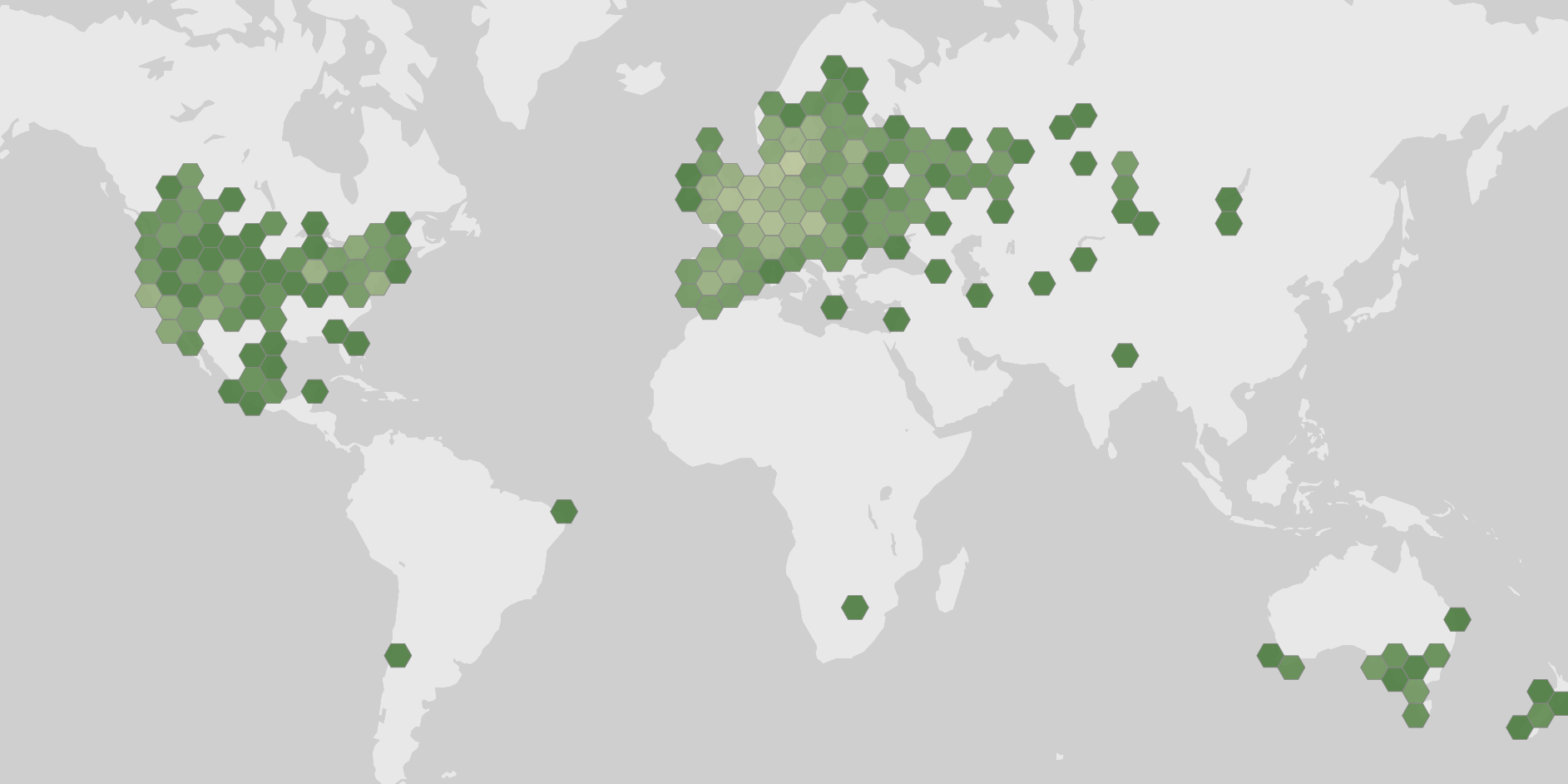
The species is occasional across North America, Europe, Asia, and Australia, favoring disturbed, compacted urban ground over undisturbed woodland soil. Observation records show a sharp seasonal pattern, with counts rising steeply from spring and peaking between May and September, before tapering off through autumn and dropping to low numbers in winter. This points to a strong warm-season fruiting pattern, though these figures reflect where the mushroom has been recorded, not its true abundance or the full extent of its range.
Uses and Cultural History
Agaricus bitorquis has been grown commercially since 1968, when cultivators began looking at it as an alternative to the standard button mushroom, Agaricus bisporus. Several traits made it attractive for production: it resists various viral diseases better than A. bisporus, tolerates higher growing temperatures and carbon dioxide concentrations, and withstands bruising more effectively during handling.
More recently, growers have developed high temperature-resistant strains of the species. These strains help address a practical problem in mushroom farming: the cost and difficulty of cooling production rooms during hot summer months, when maintaining conditions suited to A. bisporus becomes expensive.
Fun Facts
- Lucien Quélet named this mushroom Psalliota bitorquis in 1883, and Italian mycologist Pier Andrea Saccardo transferred it to the genus Agaricus in 1887.
- It goes by many common names, including torq, banded agaric, spring agaric, banded agaricus, urban agaricus, and pavement mushroom.
- The current scientific name, Agaricus bitorquis, supersedes an older name, Agaricus rodmani.
- It can push up through asphalt and paving slabs, sometimes maturing entirely underground before it surfaces.
- Commercial cultivation of the species began in 1968, making it one of the earlier alternatives explored to the standard button mushroom.
Photos
Photographs from via iNaturalist, licensed under CC0 1.0., by Kaylee Martig via iNaturalist, licensed under CC BY 4.0., by rainerburkard via iNaturalist, licensed under CC BY 4.0., by earl woolsey via iNaturalist, licensed under CC BY 4.0., by imaginaryconstruct via iNaturalist, licensed under CC BY 4.0., by Ken Buegeleisen via iNaturalist, licensed under CC BY 4.0., by nuthatchnicole via iNaturalist, licensed under CC BY 4.0., and by Heather Alice-Grace Orchard via iNaturalist, licensed under CC BY 4.0., credited on each photo.
Ecology and classification
Classification
- Phylum
- Basidiomycota
- Class
- Agaricomycetes
- Order
- Agaricales
- Family
- Agaricaceae
- Genus
- Agaricus
- Species
- Agaricus bitorquis
Sources
- GBIF Species names and classification
- iNaturalist Photos
- Wikidata Common names and conservation status
- Wikipedia Summary extract