Within hours of being picked, this mushroom digests itself, its gills liquefying into a pool of black ink. That startling transformation gives Coprinus comatus its common names: shaggy ink cap, lawyer's wig, and shaggy mane.
It belongs to the family Agaricaceae in the phylum Basidiomycota, and its fruiting bodies begin as slender white cylinders that push up from the ground before opening into bell-shaped caps. The IUCN lists the species as Least Concern, reflecting its wide distribution and abundance in grasslands and disturbed soils. Beyond its odd appearance, its rapid life cycle and unusual ecological habits make it one of the more distinctive fungi encountered in temperate landscapes.
Fruiting Body and Identification
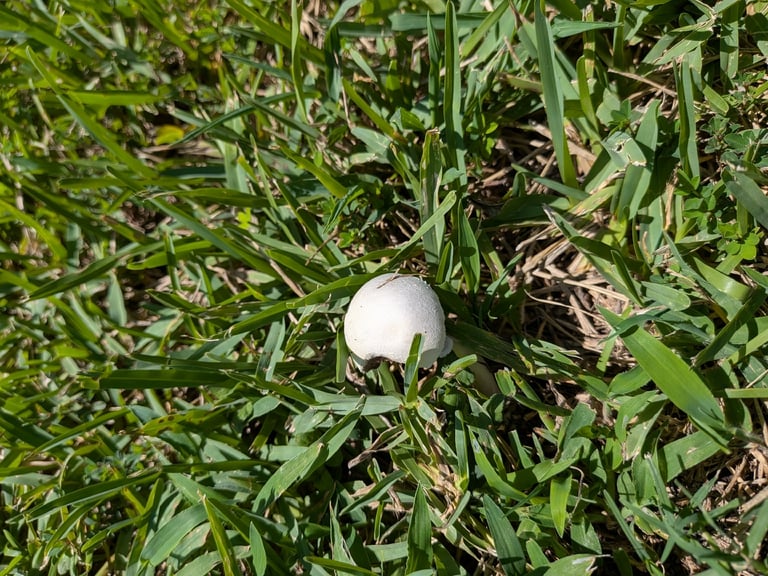
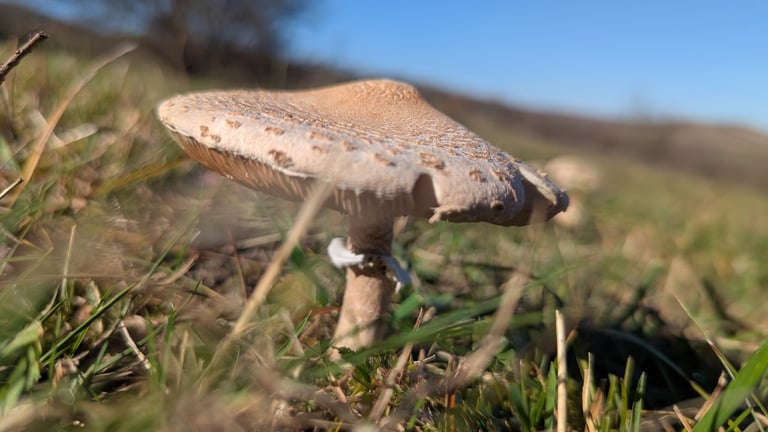
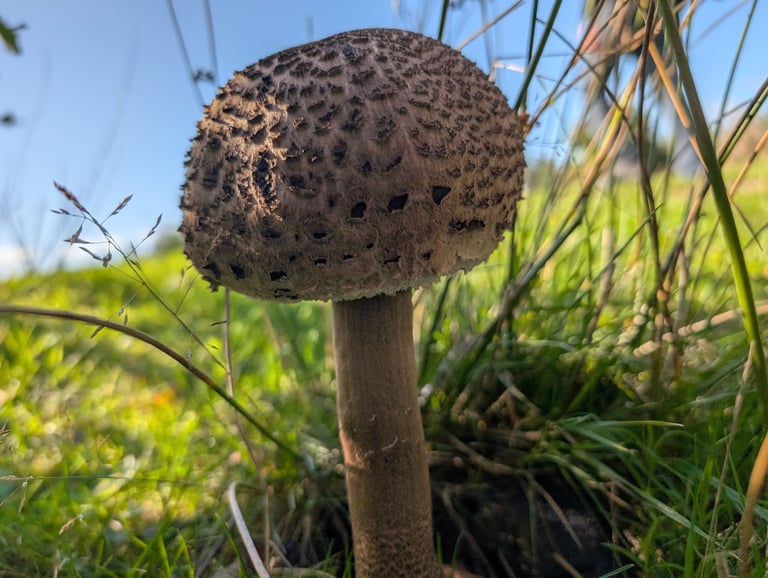
The most reliable identifying feature is the cap's shape: almost cylindrical when young, it covers most of the stem before opening into a bell. It measures 4–8 cm wide and 6–20 cm tall, mostly white, and covered in shaggy scales that turn pale brown toward the apex.
Beneath the cap, the free gills shift color in sequence, from white to pink and finally to black, as they deliquesce into an inky, spore-laden liquid, the source of the "ink cap" name. The stipe is white, fairly thick, and hollow, standing 6–40 cm high and 1–2.5 cm in diameter, with a loose ring near its base. The flesh is white with a mild taste, and under the microscope the mushroom lacks pleurocystidia. Its spore print is black-brown, with spores measuring 10–13 by 6.5–8 μm.
Distribution and Habitat
Coprinus comatus grows directly on soil, favoring lawns, grassy verges along roads and paths, and other disturbed ground. It fruits in groups across grasslands and meadows in North America and Europe, appearing in the United Kingdom from June through November.
The species has also been introduced beyond its native range, having established populations in Australia, New Zealand, and Iceland. GBIF presence records show observations spread across the year but concentrated heavily from August through October, with counts climbing from a few thousand in midsummer to tens of thousands in September before tapering off by winter. These figures reflect where and when the species has been recorded, not its true abundance or the full extent of its range, but the pattern is consistent with a mushroom that fruits most heavily in late summer and autumn.

Ecology and Relationships
Coprinus comatus grows on soil in grasslands, lawns, and disturbed ground, often along roadsides and paths, where it typically fruits in groups. Its ecological role extends beyond breaking down organic matter in soil: the species is nematophagous, meaning it actively kills and digests roundworms.
It has been documented killing and digesting the nematode species Panagrellus redivivus and Meloidogyne arenaria, the latter a plant-parasitic root-knot nematode. This predatory capability sets it apart from most mushrooms encountered on lawns and meadows, linking its presence in disturbed soils to a subtler role in regulating soil-dwelling invertebrate populations.
Uses and Cultural History
In Australia, Coprinus comatus is common enough to have been featured on a postage stamp issued by Australia Post in 1981, a sign of its familiarity and cultural visibility in regions where it has become established.
Fun Facts
- The mushroom's sudden appearance after rain has fed folklore in many cultures, where it has been regarded as a magical entity that seems to sprout overnight.
- Liquefied Coprinus comatus is said to have been used as writing ink as far back as George Washington's day.
- Beyond decomposing organic matter, this mushroom actively kills and digests nematodes, an unusual predatory trait for a fungus best known for its ink-like dissolution.
Conservation status
- LC
- NT
- VU
- EN
- CR
Least Concern
Ecology
Behavior
- Predator
Habitat
- Grassland
- Urban
- Disturbed Ground