The pink lady's slipper tricks its pollinators, offering bees no nectar or food reward at all, yet it still manages to reproduce through sheer deception.
Also known as the moccasin flower, Cypripedium acaule is a perennial orchid native to eastern North America, where it grows in forests from the Great Lakes and Northeast down through the Appalachians to Alabama. It carries a status of Least Concern overall, though some individual regions report it as rare or vulnerable.
Beyond its striking pink pouch, the species holds cultural weight as the provincial flower of Prince Edward Island and the state wildflower of New Hampshire, and its finicky relationship with soil fungi and acidity makes it one of the more demanding orchids to understand or grow.
Identification and Appearance
The single pink pouch, split by a distinctive slit running down the front rather than a round opening, is the easiest way to recognize Cypripedium acaule among lady's slippers.
The plant stays low, reaching only about 0.4 meters in height, and produces just one flower per season on a long, pubescent stalk. Two large, plicate, elliptical leaves grow near the ground, opposite each other, with the flowering stalk emerging between them.
Color varies: the sepals and petals range from yellowish-brown to maroon, while the pouch itself is usually some shade of pink but can appear white to nearly magenta. Flowering occurs between April and June, after which the plant goes dormant following fruiting.
The front-slit opening of the pouch sets this species apart from most other Cypripedium species, which typically have a round opening instead.
Distribution and Habitat
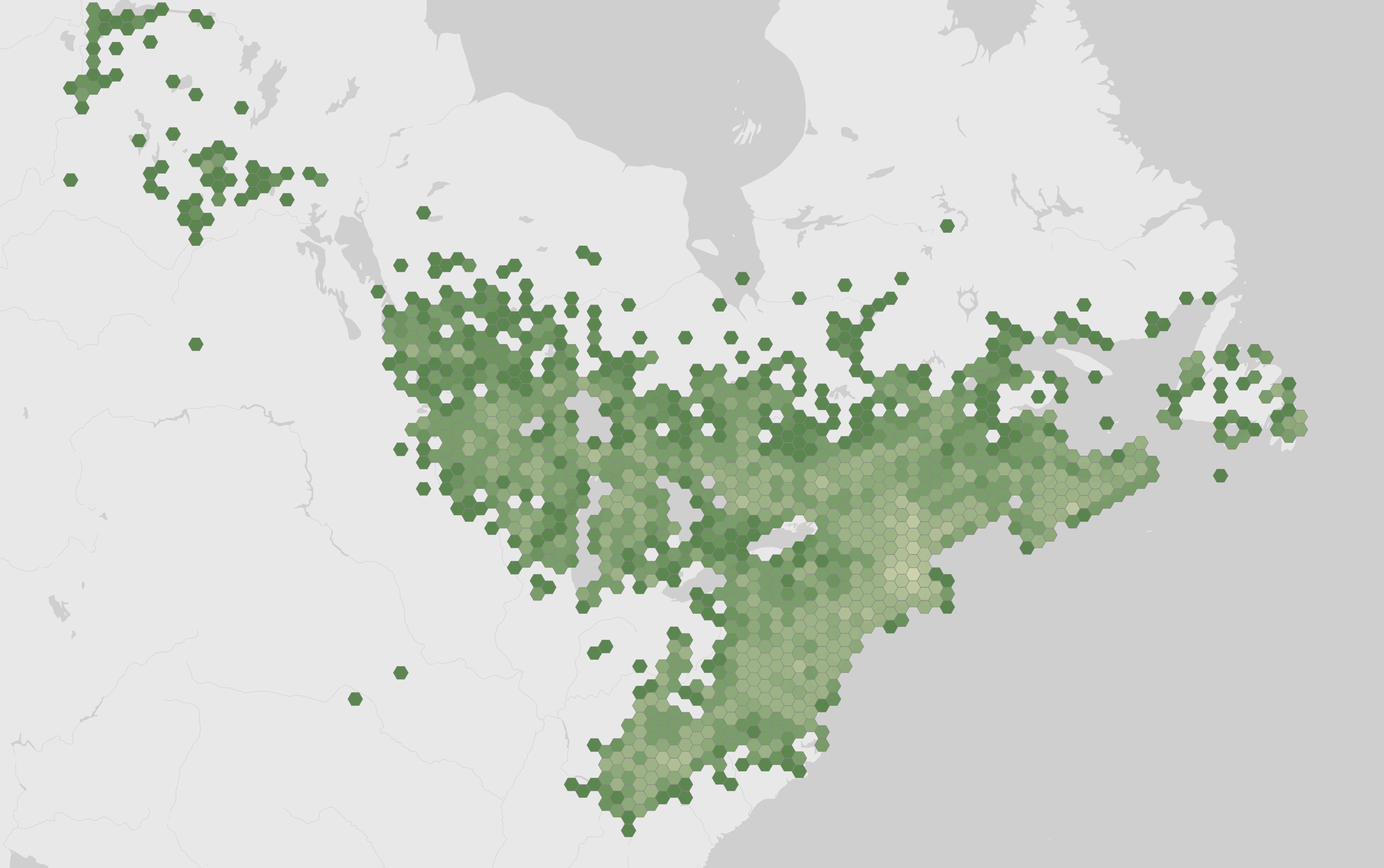
Cypripedium acaule occurs across the eastern third of the United States, concentrated in the Great Lakes region and the Northeast, and extending south along the Appalachians into Alabama. It is widespread in Canada, found in every province except British Columbia, as well as in the Northwest Territories and Saint Pierre and Miquelon.
Within this range the species occupies a wide variety of environments, from coastal plains and pine barrens to mountaintops. It favors highly acidic soil and tolerates a range of shade and moisture conditions, though it prefers at least partial shade and well-drained slopes. Large colonies often form in pine forests with sandy soils, though it also grows in deciduous woods.
Because it is highly sensitive to shade levels and soil disturbance, the species is classified as a forest habitat specialist, tied to shaded, mature forest conditions. Canopy removal and disturbance to the forest floor or soil can reduce habitat suitability by altering shade, moisture, and the mycorrhizal associations the plant depends on.
Observation records suggest a strong seasonal peak in presence during spring, consistent with its April to June flowering period, though these records reflect sightings rather than actual population numbers. Regionally, the species is considered endangered in Illinois and Tennessee, Vulnerable in New York, and Unusual in Georgia.
Growth and Form
Cypripedium acaule grows as a rhizomatous geophyte, spreading and persisting through an underground rhizome rather than above-ground stems. This growth form allows the plant to survive dormancy each year after its brief flowering and fruiting period ends.
Reproduction and Life Cycle
Pollination in Cypripedium acaule depends entirely on deception, since the flower offers no nectar or food reward to the bees it attracts. Color, shape, and scent lure insects into the pouch, which functions as a one-way trap: once inside, a bee must crawl past the stigma, depositing pollen it carries from earlier flowers, before reaching the anther to pick up fresh pollen on its way out.
The two bee species most frequently observed visiting the flowers are Bombus vagans and Bombus borealis queens, suggesting that queen bumblebees serve as the primary pollinators. Because the flowers offer nothing in return, bees tend to stop visiting them after learning there is no reward, which likely limits pollination success. Self-pollination can occur, but only if the same pollinator happens to re-enter the same flower.
Once pollination succeeds, the ovary develops into an oblong, pointed-tipped green seed pod. The pod stays green until temperatures drop, at which point it splits open and releases tiny, powdery seeds resembling white pepper.
Uses and Human Relationships
Indigenous peoples, including the Algonquin, traditionally used Cypripedium acaule for medicinal purposes. Over time, the plant's common name shifted from earlier Indigenous terminology to "lady's slipper," a term borrowed from European usage, and nineteenth-century poets such as William Bryant used the moccasin flower as a symbol of death, applied both to individuals and, more broadly, to Native American culture. The species also appears in regional folklore, tied to the eerie legend of the Jersey Devil in New Jersey.
Today the plant holds formal recognition as the provincial flower of Prince Edward Island and the state wildflower of New Hampshire. Commercial availability has grown somewhat thanks to seed germination labs, though the species remains less common in cultivation than other Cypripedium species and hybrids, largely because of the intensive soil and fungal conditions it requires to survive outside its natural habitat.
Fun Facts
- The name Cypripedium acaule derives from Latin and Greek roots roughly translating to "Venus's shoe."
- During the Victorian era, the pink lady's slipper was mistakenly declared extinct after it disappeared from certain areas, even though it survived elsewhere.
- Among roughly fifty varieties of lady's slippers, the pink form is considered one of the rarest.
Photos
Photographs from via iNaturalist, licensed under CC0 1.0., by Matt Berger via iNaturalist, licensed under CC BY 4.0., by Steven Lamonde via iNaturalist, licensed under CC BY 4.0., by Josh Ebbin via iNaturalist, licensed under CC BY 4.0., by Rachel Stepek via iNaturalist, licensed under CC BY 4.0., by Cy Stavros via iNaturalist, licensed under CC BY 4.0., by Charlie Pavlisich via iNaturalist, licensed under CC BY 4.0., by Bob Schwartz via iNaturalist, licensed under CC BY 4.0., by Keith Wauthy via iNaturalist, licensed under CC BY 4.0., by Daniel Washburn via iNaturalist, licensed under CC BY 4.0., by Brandon Corder via iNaturalist, licensed under CC BY 4.0., and by Shelby Lyn Sanders via iNaturalist, licensed under CC BY 4.0., credited on each photo.
Ecology and classification
Habitat
Growth habit
- Herb
Classification
- Phylum
- Tracheophyta
- Class
- Liliopsida
- Order
- Asparagales
- Family
- Orchidaceae
- Genus
- Cypripedium
- Species
- Cypripedium acaule
Sources
- GBIF Species names and classification
- iNaturalist Photos
- Wikidata Common names and conservation status
- Wikipedia Summary extract
- Plants of the World Online Native range, life form and climate (WCVP)