The early-purple orchid tricks its pollinators rather than rewarding them: its flowers produce no nectar at all, surviving instead on visual deception that lures bees and wasps into visiting anyway.
Orchis mascula, known as the early-purple orchid or early spring orchis, is a perennial herb in the orchid family, Orchidaceae. It grows across a wide swath of Europe, North Africa, and the Middle East, flowering in the first warm weeks of spring after most other orchids are still dormant. Beyond its ecological trickery, the plant carries a long thread of human history behind it: its tubers were once ground into a starchy flour, and its very name comes from Greek myth.
Identification and Appearance
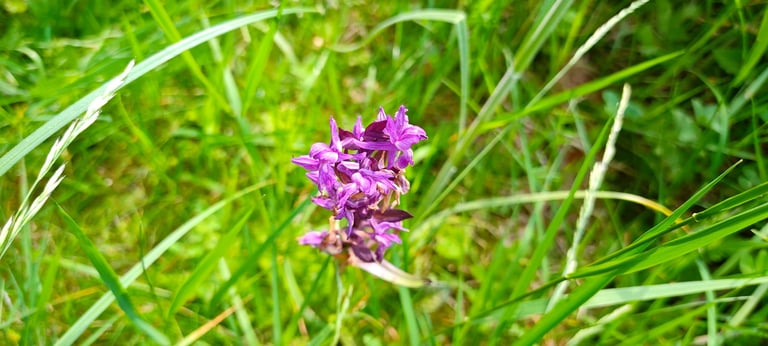
The single best field mark is timing combined with color: a dense, cylindrical spike of 6 to 20 pinkish-purple to purple flowers appearing from April to June, before many other orchids bloom. Each flower measures about 2.5 centimeters (1 inch) across.
The plant stands 50 to 60 centimeters (20 to 24 inches) tall on a stem that is green at the base and flushes purple toward the tip. Two rounded to ellipsoid tubers anchor the root system below ground. Leaves cluster at the base of the stem, oblong-lanceolate in shape, pale green, and sometimes marked with brownish-purple speckles.
Within each flower, the lateral sepals stand erect and are ovate-lanceolate, while the smaller median sepal and petals fold over the gynostegium like a hood. The labellum, or lip, is three-lobed and convex with crenulated edges, pale at its base and dotted with purple-brown spots. A cylindrical or club-shaped spur projects horizontally or angles upward behind the flower, and short reddish-green anthers sit within the gynostegium.
Distribution and Habitat
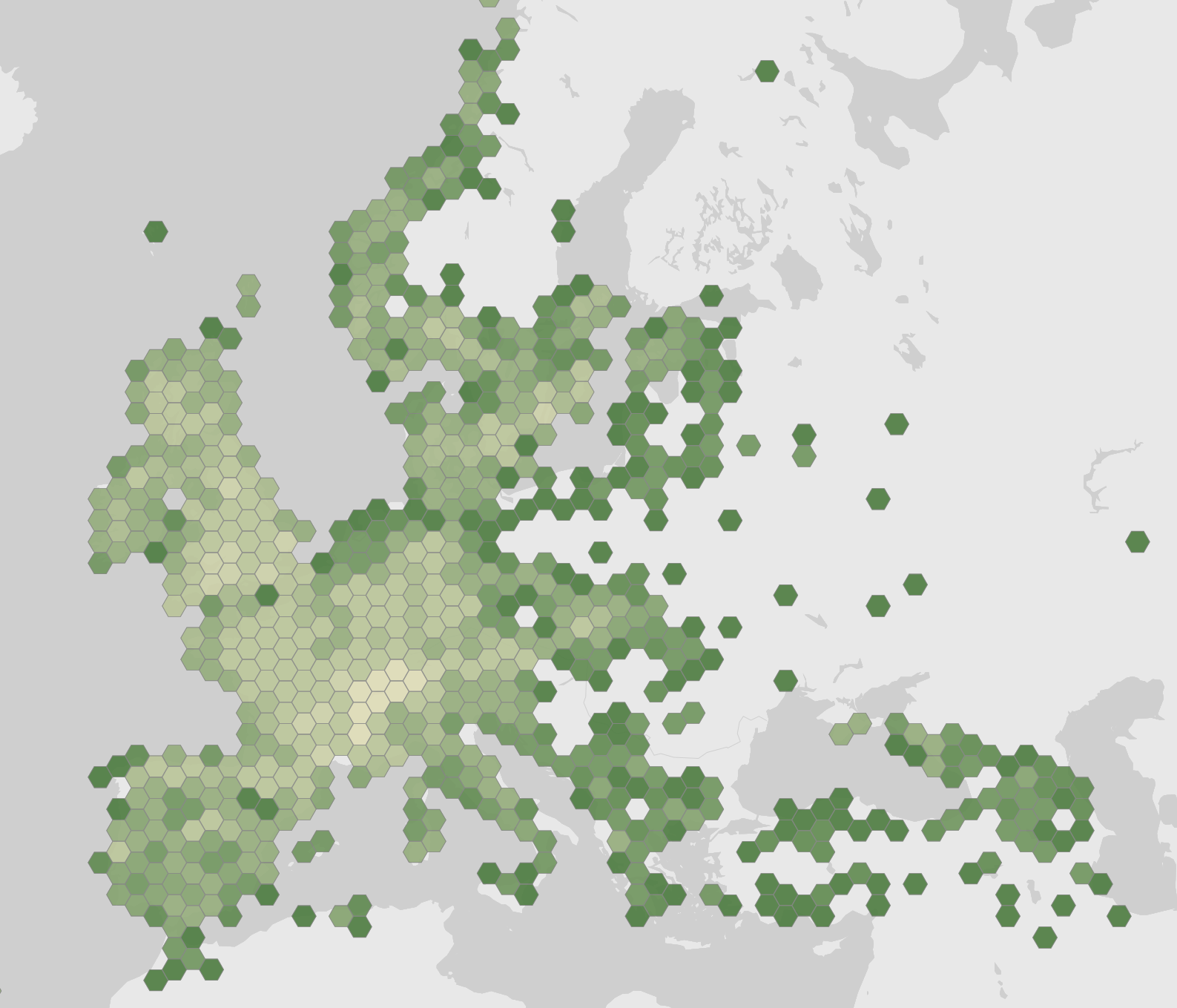
Orchis mascula has a broad native range stretching from Portugal in the west to the Caucasus in the east, taking in Ireland, Great Britain, the Faroe Islands, Scandinavia, and most of continental Europe as far as Russia and Ukraine. It also occurs in northwest Africa, in Algeria, Tunisia, and Morocco, and through the Middle East in Lebanon, Syria, and Iraq, extending into Iran.
The species tolerates a wide range of habitats: meadows, mountain pastures, and woodland, in both full sun and shade. Its altitudinal range is equally broad, from sea level up to 2,500 meters (8,000 feet).
Monthly presence-observation counts peak sharply in April and May, with tens of thousands of records compared to only a few thousand in the winter months. This pattern lines up with the plant's spring flowering period, when it is most visible and most likely to be recorded, rather than indicating a true seasonal shift in where the species grows.
Ecology and Relationships
Orchis mascula draws in bees and wasps from several genera, including Apis, Bombus, Eucera, Andrena, Psithyrus, and Xylocopa, along with occasional beetles, despite offering no nectar reward. Its flowers succeed by mimicking the appearance of other, nectar-producing species, exploiting the visiting insects' expectations rather than feeding them.
Below ground, the orchid depends on a mycorrhizal partnership to grow at all. Species in the genus Orchis typically pair with fungi in the family Tulasnellaceae, and Orchis mascula has been suggested to rely on just a single mycorrhizal partner within that family, a notably narrow relationship for an orchid.
This dependence on both a specific pollinator community and a specific fungal partner ties the species closely to the meadows, pastures, and woodlands where those partners are also present.
Uses and Human Relationships
People have harvested the tubers of Orchis mascula, along with those of related orchid species, to produce a flour known as salep or sachlav. Salep contains glucomannan, a starch-like polysaccharide valued for its nutritional content.
The plant's cultural weight goes back to Greek myth: Orchis was said to be a young man, son of a satyr and a nymph, who angered the gods and was transformed into the orchid as punishment. That story, tied to his father's reputation, fed a lasting belief across the ancient Mediterranean that orchids were aphrodisiacs and symbols of fertility and desire, a reputation that shaped how the plant was regarded long before modern botany named it.
Fun Facts
- The plant's genus name comes from Orchis, a figure in Greek myth said to be the son of a satyr and a nymph, transformed into the flower after angering the gods.
- That myth helped orchids gain a reputation across the ancient Mediterranean as aphrodisiacs and symbols of fertility and desire.
- The species offers pollinators no nectar at all, relying entirely on mimicry to attract bees, wasps, and occasional beetles.
Photos
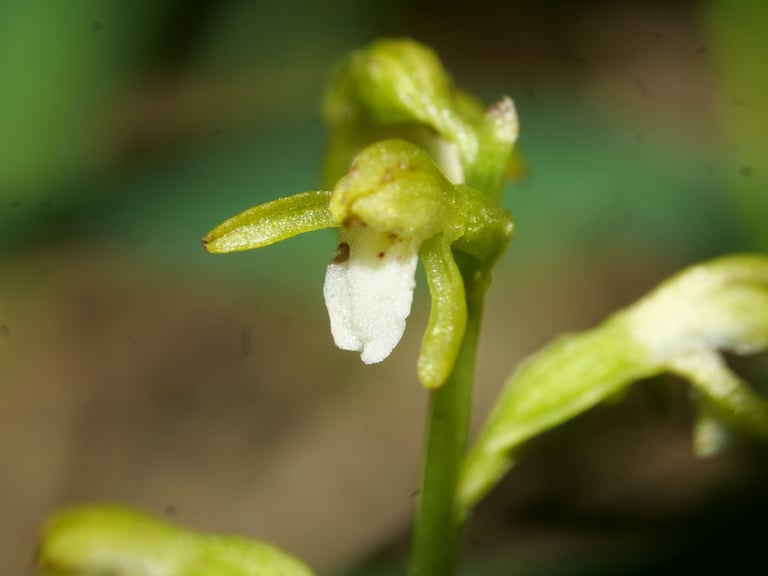
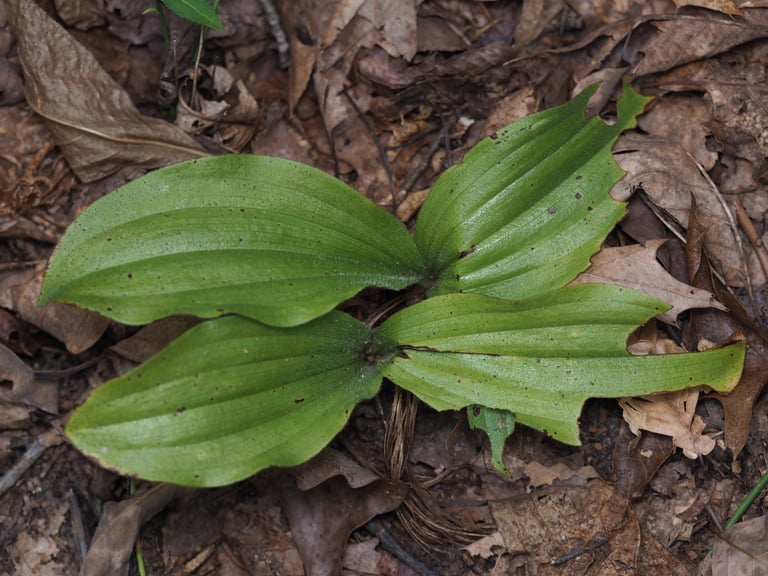
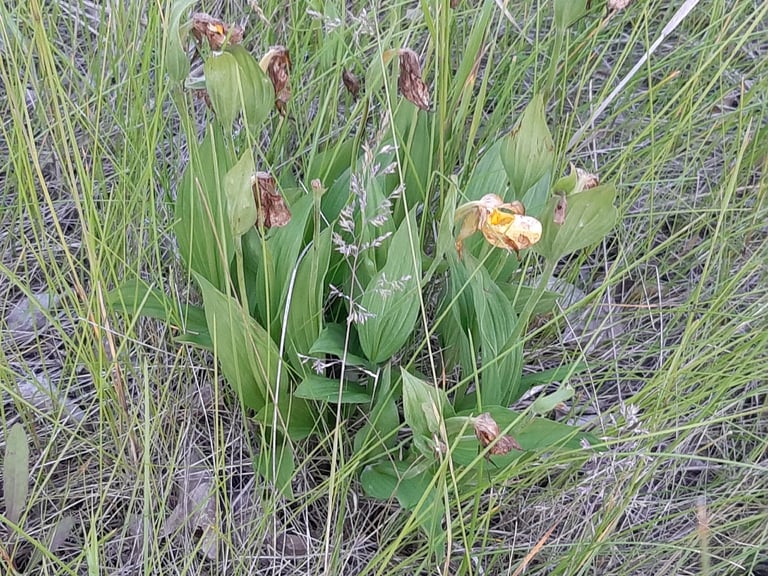
Photographs from by Andrejus Gaidamavičius via iNaturalist, licensed under CC BY 4.0., via iNaturalist, licensed under CC0 1.0., by Barry Stewart via iNaturalist, licensed under CC BY 4.0., by Thomas Dreux via iNaturalist, licensed under CC BY 4.0., by Demian Hiß via iNaturalist, licensed under CC BY 4.0., by Elena Obradović via iNaturalist, licensed under CC BY 4.0., by Yannick Brenz via iNaturalist, licensed under CC BY 4.0., by Claude Kolwelter via iNaturalist, licensed under CC BY 4.0., by Balder Dyekjær via iNaturalist, licensed under CC BY 4.0., by Mathieu Soetens via iNaturalist, licensed under CC BY 4.0., by goodwinmagic via iNaturalist, licensed under CC BY 4.0., by Mark Partington via iNaturalist, licensed under CC BY 4.0., by Barry Walter via iNaturalist, licensed under CC BY 4.0., and by Mehdi Chetibi via iNaturalist, licensed under CC BY 4.0., credited on each photo.
Ecology and classification
Classification
- Phylum
- Tracheophyta
- Class
- Liliopsida
- Order
- Asparagales
- Family
- Orchidaceae
- Genus
- Orchis
- Species
- Orchis mascula
Sources
- GBIF Species names and classification
- iNaturalist Photos
- Wikidata Common names and conservation status
- Wikipedia Summary extract