One shelf fungus recorded by botanist Sir William J. Hooker at Dalbeth, Scotland, in 1810 grew to a circumference of 2.3 meters and a weight of 15.5 kilograms in just four weeks — one of the fastest growth rates documented in any bracket fungus.
Better known as dryad's saddle or pheasant's back mushroom, Cerioporus squamosus is a basidiomycete bracket fungus in the family Polyporaceae. It grows on dead and living hardwood trees across Eurasia and North America, where it causes a white rot in the heartwood.
Its combination of huge size, rapid growth, and wide distribution makes it one of the more conspicuous polypores a forest walker can encounter.
Fruiting Body and Identification
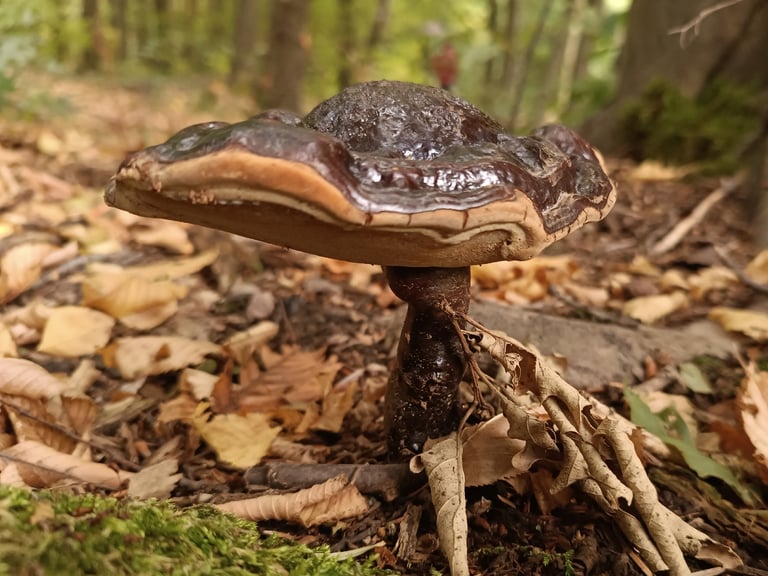
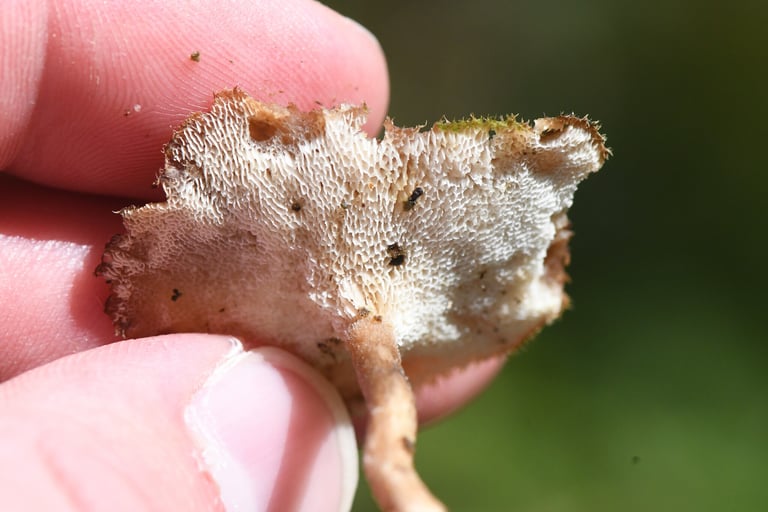
The clearest way to recognize dryad's saddle is its large, round cap covered in dark squamules, paired with a honeycomb of tiny pores on its underside and a smell resembling watermelon rind.
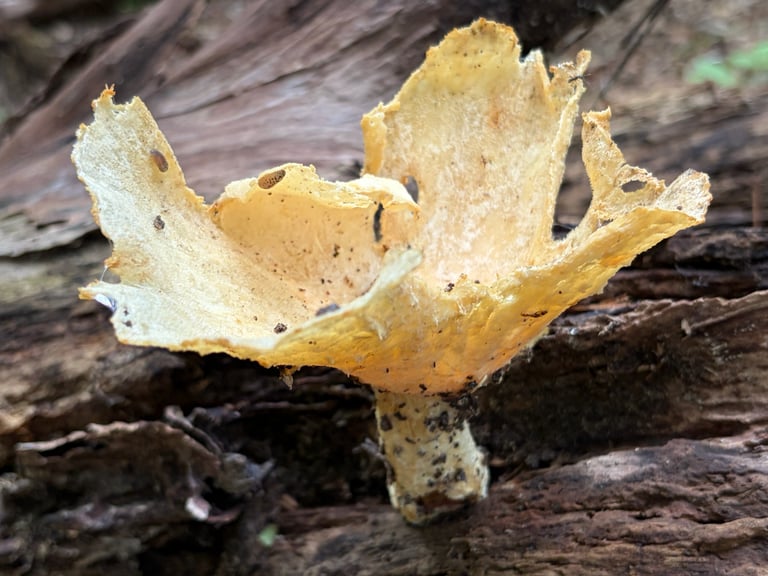
The fruit body is typically 8 to 30 centimeters across, though exceptional specimens reach 60 centimeters, and up to 10 centimeters thick. Its surface ranges from yellow to brown and is patterned with the flattened, dark scales — the squamules — that give the species its "pheasant's back" look.
On the underside, the pore surface typical of the genus Cerioporus is made up of tightly packed tubes 1 to 12 millimeters long. The stalk is 3 to 12 centimeters long and 1.5 to 3.5 centimeters thick, supporting a body that starts soft and pliable but toughens with age. Fruit bodies appear singly, in clusters of two or three, or as overlapping shelves.
The spore print is white, with smooth, elongated ellipsoid spores measuring 11 to 15 by 4 to 5 micrometers. A close relative, Polyporus tuberaster, can look similar but has a rounder cap, a more centrally placed stalk, and scales that are dark only at their tips.
Distribution and Habitat
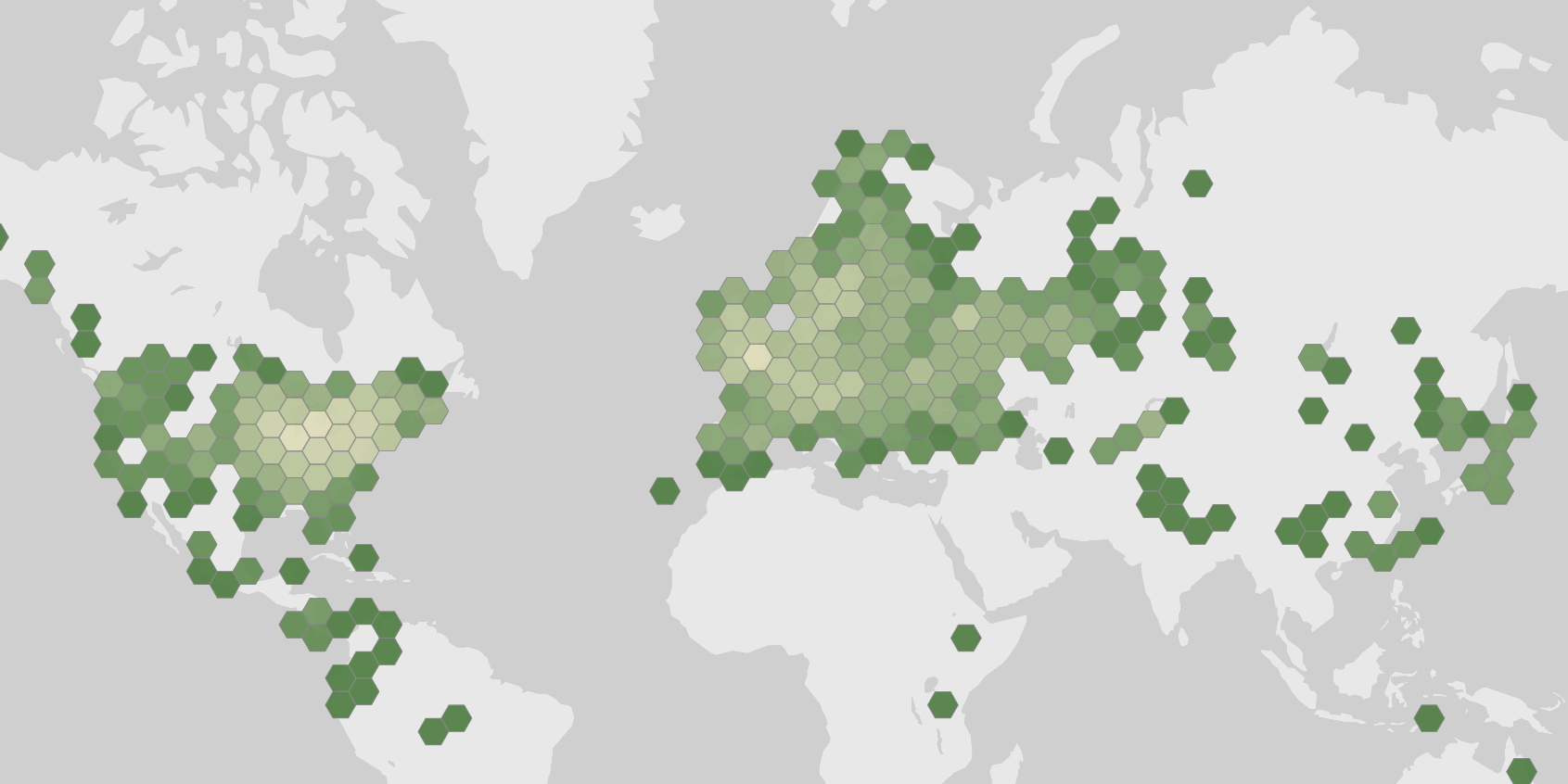
Dryad's saddle occurs across much of Europe, where it fruits mainly from July to November, and east of the Rocky Mountains in the United States, where its season runs from April to October. It has also been recorded in Asia and Australia, and its spring fruiting often overlaps with morel season, so mushroom hunters searching for morels frequently stumble across this much larger polypore instead.
Presence records from GBIF show a sharp rise in observations from April through June, peaking in May, consistent with its known spring fruiting pattern; a smaller secondary rise appears around September. These figures show where and when the fungus has been recorded, not its overall abundance or complete range.
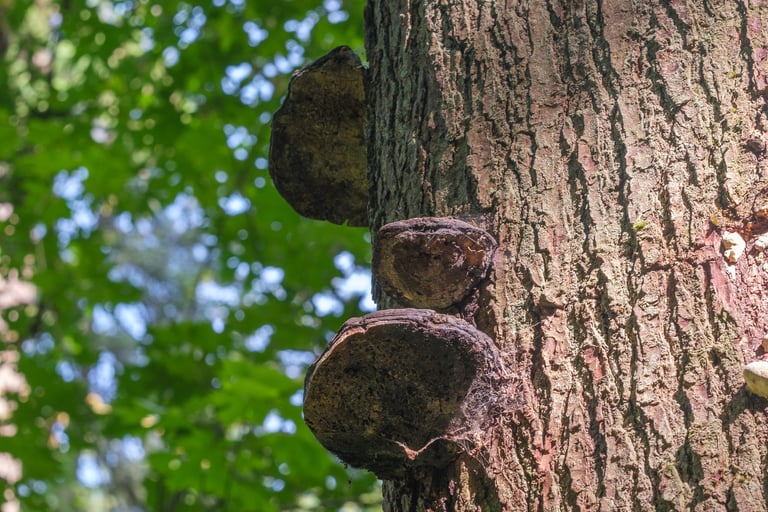
It grows mainly as a white rot fungus on elm and maple, though it has also been found on ash, beech, horse-chestnut, Persian walnut, lime, plane, poplar, magnolia, and willow. Most often it breaks down dead wood, but it occasionally acts as a parasite on living trees.
Its fruit bodies also host insect life: the pleasing fungus beetles Dacne quadrimaculata and Tritoma humeralis favor it as food, and the larvae of Tritoma mimetica feed on it as well, even though the adults of that species generally avoid it.
Uses and Cultural History
The common name dryad's saddle comes from Greek mythology, where dryads — nymphs originally associated specifically with oak trees before the term broadened to cover all tree spirits — were imagined perching on the fungus's broad, saddle-like cap as it emerged from a trunk. The alternate name, pheasant's back, describes the concentric brown scales on the cap, which resemble the overlapping feathers on a pheasant's back.
The mushroom is edible when young and cooked, and cookbooks covering its preparation generally recommend gathering it while still tender, slicing it small, and cooking it over low heat. As specimens mature they often become infested with maggots and turn firm and rubbery, making older fruit bodies inedible.
Beyond the kitchen, some people make thick, stiff paper from this species and other mushrooms in the genus Cerioporus.
Fun Facts
- The word "dryad" originally referred only to nymphs of oak trees before it broadened to describe tree spirits in general, a detail behind the fungus's most familiar common name.
- The fungus carries several regional common names beyond dryad's saddle and pheasant's back, reflecting how widely it is recognized across its range in Eurasia and North America.
Photos
Photographs from via iNaturalist, licensed under CC0 1.0., by Jeff Hansen via iNaturalist, licensed under CC BY 4.0., by Kevin via iNaturalist, licensed under CC BY 4.0., by Heather Alice-Grace Orchard via iNaturalist, licensed under CC BY 4.0., by Erica Tava Johnson via iNaturalist, licensed under CC BY 4.0., by Sophie Cron via iNaturalist, licensed under CC BY 4.0., by Edoardo Razzetti via iNaturalist, licensed under CC BY 4.0., by gpete via iNaturalist, licensed under CC BY 4.0., by Rachel via iNaturalist, licensed under CC BY 4.0., and by Gerry van Tonder via iNaturalist, licensed under CC BY 4.0., credited on each photo.
Ecology and classification
Classification
- Phylum
- Basidiomycota
- Class
- Agaricomycetes
- Order
- Polyporales
- Family
- Polyporaceae
- Genus
- Cerioporus
- Species
- Cerioporus squamosus
Sources
- GBIF Species names and classification
- iNaturalist Photos
- Wikidata Common names and conservation status
- Wikipedia Summary extract