Few fungi choose the cold of winter to send up their fruiting bodies, but Polyporus brumalis does exactly that. Its epithet, brumalis, means "occurring in the winter," a direct reference to the season when this small polypore most often appears.
It belongs to the family Polyporaceae within the order Polyporales, and it is found across temperate and boreal zones of the Northern Hemisphere. The fungus feeds on dead hardwood, breaking it down through white rot, and its combination of a tough, elastic flesh and a striking winter fruiting season makes it a distinctive sight on fallen branches and stumps when little else is growing.
Fruiting Body and Identification
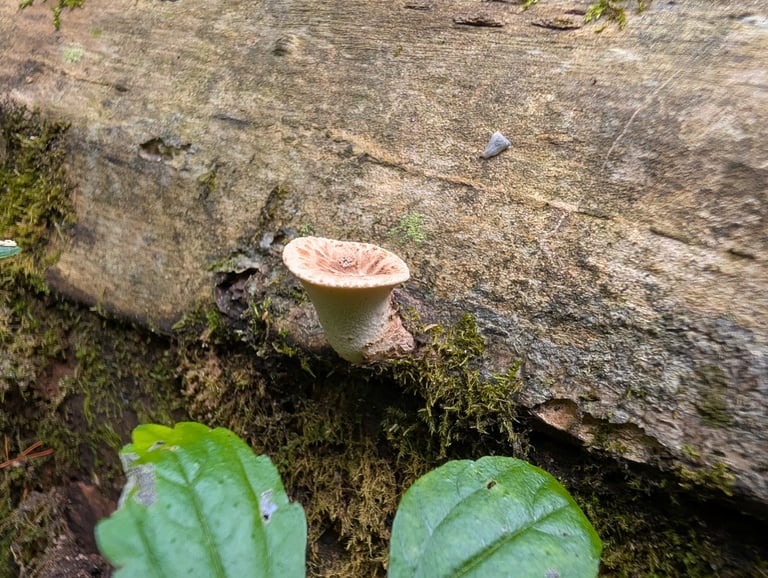
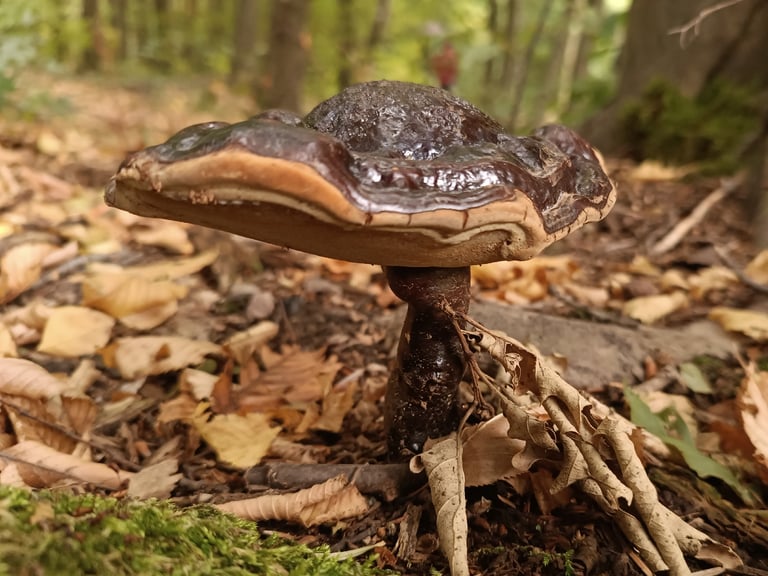
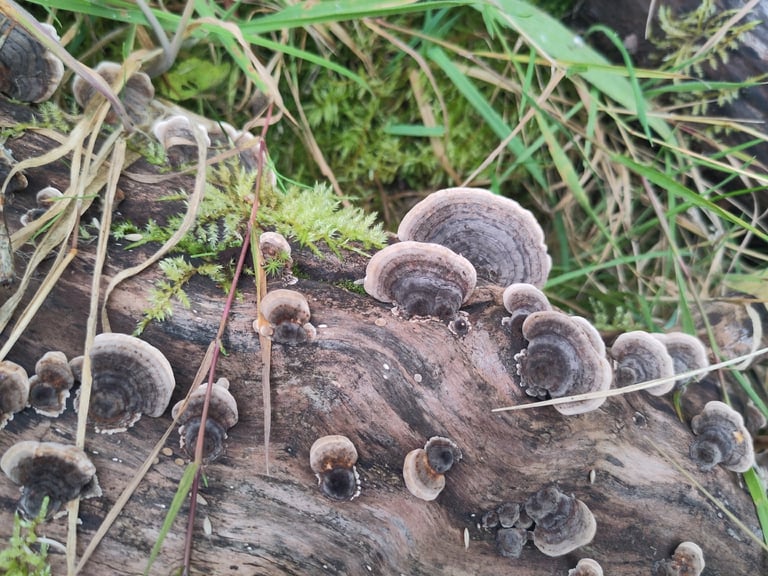
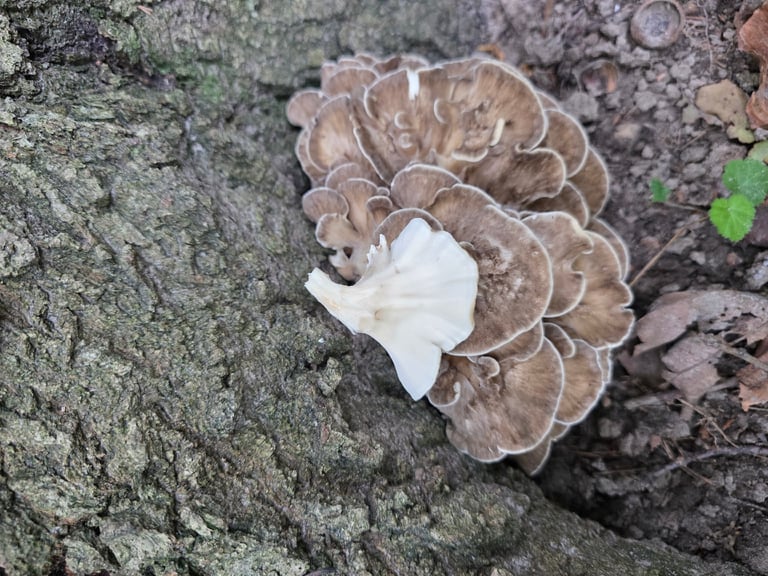
The most reliable identifying features of Polyporus brumalis are its small, dry, zoned cap and its decurrent, roundish pores on a white to cream underside. The cap is broadly convex and round, 1.5 to 10 cm across and only about 0.5 cm thick, with the center often depressed and the margin inrolled in young specimens. Its surface ranges from yellow-brown to dark brown and is rarely hairy.
On the underside, pores run 2 to 4 per square millimeter and reach about 3 mm deep, with individual pores 0.5 to 1.5 mm wide and roundish to diamond-shaped. Because they run slightly down the stem, they appear elongated near the stalk, and their surface shifts between dull and lustrous depending on the angle of light. The spore print is white, and the spores themselves are smooth, elliptic to cylindrical, and measure 5 to 7 by 1.5 to 2.5 micrometers.
The stalk stands 2.5 to 4 cm tall and 2 to 5 mm thick, colored gray to brown, sometimes with red tints, and generally paler than the cap. Its surface is dry and smooth to finely scaly. The flesh inside is white, tender to elastic, and without any distinctive taste or odor.
Under magnification, the tissue shows clamp connections throughout and a dimitic hyphal system made of thin-walled generative hyphae 4 to 10 micrometers wide alongside thick-walled, frequently branched binding hyphae. Chemical tests are notable: potassium hydroxide (KOH) produces no color change, while a drop of guaiac gum slowly turns the flesh blue over 6 to 12 hours.
Distribution and Habitat
Polyporus brumalis grows saprotrophically on dead hardwoods, particularly birch, beech, and mountain ash, and only rarely on conifers such as hemlock and fir. In Uzbekistan it has also been recorded on European nettle, willow, and poplar. It typically grows alone or in small groups rather than in dense clusters.
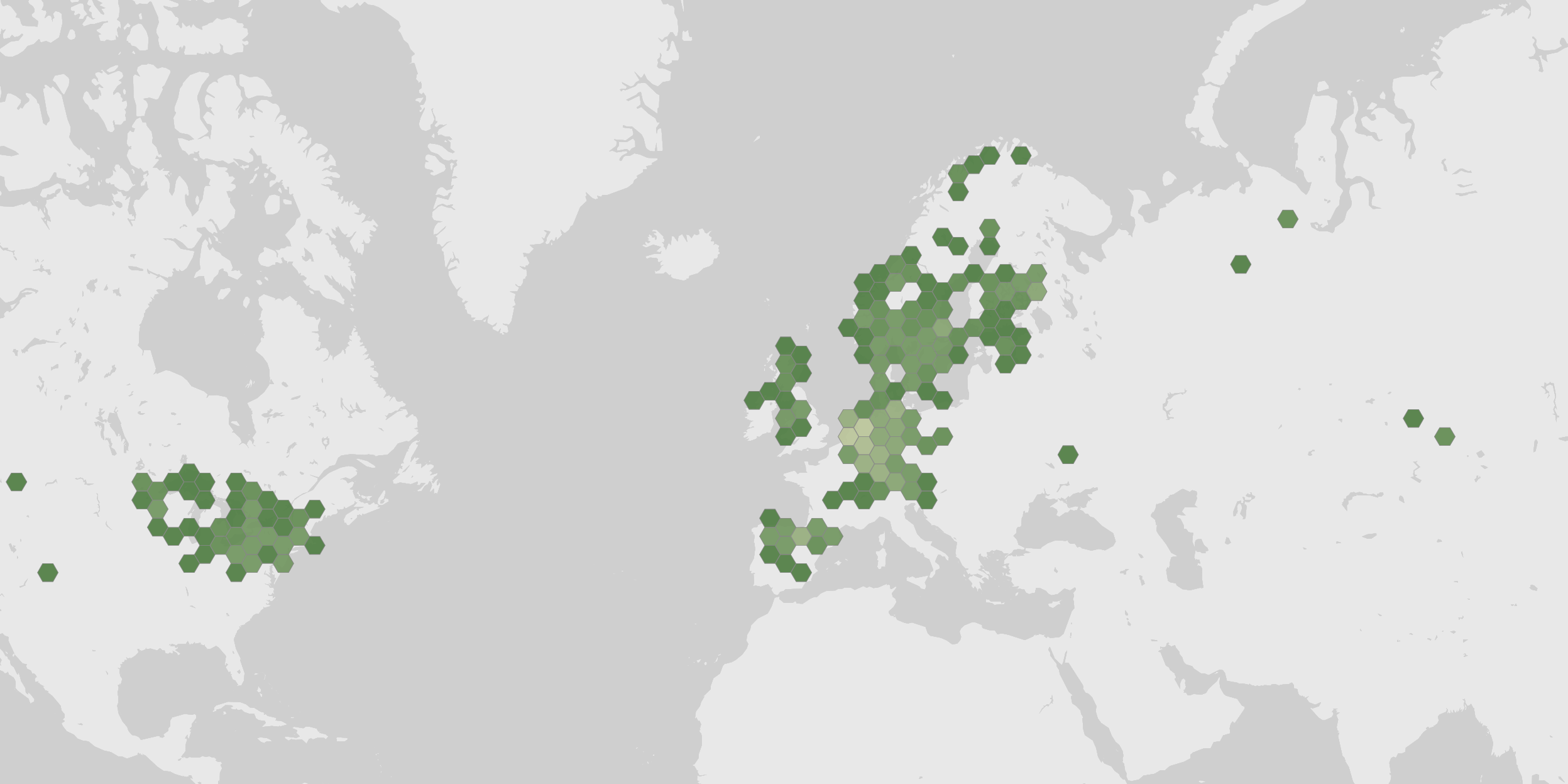
The species is distributed throughout temperate and boreal zones of the Northern Hemisphere. Fruiting timing differs by region: in eastern North America, where it is more common, it appears from June through October, while in Northern Europe it fruits later, in late October and again in March.
Monthly observation counts show the highest numbers in January (856) and February (759), declining through the summer to a low around June and July (116 and 122), before climbing again into autumn and early winter. This pattern lines up with the species' cold-season fruiting habit, though the counts reflect only recorded observations and not true abundance or the full extent of its range.
Life Cycle
Before its cap forms, the developing stalk of Polyporus brumalis is strongly phototropic, bending toward light sources. Even brief exposure of 12 to 300 seconds to bright light, around 1500 foot-candles, can cause the stalk to curve between 5 and 80 degrees within 24 hours.
This light-seeking growth helps the young fruiting body emerge into open air from crevices in the wood. Once the cap has expanded to about 9 mm across, the stalk stops responding to light and instead becomes strongly geotropic, growing away from the pull of gravity so the cap orients correctly for spore release.
Uses and Cultural History
Polyporus brumalis has little presence in human use or tradition. The fruiting body is inedible, and unlike many other polypores it has no history of use in traditional medicine or ritual practice.
It also lacks value as a dyestuff, since it yields little to no color when used for that purpose. Overall, the species has minimal representation in cultural or historical ethnomycology compared with other well-known polypores.
Fun Facts
- Polyporus brumalis produces the black pigment melanin, especially when the wood it grows on holds 35 to 55 percent moisture.
- It breaks down lignin in wood mainly through two enzymes, lignin peroxidase and laccase.
- A drop of guaiac gum on the flesh slowly turns blue over 6 to 12 hours, while potassium hydroxide (KOH) causes no color change at all.
- The flesh has no distinctive taste or smell, which is unusual among polypores.
- In Uzbekistan, the species has been found growing on unexpected hosts such as European nettle, willow, and poplar, in addition to its usual hardwood substrates.
- Its tissue is built from a dimitic hyphal system, combining thin, colorless generative hyphae with thicker, branching binding hyphae, all connected by clamp connections.
Ecology
Habitat
- Forest
Behavior
- Solitary