A single fruiting body of Polyporus squamosus recorded by botanist Sir William Hooker at Dalbeth, Scotland in 1810 grew to a circumference of 2.3 meters and a weight of 15.5 kilograms in just four weeks.
Commonly known as dryad's saddle or pheasant's back mushroom, Polyporus squamosus is a basidiomycete bracket fungus in the family Polyporaceae. It grows on the trunks and stumps of hardwood trees, where it causes a white rot in the heartwood of both living and dead wood.
The species is found across much of Eurasia and North America, making it one of the most widely encountered large polypores in the northern hemisphere. Its size, striking scaled cap, and place in mushroom-hunting folklore make it a fungus many foragers recognize on sight, even before they know its name.
Fruiting Body and Identification
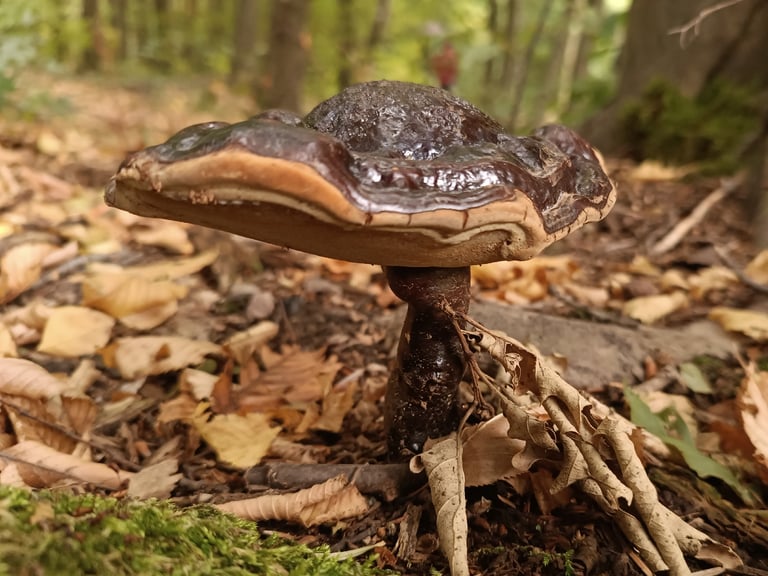
The mushroom's most recognizable feature is the pattern of flattened, dark brown scales, or squamules, pressed into its yellow-to-brown cap surface. The circular cap typically spans 8 to 30 centimeters across, though exceptional specimens reach 60 centimeters, and can be up to 10 centimeters thick.
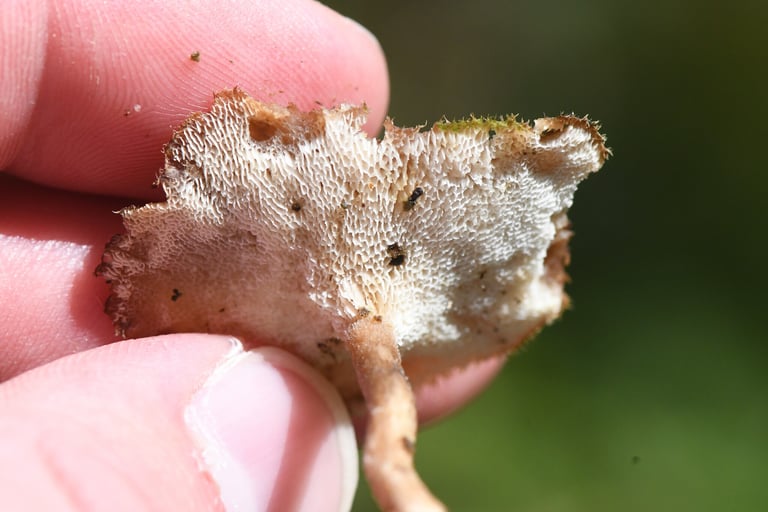
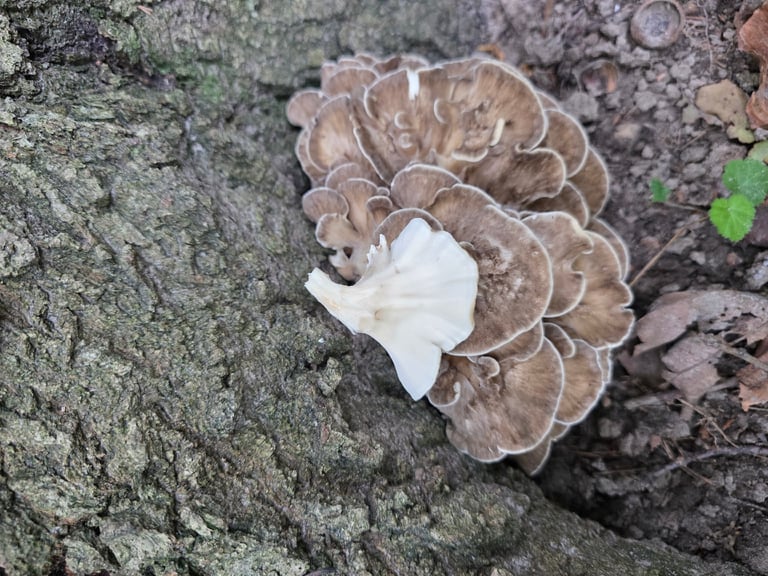
The underside carries the small, closely packed pores characteristic of the genus Cerioporus, with tubes 1 to 12 millimeters long. A thick stalk, 3 to 12 centimeters long and 1.5 to 3.5 centimeters wide, is usually attached off-center, and fruiting bodies often occur singly, in clusters of two or three, or arranged as overlapping shelves.
Its smell resembles watermelon rind, a distinctive clue in the field. The fungus produces a white spore print, with smooth, long ellipsoid spores measuring 11 to 15 by 4 to 5 micrometers. Young fruiting bodies are soft but toughen considerably as they age, growing tougher and less palatable with time.
Polyporus tuberaster is a related species that can be confused with P. squamosus, but its cap is rounder, its stalk more centrally attached, and its scales are dark only at the tip rather than spread across the surface.
Distribution and Habitat
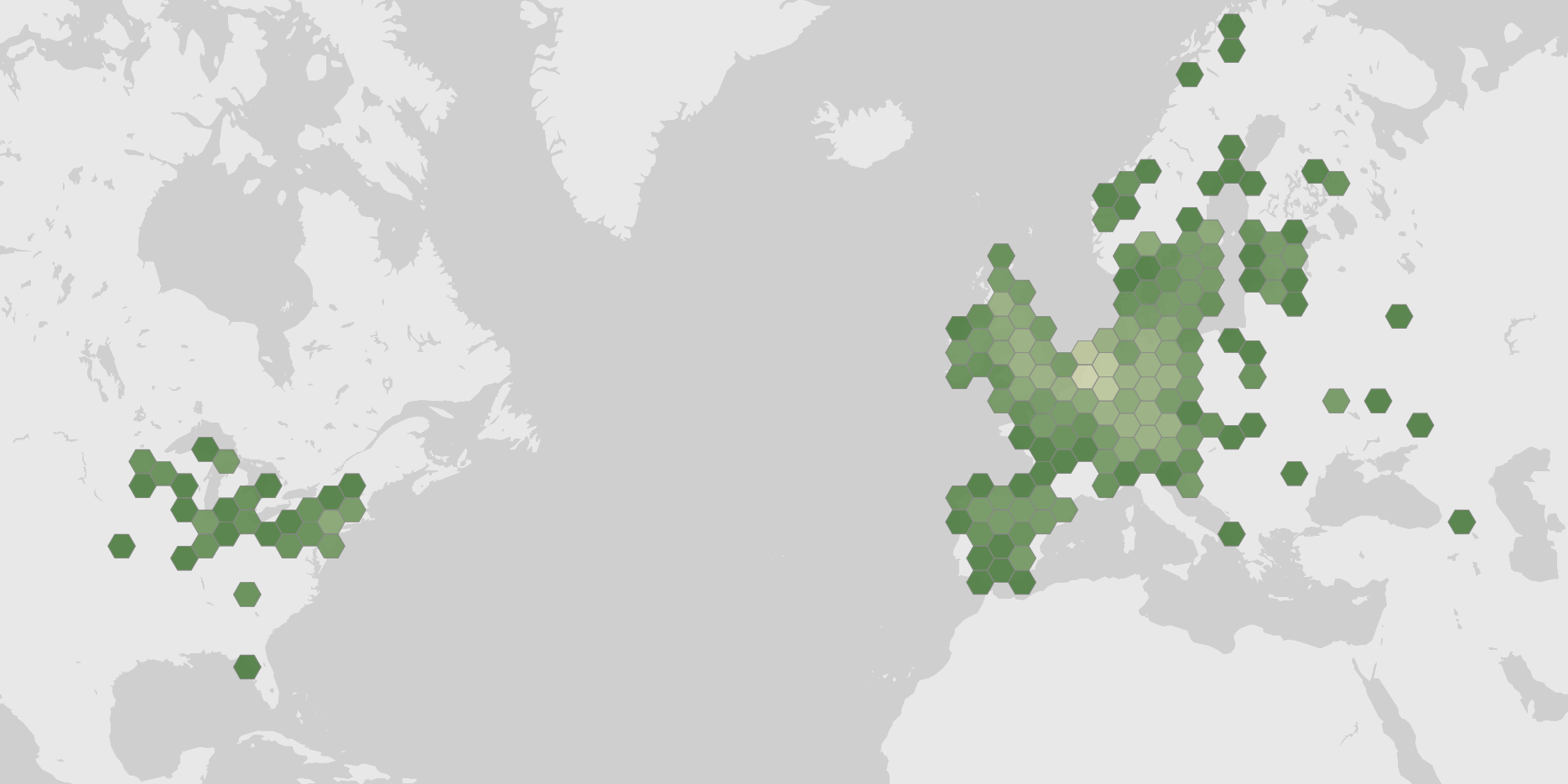
Polyporus squamosus is common and widespread, occurring across much of Europe from July through November and east of the Rocky Mountains in the United States from April through October. It is also recorded in Asia and Australia.
The fungus fruits mainly in spring, with an occasional second flush in autumn and only rare appearances at other times of year. Monthly observation records show a sharp rise beginning in April, peaking in May, with a secondary rise in September and October before numbers fall off through the winter; these counts reflect when people have recorded seeing the fungus, not its total abundance.
It grows on dead logs and stumps or attaches to living hardwood trees, most often elm and maple, but has also been recorded on ash, beech, horse-chestnut, Persian walnut, lime, plane, poplar, magnolia, and willow. Spring morel hunters frequently encounter this large polypore by chance, since the two fungi fruit at similar times.
Several insect species rely on this fungus as a habitat or food source: the pleasing fungus beetles Dacne quadrimaculata and Tritoma humeralis feed on it, and the larvae of Tritoma mimetica also consume it, though adults of that species tend to avoid it.
Uses and Cultural History
The common name dryad's saddle comes from Greek mythology, where dryads were tree-dwelling nymphs; someone imagined the broad, flattened cap as a seat these forest spirits might use while riding through the woods. The alternate name pheasant's back mushroom refers to the coloring and pattern of the cap, which echoes the mottled plumage on a pheasant's back. The scientific epithet squamosus comes from the Latin word for scaly, describing the dark scales scattered across the cap.
The mushroom is eaten when young and cooked, though specimens become tough, rubbery, and prone to maggot infestation as they mature, at which point they are no longer considered good eating. Cookbooks that cover this species generally note that only young specimens are worth harvesting, since maturity brings tougher flesh and insect infestation.
Beyond the kitchen, the flesh of Polyporus squamosus and other Cerioporus species has been used to make a thick, stiff paper, an example of practical use for these otherwise inedible mature fruiting bodies.
Fun Facts
- The name dryad's saddle stems from Greek mythology, where dryads were forest-dwelling tree nymphs imagined riding through the woods perched on this mushroom's broad cap.
- The species' epithet squamosus is Latin for scaly, a direct reference to the dark scales covering its cap surface.
- Its alternate name, pheasant's back mushroom, comes from the resemblance between the cap's color pattern and the mottled feathers on a pheasant's back.
Ecology
Habitat
- Forest
- Woodland