Nevada ephedra grows leafless stems that photosynthesize in place of foliage, an adaptation that lets it thrive where almost nothing else can hold water.
Known also as gray ephedra, Mormon tea, and Nevada jointfir, this gymnosperm belongs to the ancient family Ephedraceae. It grows scattered across the dry basins, foothills, and woodlands of western North America and carries an IUCN status of Least Concern, meaning it faces no major threat of extinction.
Beyond its role as a tough desert survivor, the plant has a long history as food, medicine, and livestock forage, making it as culturally significant as it is biologically distinctive.
Identification and Appearance
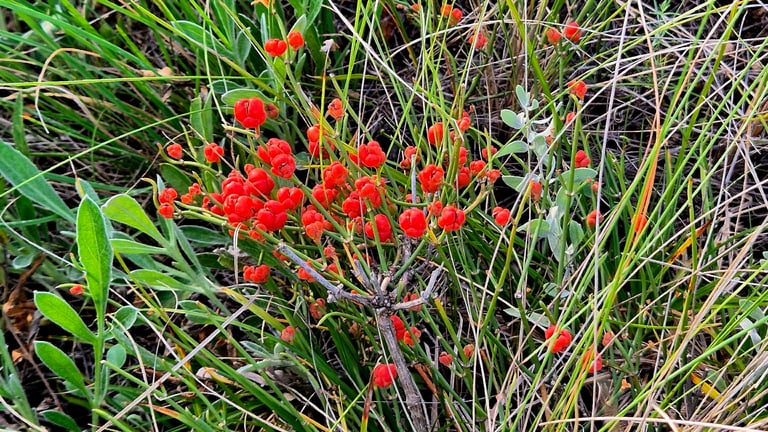
The most useful field mark is the plant's near-total absence of leaves: what looks like foliage is actually a dense tangle of slender, jointed, gray-green to yellow-green stems. These stems are opposite or whorled at each joint, giving the shrub a wiry, broom-like appearance rather than the leafy look of most flowering shrubs.
The plant forms a rounded, many-branched shrub, typically low and spreading, with stems that feel stiff and somewhat rough to the touch. Any true leaves are reduced to small, scale-like structures at the stem joints, quickly shed or barely noticeable.
Because Ephedra nevadensis is dioecious, individual plants are either male or female, and the two sexes can differ subtly in where they grow: male plants tend to occupy drier ground, while female plants favor slightly wetter sites. Cones form at the stem joints in late winter to midspring, appearing as small, papery clusters rather than showy flowers.
Within its range, it grows alongside other ephedras such as green ephedra (Ephedra viridis), so confirming stem color, joint spacing, and habitat can help separate the two where they overlap.
Distribution and Habitat
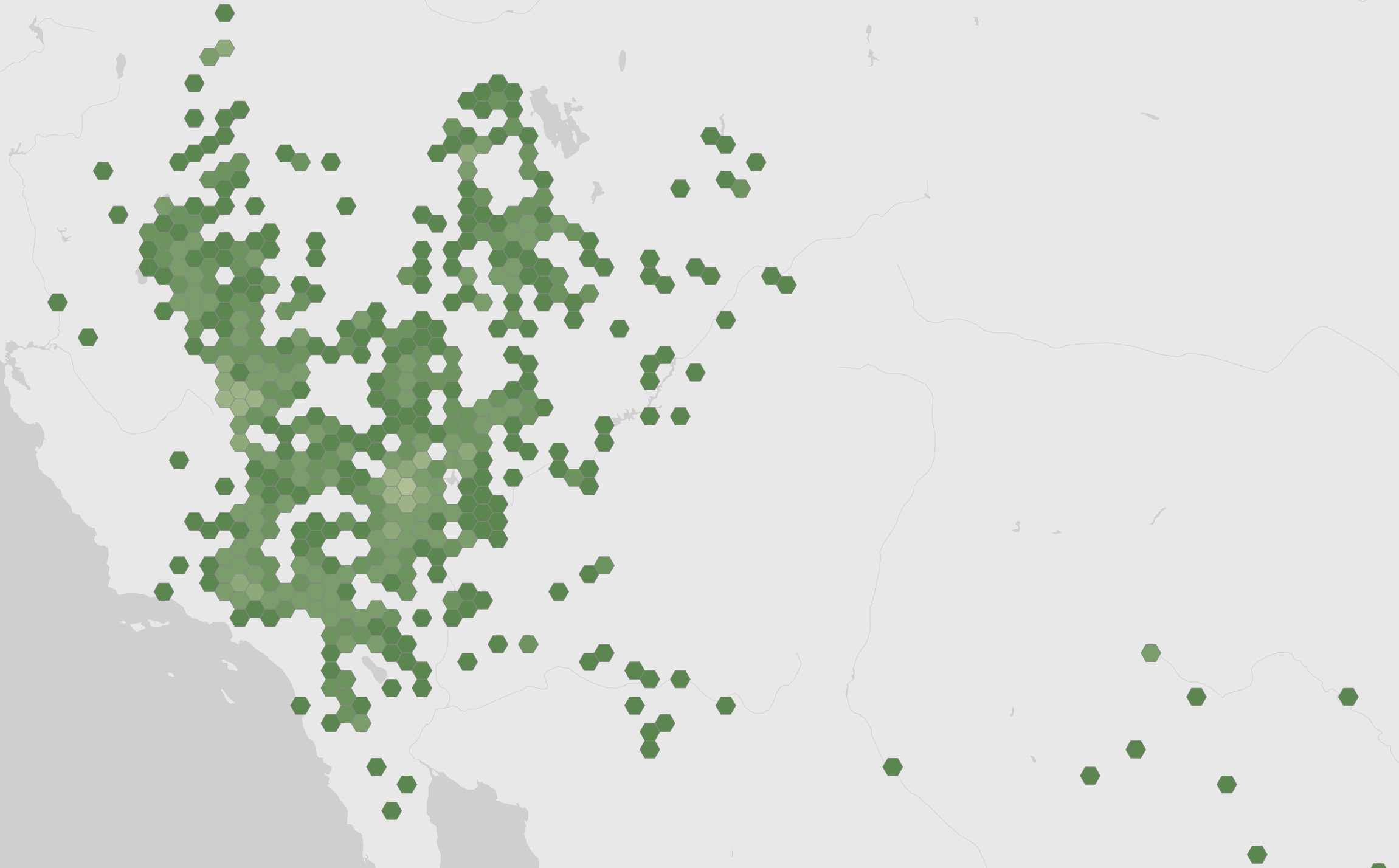
Nevada ephedra ranges across the dry interior of western North America, from California and Oregon through the Great Basin and Colorado Plateau to Texas and Baja California. It grows at elevations from about 2,000 to 7,000 feet (610 to 2,150 meters), most commonly on dry slopes and hills below 4,430 feet (1,350 meters), and reaches even higher, up to 1,900 meters, where it cones in late winter through midspring.
The species favors shallow, rocky soils often derived from limestone, no more than about 2 feet (0.6 meters) deep, and shows a high tolerance for salinity while having none for acidity. It is common at the edge of salt desert zones and thrives in sagebrush, desert shrub, pinyon-juniper, and desert chaparral communities, often growing as scattered individuals or small clumps, though isolated pure stands also occur. It requires only about 7 inches (178 millimeters) of annual precipitation, underscoring its drought tolerance.
Common plant associates include rubber rabbitbrush, antelope bitterbrush, green ephedra, Joshua tree, Mojave yucca, chamise, jojoba, mountain-mahogany, saltbush, and creosotebush, depending on region. The species is especially prominent in the transition zone between the Mojave and Great Basin deserts, where it can codominate with winterfat, spiny hopsage, or Colorado pinyon.
Monthly observation data show a strong peak in spring, particularly around the third and fourth months, tapering through summer and staying lower in fall and winter. This pattern likely reflects when the plant is most visible or actively coning rather than a true measure of its population, since these are presence records rather than counts of abundance.
Reproduction and Life Cycle
Nevada ephedra is wind-pollinated, and its near-total lack of foliage plays directly into this strategy: fewer leaves mean fewer obstacles for pollen carried on the breeze, making pollination more predictable. Male and female plants are separate, with males favoring drier ground and females settling into wetter sites, an arrangement thought to boost seed production overall.
Cones mature and pollination occurs between March and June, with seeds ripening from May through August, though the plant does not produce seed every year. Researchers studying seed dispersal across ten Ephedra species found that Ephedra nevadensis combines features of both wind and animal dispersal in its cone structures, unlike species that rely purely on one method or the other.
In the wild, rodents are a key seed disperser, carrying and caching seeds away from the parent plant. For cultivation, seeds can be collected and sown directly, and the species can also be propagated from transplants or stem cuttings.
Ecology and Relationships
Nevada ephedra grows across an unusually wide span of arid biomes, from shrublands and desert scrub to pinyon-juniper woodland and the margins of salt deserts, making it a connective presence across several harsh habitat types. Its lack of dense foliage means it rarely fuels wildfire, so regional fires occur only occasionally in stands where it dominates.
When fire does occur, the plant's ability to re-establish depends on how long the fire burns and how severe it is, rather than on any special fire adaptation. Despite offering little in the way of leafy forage or nectar that would draw smaller animals and insects, it is heavily grazed by larger herbivores.
Mule deer, pronghorn, and desert bighorn sheep all feed on it in the wild, and domestic cattle and sheep graze it as well, making it a more significant forage plant than most other North American Ephedra species. Its limited biotic relationships, absence of insect pollination, and reliance on wind for reproduction, set it apart from plants that depend more heavily on animal partners.
Uses and Human Relationships
Nevada ephedra has a long history as both food and medicine among Native American peoples, and Mormon settlers brewed its stems into a tea, one source of its common name Mormon tea. The Zuni people specifically prepared an infusion of the whole plant, excluding the root, both as a treatment for syphilis and as a tea-like beverage.
Harvested stems have reportedly been used to address fluid buildup, purify blood, and ease symptoms of gonorrhea, early-stage syphilis, topical sores, kidney trouble, and respiratory complaints including asthma. Unlike related Ephedra species, Ephedra nevadensis does not contain significant amounts of the stimulant ephedrine, which limits its potency for clinical use even as it has supported informal, domestic remedies. The plant was also historically ground into flour.
Today its most important practical use is as forage for cattle and sheep, though it suits horses less well, alongside applications in habitat restoration and occasional cultivation as an ornamental plant. Feeding trials comparing it to orchardgrass hay and cheatgrass found it scored second-highest in ammoniacal nitrogen and highest in ruminal pH, suggesting it works as a grazing alternative without standing out as exceptionally nutritious or harmful; separate toxicity studies found no dietary abnormalities in pregnant livestock or their offspring.
Fun Facts
- Despite growing without true leaves, Ephedra nevadensis is a more significant forage plant for wildlife and livestock than most other North American Ephedra species.
- Its range stretches from California and Oregon through the Great Basin and Colorado Plateau all the way to Texas and Baja California.
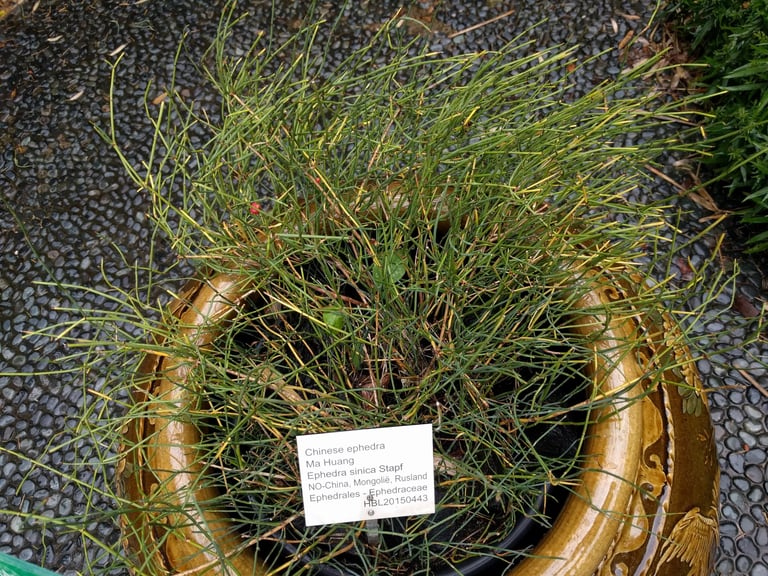
- It is sometimes called a cousin of Ma Huang (Ephedra sinica), the source of the stimulant ephedrine, but Nevada ephedra itself lacks meaningful amounts of that compound.
- Native peoples ground the plant into flour in addition to brewing it as tea, giving it a dual role as both food and drink.
Conservation status
- LC
- NT
- VU
- EN
- CR
Least Concern
Ecology
Habitat
- Woodland
- Shrubland
- Grassland
- Desert
Growth habit
- Shrub