Field horsetail grows two entirely different kinds of stems from a single underground rhizome: a short-lived, spore-bearing shoot that appears in early spring, and a separate green stem that keeps photosynthesizing all summer long.
This is a nonflowering vascular plant, a true fern relative in the family Equisetaceae, native across the arctic and temperate regions of the Northern Hemisphere. The IUCN lists it as Least Concern.
Few common plants carry such a deep evolutionary pedigree, and field horsetail is easily mistaken for the unrelated mare's tail, Hippuris vulgaris, making a closer look at its stems and cones worthwhile.
Identification and Appearance
The clearest field mark is the stem itself: hollow, ribbed, and jointed, with whorls of slender side branches erupting from each joint like the ribs of a small bottlebrush. This jointed, whorled structure is what separates Equisetum arvense from the superficially similar mare's tail, which lacks true joints and branch whorls.
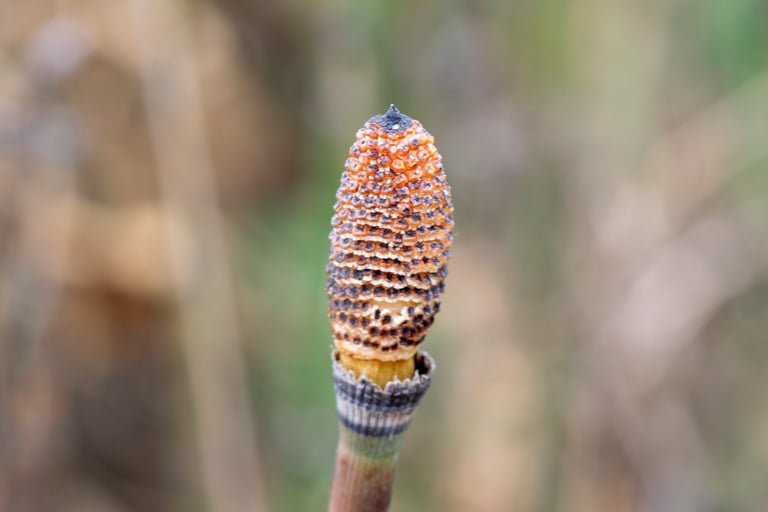
Sterile green stems stand 10 to 90 cm tall and 3 to 5 mm across, divided into segments 2 to 5 cm long, with some stems bearing as many as 20 segments. The whorled side shoots are only about 1 mm in diameter, giving the whole stem a fine, feathery outline. Fertile stems look quite different: off-white, succulent, 10 to 25 cm tall and 3 to 5 mm wide, wrapped in 4 to 8 whorls of brown scale leaves and topped by a single brown spore cone 10 to 40 mm long and 4 to 9 mm wide.
The two stem forms never appear as one plant at a time in the same way most people picture a fern. Fertile stems emerge first, in April, then collapse and die once they have shed their spores, while the green sterile stems that follow persist through the growing season. The plant also absorbs silicon from the soil, an unusual trait among herbaceous species, and carries an exceptionally high chromosome count of 216 (108 pairs).
Field horsetail has changed little in overall form since its ancestors grew in Carboniferous swamps, so its stiff, segmented stems offer a rare living glimpse of a much older plant lineage.
Distribution and Habitat
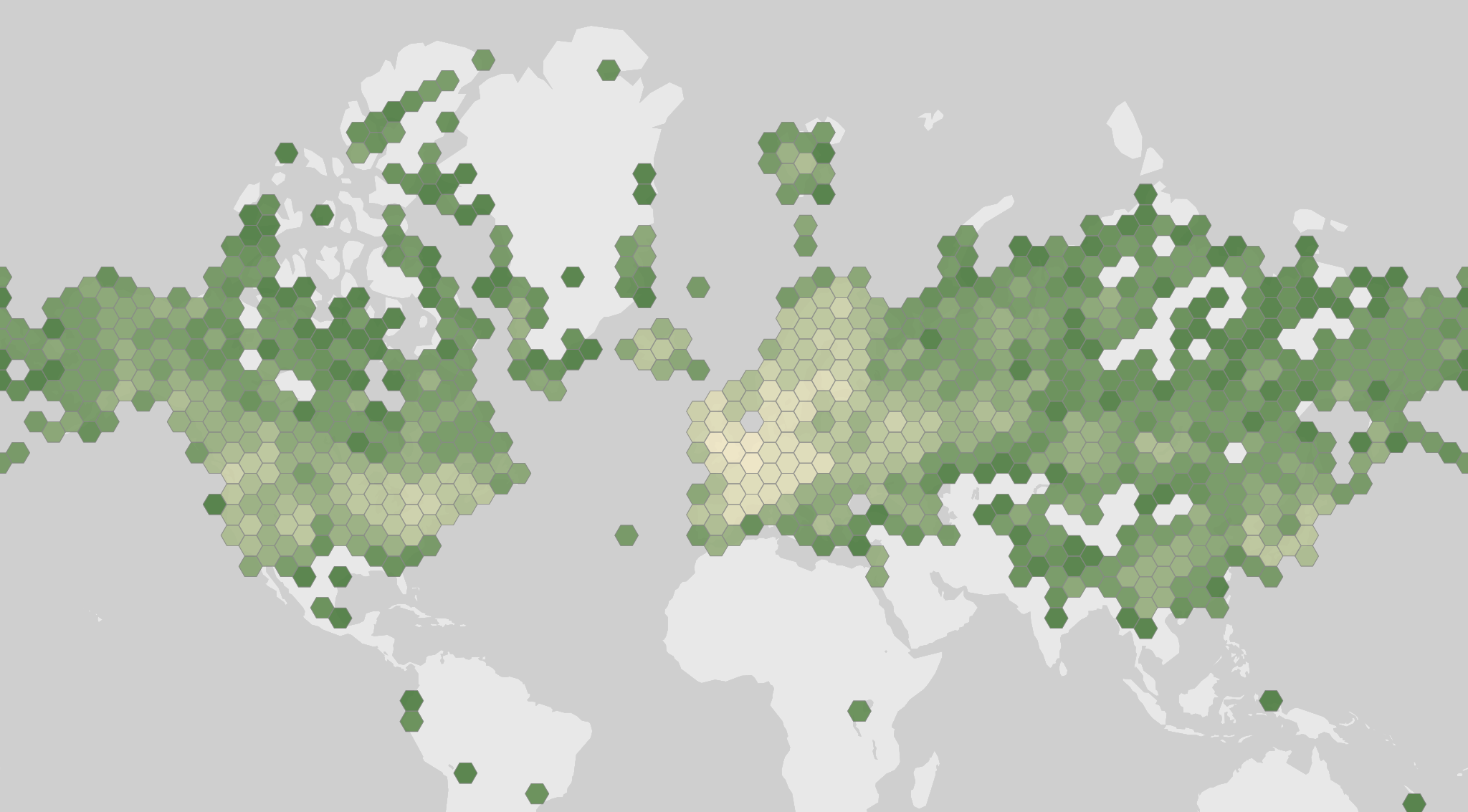
Field horsetail is one of the most widely ranging plants of the Northern Hemisphere, growing as far north as 83° in North America and 71° in Norway, Sweden, Finland, and Russia, and as far south as Texas, India, and Iran. It is far less common in the Southern Hemisphere but has been recorded in Argentina, Brazil, Chile, Madagascar, Indonesia, and Australia. It was introduced to New Zealand in the 1920s, where it is now classed as invasive and listed on the National Pest Plant Accord, which bans its sale, spread, and cultivation.
Described as a facultative wetland species, it favors damp, open woodlands, pastures, arable land, roadsides, disturbed ground, and the margins of streams, rivers, and lakes. It prefers neutral to slightly basic, sandy or silty clay loams where the water table sits close to the surface, though it tolerates mildly acid soils as well. Its climatic range is broad, spanning average temperatures below 5°C to above 20°C and annual rainfall from as little as 100 mm to as much as 2,000 mm.
Elevation range is equally wide, from sea level to alpine tundra. In Alaska it grows from the coast up into alpine heaths and rocky slopes, while in the Adirondack Mountains of New York it occurs between 64 and 640 m. Farther west, populations reach 1,400 to 2,400 m in Utah, 1,500 to 3,290 m in Colorado, and 1,500 to 3,000 m in Wyoming.
Monthly observation counts rise sharply from spring, peak in June and July, and fall off through autumn and winter. This pattern most likely reflects when the green sterile stems are most visible and easiest to record, rather than any change in true population size.
Uses and Human Relationships
Field horsetail carries a long history as a medicinal plant across unrelated cultures. Native American, ancient Roman, and Chinese healers all used it to treat a variety of ailments, and later traditions built on that use: in Austria it was brewed as tea or applied as baths and compresses for skin, urinary, kidney, and rheumatic complaints, in Finland it was dried and used to strengthen skin and treat lung disease and wounds, and in Iran an infusion of its shoots has been used against diabetes and obesity. Modern research has found only limited evidence for anti-inflammatory, diuretic, antimicrobial, and antioxidant effects.
Beyond medicine, the plant has practical household and craft uses. Its high silica content made it useful as an abrasive for polishing pewter and wood, earning it the old name "pewterwort," and hurdy-gurdy players used it to clean resin buildup from their instrument wheels. It has also been used as a folk remedy for strengthening fingernails, and its young buds are eaten as a spring vegetable in Japan and Korea.
In agriculture, an aqueous extract of the plant is approved in the European Union and United Kingdom as a fungicide, used against powdery mildew, scab, blight, and mold on crops such as cucumbers, grapevines, tomatoes, potatoes, strawberries, and fruit trees. Biodynamic farmers use a related preparation to counter excess soil moisture and the fungal problems it causes. The plant's usefulness comes with a caution, however: it is toxic to livestock, especially horses, and its rhizomes can penetrate up to 1.8 m into the soil, making it resistant to fire, mowing, and most herbicide treatments.
Fun Facts
- The Greek physician Dioscorides described the diuretic and wound-healing effects of field horsetail around the 1st century CE.
- In some traditional systems the plant was known by a name meaning "that which combats swelling," reflecting its long-standing use against inflammation.
- Native American, ancient Roman, and Chinese healers independently arrived at using this same plant for treating ailments, long before it became a subject of modern herbal research.
Conservation status
- LC
- NT
- VU
- EN
- CR
Least Concern
Ecology
Habitat
- Wetland
- Forest
- Freshwater
- Grassland
Growth habit
- Fern