The yellow trout lily spends most of its life hidden underground, and even mature colonies produce flowers in only a tiny fraction of their plants each year.
This perennial, colony-forming spring ephemeral is native to North America, where it grows in woodland habitats across eastern Canada and the eastern United States. It is common and widespread within its range. Its gray-green leaves, mottled with brown or gray, are said to resemble the coloring of brook trout, which is how the plant got its common name.
What makes the trout lily worth a closer look is its patience: colonies can persist in the same patch of forest for centuries, quietly spreading underground long before most of their members ever produce a bloom.
Identification and Appearance
The single most telling feature of a trout lily is its mottled leaf: gray-green and blotched with brown or gray, giving rise to the "trout" name. Non-flowering plants produce just one such leaf, while flowering plants grow two basal leaves, each ranging from 8 to 23 centimeters long and elliptic to lanceolate in shape, with smooth margins.
When present, the flower rises on an erect stalk and nods downward, with six recurved, yellow, lance-shaped tepals (three petals and three petal-like sepals) measuring 20 to 33 mm long. The flower is bisexual and closes at night, reopening the following day.
Timing is another clue: trout lilies bloom in early spring, before the trees above them leaf out, taking advantage of sunlight reaching the forest floor before the canopy closes in.
Because flowering is so rare, with only about 0.5% of individuals in a colony blooming at any time, most plants encountered will show the single, unmottled-free leaf form rather than the paired leaves and flower.
Distribution and Habitat
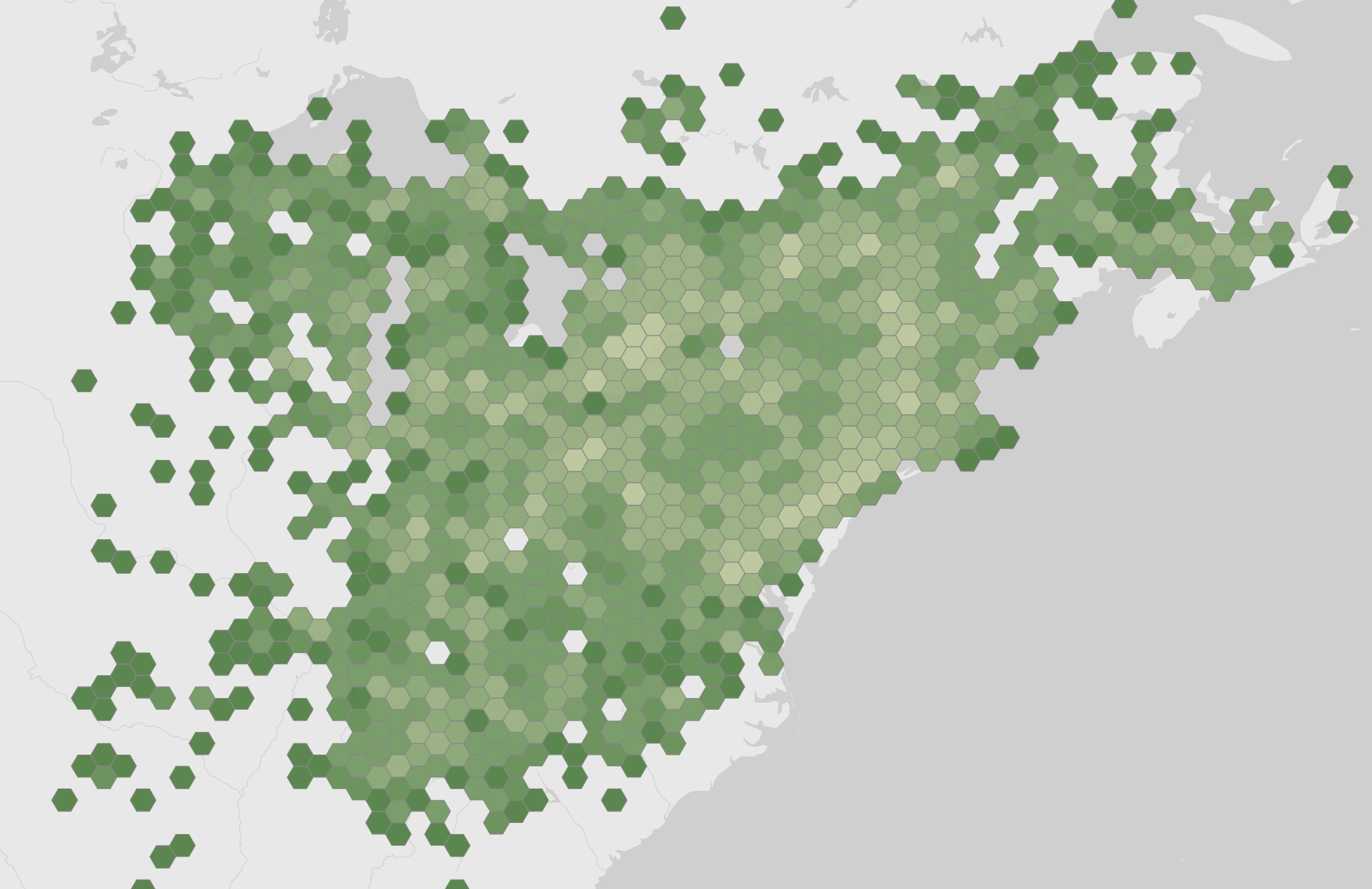
The yellow trout lily's range runs from eastern Canada south to North Carolina and across the eastern United States, including states and provinces from Newfoundland and Labrador through Ontario and Québec down to Alabama, Georgia, and South Carolina. It occupies a temperate climate zone and is closely tied to woodland habitats throughout this range.
Observation records show a strong seasonal pattern, with counts rising sharply in early spring and peaking before falling off through summer, consistent with the plant's identity as a spring ephemeral that appears briefly before the tree canopy fills in. These are presence records only and do not reflect population size or a complete range map.
Within its native woodlands, the species is described as very common and widespread, particularly in eastern North America.
Growth and Form
Erythronium americanum grows as a bulbous geophyte, storing its energy underground in a corm between growing seasons rather than maintaining above-ground growth year-round. This form suits its spring ephemeral life cycle, in which the plant emerges, leafs out, flowers if mature enough, and then dies back before the forest canopy closes overhead.
Reproduction and Life Cycle
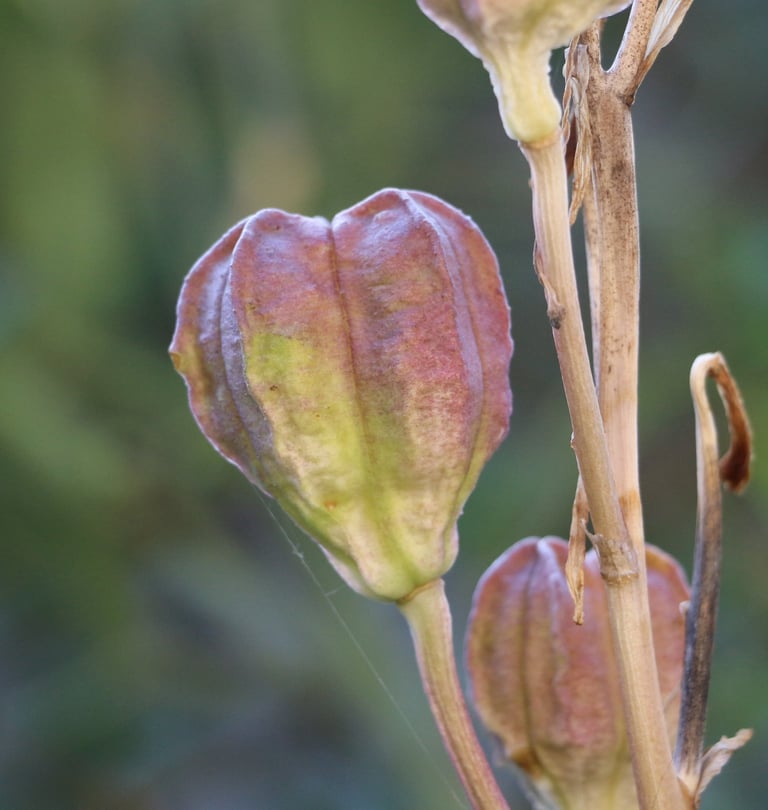
Sexual reproduction in the trout lily is inefficient: only about 10% of pollinated flowers go on to develop seeds. When they do, the fruit is a capsule 12 to 15 mm long, held above the ground on the flower stalk. The seeds carry an elaiosome, a fleshy structure that attracts ants, which disperse the seeds and reduce the chance they are eaten by other predators, a strategy known as myrmecochory.
Each plant grows from an oval corm 15 to 28 mm long, typically buried in the upper 11 cm of soil but sometimes as deep as 30 cm, notably deeper than corms of other lily family members. The corm is packed with starch for energy storage and is wrapped in a papery husk left over from the previous year's stalk.
Given the low success rate of seed production, colonies rely heavily on asexual spread. New corms form at the tip of a "dropper," a fleshy stem that grows upward from the parent corm before turning downward to push deep into the soil, where it forms a new corm; the connecting stem to the parent then dies. Small bulbs budding directly off the main corm add to this spread. Through this process, some colonies have been dated to be as old as 300 years.
Uses and Human Relationships
Several Native American tribes historically used parts of the trout lily for medicinal purposes, and the plant appears frequently in literature and folklore tied to its woodland setting and early spring appearance.
Fun Facts
- Trout lily colonies spread using structures called "droppers," tubular stems that grow up from a parent corm and then dive back into the soil to form a new corm at the tip, a reproductive trick shared with tulips.
- Despite being a very common and widespread woodland plant across its range, an individual trout lily may wait 4 to 7 years before it flowers for the first time.
Photos
Photographs from by JSReiff via iNaturalist, licensed under CC BY 4.0., via iNaturalist, licensed under CC0 1.0., by Patrick Jackson via iNaturalist, licensed under CC BY 4.0., by Richard Littauer via iNaturalist, licensed under CC BY 4.0., by Alex Novarro via iNaturalist, licensed under CC BY 4.0., by Nick Kleinschmidt via iNaturalist, licensed under CC BY 4.0., by Jensyn Scott via iNaturalist, licensed under CC BY 4.0., by Sheila Collins Bourgoin via iNaturalist, licensed under CC BY 4.0., by Loïc Mathieu via iNaturalist, licensed under CC BY 4.0., by Cy Stavros via iNaturalist, licensed under CC BY 4.0., and by Robert Stegmann via iNaturalist, licensed under CC BY 4.0., credited on each photo.
Ecology and classification
Habitat
Growth habit
- Herb
Classification
- Phylum
- Tracheophyta
- Class
- Liliopsida
- Order
- Liliales
- Family
- Liliaceae
- Genus
- Erythronium
- Species
- Erythronium americanum
Sources
- GBIF Species names and classification
- iNaturalist Photos
- Wikidata Common names and conservation status
- Wikipedia Summary extract
- Plants of the World Online Native range, life form and climate (WCVP)