The Eurasian nuthatch can come down a tree trunk head first, and it does not use its tail for support when it moves on trees. This small passerine is found across the Palearctic and throughout Eurasia, where it breeds from Great Britain to Japan. It weighs about , and the longest known life for the species is , a record set in captivity and in the wild.
It has a short tail, a long bill, blue-grey upperparts and a black eye-stripe, and it gives a loud, repeated dwip call. More than 20 subspecies are grouped into three main forms, which differ mainly in the color of their underparts and throat. The species is classified as Least Concern by the International Union for Conservation of Nature.
Its appeal lies in how closely it is tied to old trees. Its nests, its food and its survival through winter all depend on mature woodland, which makes it a useful bird for seeing how forests work.
Identification and Appearance
The most useful field mark is the combination of blue-grey upperparts with a black eye-stripe above a whitish throat. The flanks and lower belly are orange-red, mottled with white on the undertail. The adult male of the nominate subspecies is about 14 cm long, with a wingspan of 22.5–27 cm and a weight of 17–28 g. The stout bill is dark grey with a paler base to the lower mandible, and the legs are pale brown or greyish.
In flight the bird looks distinctive, with a pointed head, rounded wings and a short, square tail. Its flight is fast, with the wings closed between beats, and it usually lasts only a short distance.
The female looks much like the male, but her upperparts are slightly paler, her eye-stripe is browner and her flanks and lower belly are more washed out. Young birds resemble the female, though their plumage is duller and their legs are paler. In the eastern subspecies, some males have buff underparts like the female, and these birds are hard to sex in the field.
In most of its range it is the only nuthatch present. The western rock nuthatch is paler and lacks white spots on its tail, the Krüper's nuthatch is smaller with a dark crown and a large russet patch on the breast, and the Corsican nuthatch is found only on Corsica. The chestnut-vented nuthatch of southwest China has darker upperparts and less white on the face.
Distribution and Habitat
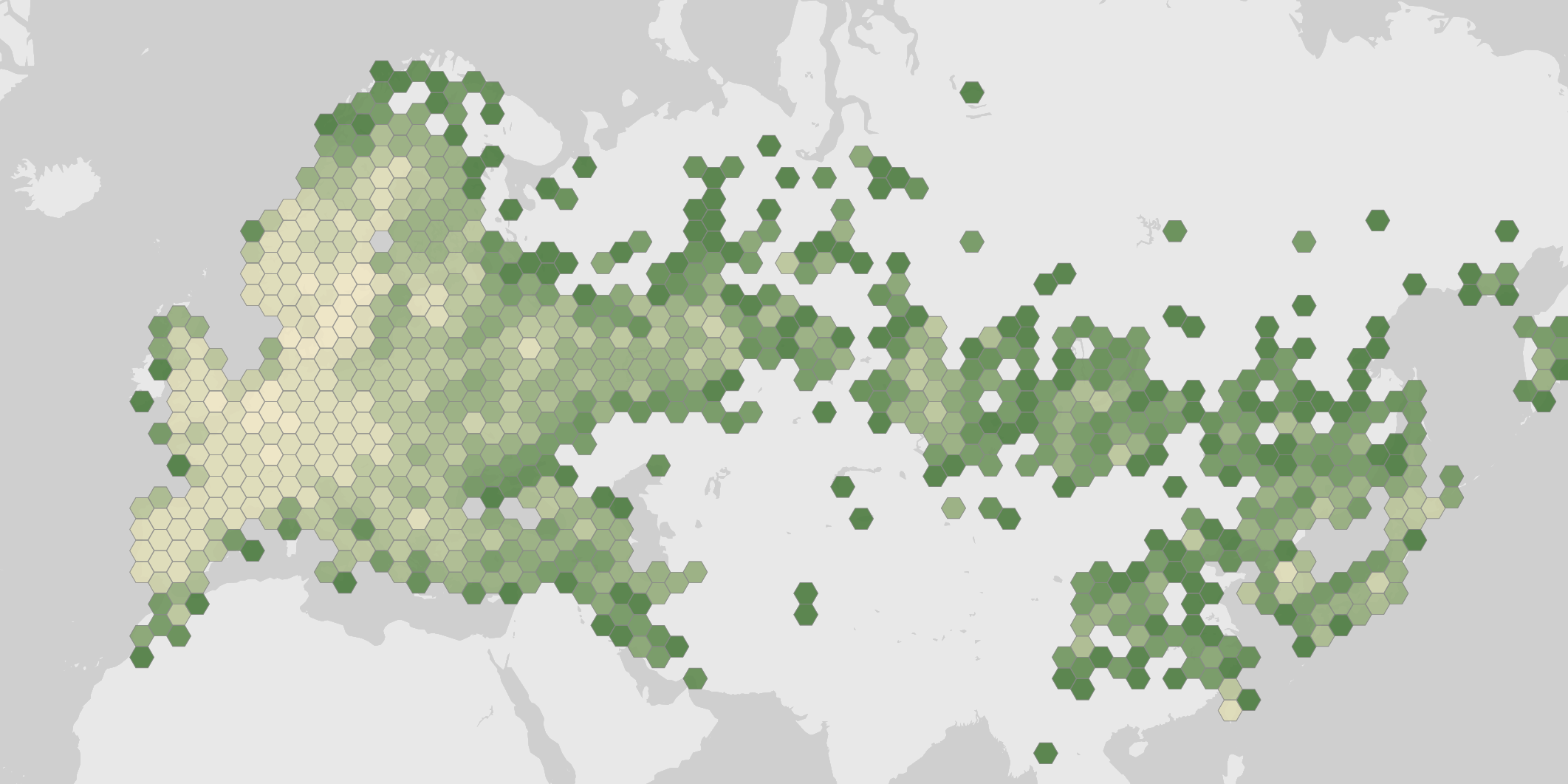
The breeding range runs across temperate Eurasia from Great Britain, though not Ireland, to Japan. In the east it includes most of China and Taiwan and much of Korea. The species breeds south to the Mediterranean in Europe but is absent from the islands there, apart from Sicily. In the north it reaches about 64°N in western Russia and 69°N in Siberia.
Most populations stay in one area all year. Young birds may disperse after breeding, and the birds show a reluctance to cross even short stretches of open water. Northern and eastern breeders depend on the cones of the Siberian stone pine. When the cone crop fails, many birds of the eastern subspecies move west into northern Sweden and Finland in autumn, and some stay to breed there.
The preferred habitat is mature woodland with large, old trees, which provide foraging surfaces and nesting holes. In Europe, deciduous or mixed forest is favored, especially where oak grows. Parks, old orchards and other wooded areas are also used, as long as they hold at least a 1 ha block of suitable trees. In mountains, old spruce and pine forests are used, and in Taiwan pine is favored. Moroccan birds nest in oak, Atlas cedar and fir.
In the north of its range it is mainly a lowland bird, but it reaches the tree line in Switzerland at 1,200 m or higher. In Austria it breeds occasionally at 1,800–2,100 m. In southern Japan it is mainly a mountain bird at 760–2,100 m, and in Taiwan at 800–3,300 m.
Communication
The most frequent call is a loud, sharp dwip, usually repeated twice and given more often when the bird is excited. A shrill alarm call sounds like sirrrr or tsi-si-si, and a thin tsit call is given just before flight.
The song is a slow whistled pee-pee-pee. It has many variants, including a faster version, and it is often mixed with the bird's calls.
The song of the distinctive Siberian subspecies is said to differ noticeably from that of its relatives. This difference could help show whether it is a full species.
Recordings
song · France · Sonothèque ADVL · Public domain
Diet and Nutrition
The Eurasian nuthatch eats mainly insects, especially caterpillars and beetles. Flies and caddisflies are its main prey groups, and it also takes stoneflies and moths. In autumn and winter it adds nuts and seeds to its diet, with hazel nuts and beech mast preferred.
It finds most food on tree trunks and large branches and sometimes investigates smaller branches. Outside the breeding season it also takes food from the ground. It can forage while climbing or descending head first, and some prey is caught in flight. It removes bark or rotten wood to reach insects, but it cannot chisel into healthy wood the way a woodpecker can. Large prey and hard nuts are wedged into crevices in the bark and broken open with the strong bill.
In winter it visits bird tables and feeders, eating fat, cheese, butter and bread. It has also been seen taking slaughterhouse offal.
Plant food is stored throughout the year but mostly in autumn. Each seed is hidden in a bark crack, sometimes in a wall or in the ground, and covered with lichen, moss or small pieces of bark. Siberian birds store the seeds of the Siberian stone pine, sometimes enough to last a whole year. Stored food is retrieved in cold weather and can be eaten up to three months after caching. Where beech mast is important, adult survival holds up in years with a poor crop, but fewer juveniles survive the autumn.
Nesting and Breeding
Nuthatches form monogamous pairs, and the pair holds a territory where it also spends the winter. Territories range from 2–10 ha in Europe to an average of 30.2 ha in the sparser conifer forests of Siberia. The male sings to defend the territory and to attract a mate. Both sexes perform a courtship display of floating, quivering flight, and the male also makes circular flights with a spread tail and raised head. He feeds the female while courting her. Even with lifelong pairing, genetic research in Germany found that at least 10% of the young in the study area had been fathered by a male from a neighboring territory.
The nest is in a tree cavity, usually an old woodpecker hole, though natural holes are also used. The female sometimes enlarges an existing hole in rotten wood. The nest is typically 2–20 m above the ground and has a deep base of pine bark or wood chips. If the entrance is too large, the female plasters it with mud, clay and sometimes dung to narrow it. A small entrance and a roomy interior, together with a deep layer of wood chips for burying eggs and small young, likely reduce the risk of predation. Nests with small entrances are the most successful. The female does most of the building, often plastering the cavity interior as well, and the work can take up to four weeks. The nest is often reused in later years.
The clutch is usually 6–9 red-speckled white eggs, and up to 13 are sometimes laid. The female incubates them for 13–18 days. The chicks are altricial and downy, and the female broods them until they fledge 20–26 days later. Both adults feed the chicks in the nest and continue feeding them after they fledge, until the young become independent at about 8–14 days. Normally only one brood is raised each year.
Because the species is sedentary, a juvenile can take up a territory only by finding a vacant area or by replacing a dead adult. In Europe, young birds almost always move to unoccupied habitat, while in the larger Siberian territories most settle within the range of an adult pair.
Population and Ecological Role
The European population has been estimated at 22.5–57 million birds, which suggests a global total of 45.9–228 million individuals. China, Taiwan, Korea, Japan and Russia each hold between 10,000 and 100,000 breeding pairs. Numbers in Siberia rise and fall with the pine cone crop from year to year. Recent decades have brought range expansion, with the bird colonizing Scotland and the Netherlands and spreading in Wales, northern England, Norway and the High Atlas in North Africa.
Across most of Europe, the sparrowhawk is the most important predator. Northern goshawks, hobbies, tawny owls, pygmy owls and least weasels also take nuthatches. A Swedish study found that 6.2% of nests in its study area were raided, though the raiders were not identified.
Common starlings can take over nest holes, which lowers breeding success, especially when the nest is high in a tree and nuthatches are dense locally. Introduced ring-necked parakeets may also compete for holes, but they mainly occupy fragmented urban woodlands, while nuthatches prefer large old oak woodlands. Mites of the genus Ptilonyssus live in the nasal cavities, and intestinal nematodes have also been found.
Conservation and Threats
The International Union for Conservation of Nature classifies the Eurasian nuthatch as Least Concern. Its large numbers and very wide breeding range support that rating, and the population appears to be stable. The species is common across much of its range, though densities are lower in the far north and in coniferous forests.
The main threat is the loss of old woodland. Large trees are essential to the species, so felling or fragmenting old forest can cause local declines or losses. Food supply is a second pressure: when pine cones or hazel and beech nut crops fail, numbers of young birds drop, and some birds move far from their usual range.
In recent decades the bird has spread into new areas, including Scotland, the Netherlands, Wales, northern England, Norway and the High Atlas. Its expansion shows that it can settle wherever suitable old trees and holes are available.
Photos
Photographs from via iNaturalist, licensed under CC0 1.0., by Mykola Borysenko via iNaturalist, licensed under CC BY 4.0., by Ксения Волянская via iNaturalist, licensed under CC BY 4.0., by Richard Nuttall via iNaturalist, licensed under CC BY 4.0., by Vlad Bormotov via iNaturalist, licensed under CC BY 4.0., by Jess Hughes via iNaturalist, licensed under CC BY 4.0., by Uliana Bogatyreva via iNaturalist, licensed under CC BY 4.0., by Daniel K via iNaturalist, licensed under CC BY 4.0., by Сергей Неклюдов via iNaturalist, licensed under CC BY 4.0., by Константин Селивёрстов via iNaturalist, licensed under CC BY 4.0., by Reni via iNaturalist, licensed under CC BY 4.0., by Kate Senatskaya via iNaturalist, licensed under CC BY 4.0., by Tim Parker via iNaturalist, licensed under CC BY 4.0., and by Tatiana Strus via iNaturalist, licensed under CC BY 4.0., credited on each photo.
Ecology and classification
Classification
- Phylum
- Chordata
- Class
- Aves
- Order
- Passeriformes
- Family
- Sittidae
- Genus
- Sitta
- Species
- Sitta europaea
Sources
- GBIF Species names and classification
- iNaturalist Photos
- Wikidata Common names and conservation status
- Wikipedia Summary extract
- Xeno-canto Audio recordings
- AnAge Longevity
- AVONET Bird mass, habitat, migration, diet and range size
- GloBI What it eats, what eats it, parasites and pollinators
- trophiCH
- TETRA-EU