The European squid can be found in abundance in coastal waters from the North Sea to at least the west coast of Africa. It is a large squid of the family Loliginidae, and its mantle can reach 40 cm (16 in) in length.
The species lives from sea level down to depths of 500 m (1,600 ft). It is found throughout the Mediterranean and the eastern Atlantic, where it is one of the more common squids of shallow shelf waters.
The European squid is listed as Data Deficient by the IUCN, so its status is not yet clear. Its abundance and heavy fishing make it an important species for anyone studying coastal cephalopods.
Identification and Appearance
The most useful field mark is the body shape: a long, moderately slender, cylindrical body with rhomboid fins that together cover about two-thirds of the mantle length. The rear edge of the fins is slightly concave, and the fins drive the squid's movement alongside jet propulsion.
The head is relatively small, with large eyes covered by a transparent membrane. Like other squid, it has ten limbs around the mouth and beak. Eight are relatively short arms, while two long tentacles are used to catch prey. In males, the fourth left arm is a hectocotylus used in mating.
Most adults measure 15 to 25 cm (6 to 10 in) in mantle length, though they can grow to 30 to 40 cm (12 to 16 in). Males are generally larger than females and grow more rapidly.
The body colour is greyish-transparent or reddish, depending on how far the colour cells (chromatophores) in the skin are expanded. Males carry small chromatophores on the mantle that help distinguish them.
Distribution and Habitat
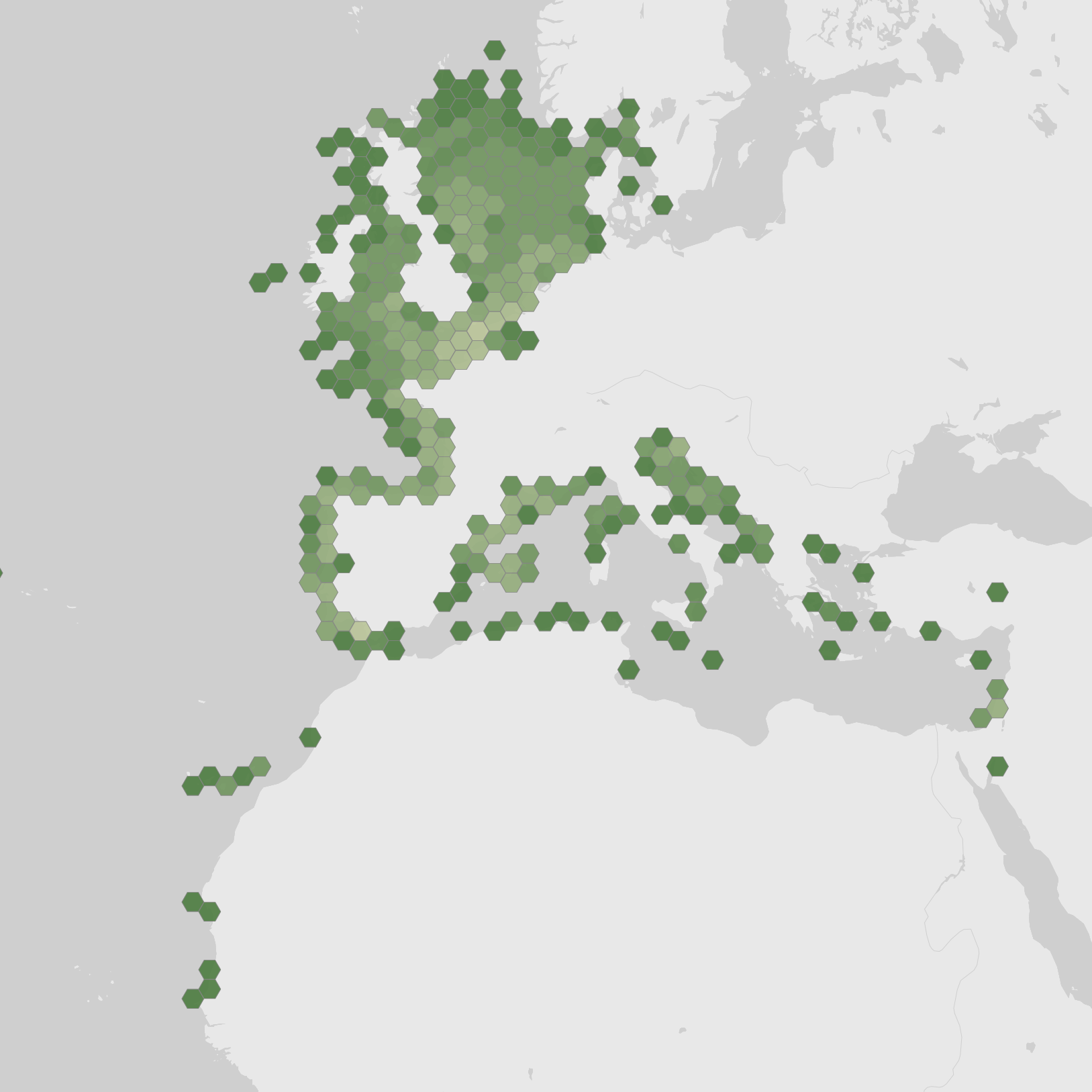
The European squid occurs throughout the Mediterranean and in the eastern Atlantic Ocean, from the North Sea to the Gulf of Guinea. In British waters, it is found mainly in the Irish Sea, along the south coast of England, and off northern Scotland.
The species is a neritic, semidemersal squid that lives close to the seabed of the continental shelf. It makes distinct horizontal and vertical migrations, shifting its position depending on the environment. Its depth range runs from sea level to 500 m (1,600 ft).
In the Adriatic Sea, it is found over a range of bottoms, from sandy to muddy substrates. It occupies waters between 13°C and 20°C, and it prefers about 18°C.
In observations, presence appears strongest in October, with high levels also in January and February.
Photos
Photographs from via iNaturalist, licensed under CC0 1.0., by Vsevolod Rudyi via iNaturalist, licensed under CC BY 4.0., by Isaac Guard via iNaturalist, licensed under CC BY 4.0., by lukeromaine via iNaturalist, licensed under CC BY 4.0., by Michel Langeveld via iNaturalist, licensed under CC BY 4.0., by Matthieu Trotignon via iNaturalist, licensed under CC BY 4.0., by John Hepburn via iNaturalist, licensed under CC BY 4.0., by Julien Renoult via iNaturalist, licensed under CC BY 4.0., by luluchouette via iNaturalist, licensed under CC BY 4.0., by Katrin Simon via iNaturalist, licensed under CC BY 4.0., by Donald Davesne via iNaturalist, licensed under CC BY 4.0., by Denis via iNaturalist, licensed under CC BY 4.0., by Tim Johnson via iNaturalist, licensed under CC BY 4.0., by Lou Wagstaffe via iNaturalist, licensed under CC BY 4.0., by nebrooks via iNaturalist, licensed under CC BY 4.0., by Aaron Chidwick via iNaturalist, licensed under CC BY 4.0., and by Daniel Benák via iNaturalist, licensed under CC BY 4.0., credited on each photo.
Ecology and classification
Classification
- Phylum
- Mollusca
- Class
- Cephalopoda
- Order
- Myopsida
- Family
- Loliginidae
- Genus
- Loligo
- Species
- Loligo vulgaris
Sources
- GBIF Species names and classification
- iNaturalist Photos
- Wikidata Common names and conservation status
- Wikipedia Summary extract
- Encyclopedia of Life Habitat, diet and behavior traits
- GloBI What it eats, what eats it, parasites and pollinators
- Wardeh et al. 2015 (EID2)
- MammalBase