The giant panda has the strongest bite force relative to its body size of any bear, a paradox for an animal that spends up to twelve hours a day chewing almost nothing but bamboo.
Ailuropoda melanoleuca is a bear endemic to China, instantly recognizable by its white coat marked with black patches on the ears, eyes, legs and shoulders. It lives in a handful of mountain forest regions in Sichuan, Shaanxi and Gansu provinces, and the IUCN lists it as Vulnerable after decades of habitat loss.
Few animals combine such contradictions so visibly: a carnivore's skull built for meat, a digestive tract that struggles to extract nutrients from woody stems, and a reputation as one of the world's most protected and adored species.
Identification and Appearance
The panda's black-and-white coat is its most obvious identifier: white fur covers the body while black patches ring the eyes and cover the ears, legs and shoulders. Researchers think this pattern works as camouflage in two ways—white areas blend into snow, and black shoulders and legs vanish into forest shade—while the black ears may signal aggression and the eye patches help pandas recognize one another.
Adults measure 1.2 to 1.9 meters long, including a tail of 10 to 15 centimeters, and stand 60 to 90 centimeters at the shoulder. Weight typically ranges from 70 to 125 kilograms, with an average of 100 to 115 kilograms; large males can reach 160 kilograms. Females run 10 to 20% smaller than males, the species' main form of sexual dimorphism.
The skull is built for crushing: large molars, an expanded temporal fossa and the largest masticatory muscles of any bear support a bite force measured at 1,298.9 newtons at the canines and 1,815.9 newtons at the carnassials in a 117.5-kilogram individual—the highest bite force relative to body size recorded among ursids.
A modified sesamoid bone forms a pseudo-thumb on each forepaw, letting the panda grip bamboo stalks much as a primate grips with an opposable thumb. Its tail, at 10 to 15 centimeters, is the second-longest in the bear family after the sloth bear's.
Distribution and Habitat
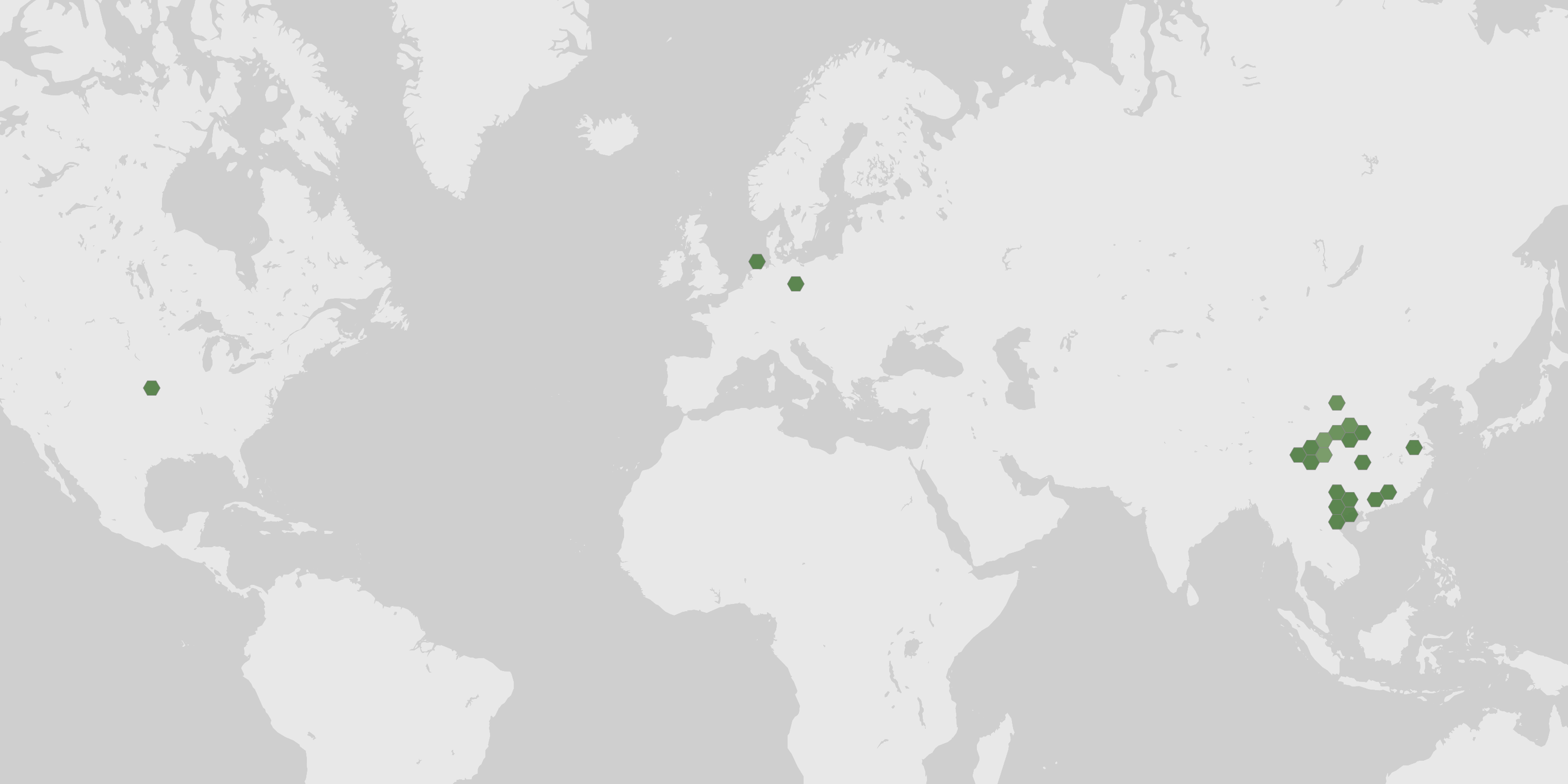
The giant panda survives only in fragmented mountain regions of central China, principally Sichuan province with smaller populations in neighboring Shaanxi and Gansu. Six mountainous areas hold the remaining wild population, including the Qinling, Daxiangling, Qionglai, Liangshan and Xiaoxiangling ranges.
Pandas live in temperate montane forest between roughly 1,200 and 3,400 meters elevation—sometimes recorded as high as 3,900 meters—wherever bamboo grows densely beneath a canopy of conifers or broadleaf trees. The Qionglai population favors upland conifer forest almost exclusively, Qinling pandas select mixed evergreen broadleaf and conifer stands, and the Daxiangling population uses both forest types.
This is a fraction of the panda's former range, which once stretched from Myanmar and northern Vietnam across much of southeastern China. Subfossil remains show pandas persisted in Yunnan's Gaoligong Mountains as recently as 5,000 years ago; by 2001 researchers estimated the species' range had shrunk by about 99% from its historical extent, driven first by climate shifts and later by deforestation and human expansion.
Monthly observation records show sightings in every month, with the highest counts in November and December and a low point from August through October. Because these are presence records rather than population counts, the pattern likely reflects observer activity and visibility more than any real seasonal shift in panda numbers.
Behavior and Lifestyle
Giant pandas are solitary outside the breeding season, each adult holding a defined territory that a resident female defends against other females. They come together only briefly each spring to mate; once that is done, the male leaves and plays no further part in raising the cub.
Unlike other bears, pandas do not hibernate. Instead of building a permanent den, they shelter in hollow trees or rock crevices and shift to lower, warmer elevations when winter turns cold, occasionally covering themselves in horse manure for extra insulation. They are strong climbers and capable swimmers, though they spend most of their time on the ground.
Activity does not follow the simple dawn-and-dusk pattern once assumed; pandas show peaks in the morning, afternoon and around midnight, a pattern likely driven by the poor nutritional quality of bamboo, which forces frequent feeding, and by the absence of major predators, which removes any pressure to stay hidden during the day. Activity rises through June, tapers off in late summer and autumn, and picks up again from November through March, tracking closely with the amount of solar radiation on a given day.
Communication
Vocal signals mark the boundary between peace and conflict. A blatting call accompanies calm, non-threatening encounters, while roars and growls appear during fights or hostile stand-offs. Squeals signal submission from the losing side of a dispute, honks and moans serve other social functions, and a female in estrus announces her condition with a distinctive chirp.
Scent is the panda's primary channel for staying in contact with a population it rarely meets face to face. Glands near the anus deposit chemical marks on rocks and trees, and each sex has its own posture for doing so: males lift a hind leg or rub their backside against a landmark, while females squat or rub their genitals directly on the surface. These marks, sometimes concentrated at shared "scent stations," carry information on sex, age, individual identity, reproductive status and dominance—a higher mark advertises a larger, more competitive animal.
What a panda reads into a scent mark changes with the season. Outside the breeding period, females are drawn to the odors of other females, since finding a mate is not their priority; during the brief breeding season, opposite-sex odors become far more attractive. Female urine contains civetone and decanoic acid, compounds that raise androgen levels in males and act as panda pheromones, letting a female broadcast her fertility to any male that crosses her scent trail.
Diet and Nutrition
Bamboo makes up more than 99% of the giant panda's diet, a food so poor in nutrients that pandas extract only about 17% of what the stems and leaves contain. To compensate, they feed for 10 to 12 hours a day and travel as little as possible, treating nearly every waking hour outside of rest as time to forage.
Because bamboo grows year-round, pandas have traded nutritional quality for reliability: an abundant food source that requires little competition or searching, at the cost of needing to eat almost constantly. They typically feed in an upright sitting position that frees their forelimbs, using the pseudo-thumb on each forepaw to grip and strip stalks with practiced dexterity.
The panda's digestive system carries traces of its carnivorous ancestry rather than a typical herbivore's adaptations: a short gut and a stomach with extremely muscular walls, lined with a thick layer of mucus that protects the tissue from bamboo splinters. Beyond bamboo stems and shoots, pandas occasionally take fruit such as kiwi, and in rare cases small mammals, fish and insects, though these make up a negligible share of the overall diet.
Reproduction and Raising Young
Mating takes place in a narrow window from March to May, when a female comes into estrus for just one to three days a year. Males compete for access to a receptive female, and copulation itself, with the female crouching and the male mounting from behind, lasts anywhere from 30 seconds to five minutes, often repeated to secure fertilization.
Gestation runs from roughly 95 to 160 days, an unusually wide range caused by delayed implantation: the fertilized egg can linger before attaching to the uterine wall for one and a half to four months, apparently timed so cubs arrive when conditions are most favorable. Most births happen in August and September, after only about six weeks of actual embryonic development.
Newborn cubs are pink, blind and toothless, weighing just 85 to 140 grams—about 1/800th of the mother's weight, proportionally the smallest of any placental mammal. Twins occur in roughly half of pregnancies, but in the wild the mother can typically nurse only one; she selects the stronger cub, and the other usually dies of starvation because she does not store enough fat to produce milk for two. Cubs nurse up to 14 times a day for sessions as long as 30 minutes, open their eyes at three weeks, and cannot move independently until three to four months old.
Weaning is complete by about 46 weeks, though cubs typically stay with their mother until 18 months to two years of age, and females generally breed no more often than once every two years. Breeding in captivity proved so difficult that researchers turned to artificial insemination, frozen sperm banks and even hormone treatments to improve success; the first cub conceived from frozen sperm was confirmed born in July 2009.
Population and Ecological Role
Genetic sampling from panda droppings suggested in 2006 that the wild population could be as large as 3,000 individuals, well above earlier estimates of around 1,000 based on conventional surveys; either figure leaves the species spread thinly across more than 30 fragmented subpopulations.
Pandas act as seed dispersers for the bamboo they depend on, tying their own numbers directly to the health of the forests they inhabit. As an umbrella species, panda habitat protection has been shown to shelter around 70% of China's forest bird species, 70% of its mammals and 31% of its amphibians within the same reserves.
Adult pandas have few natural predators, but cubs and sub-adults under about 50 kilograms are vulnerable to snow leopards, yellow-throated martens, eagles, feral dogs, Asian black bears and leopards. They share habitat and bamboo with the takin, and compete to a lesser extent with wild boar, Chinese goral and Asian black bears; when competition is intense, pandas shift to the margins of takin range. Disease poses another threat, particularly baylisascariasis from the parasitic nematode Baylisascaris schroederi, which kills more wild pandas than any other single cause, alongside susceptibility to canine distemper and other pathogens carried by domestic dogs and livestock.
Conservation and Threats
The IUCN lists the giant panda as Vulnerable, an improvement from its former Endangered status but still short of full security. Habitat loss and fragmentation remain the most serious threat: the bamboo forests left in China support only around 1,000 to 3,000 wild pandas, split across roughly 20 disconnected patches that make it hard for animals to move between populations.
Poaching has declined sharply since anti-poaching laws took effect—China carried out its first executions for trading panda skins in October 1989—but historic demand for pelts, along with a naturally low birth rate in both wild and captive pandas, has left the species with little margin for error. Modeling suggests climate change could shrink the panda's remaining range by up to 100% by 2100 as bamboo distributions shift.
Protections now include CITES Appendix I status, China's 1988 Wildlife Conservation Law, and a reserve network that grew from 13 sites in 1998 to more than 40 by 2006. In 2020, nearly 70 separate reserves—including the long-standing Wolong National Nature Reserve—were merged into the 10,500-square-mile Giant Panda National Park, an area roughly three times the size of Yellowstone. The Sichuan Giant Panda Sanctuaries earned UNESCO World Heritage status in 2006, and Chinese researchers report that panda numbers have held stable over the past 20 years.
Conservation status
- LC
- NT
- VU
- EN
- CR
Vulnerable
Cultural Significance
The giant panda has held a special place in Chinese culture for millennia. The Empress Dowager Bo was buried with a panda skull in her tomb, and imperial gardens kept live pandas as prized exhibits as far back as the Western Han Dynasty, when the writer Sima Xiangru described the panda as the most treasured animal in the emperor's collection at Chang'an. One folk tale traces the panda's black eye patches to a girl who died protecting a cub, with mourning pandas said to have rubbed ash-stained paws across their eyes and left the marks behind.
Ancient Chinese texts likely refer to the panda under the name mo (貘), a term later misapplied to the Malayan tapir after a 19th-century French scholar misread a woodcut illustration; some scholars also connect the panda to the legendary creature pixiu. During the Ming Dynasty, a captured animal presented to the Yongle Emperor was identified as a zouyu, a mythical "righteous animal" believed to appear only under a benevolent ruler.
In the twentieth century the panda became a global diplomatic symbol: China gifted pandas to zoos abroad through the 1970s in a practice dubbed "panda diplomacy," later replaced by ten-year loans worth up to a million dollars a year, with any cubs born abroad remaining Chinese property. Chi Chi, exhibited at London Zoo, became popular enough to inspire the World Wildlife Fund's panda logo, while panda pelts—once believed to ward off ghosts and reveal the future through dreams—have historically sold in Japan for prices as high as $176,000.
Fun Facts
- A Chinese folk tale holds that the panda's black eye patches come from grief: a girl died shielding a cub, and mourning pandas wiped their eyes with ash-stained paws.
- The character mo (貘), used in texts as old as the first-century Shuowen Jiezi, most likely referred to the giant panda long before it was mistakenly applied to the Malayan tapir.
- During the Ming Dynasty, a panda presented to the Yongle Emperor was recorded as a zouyu, a legendary animal said to appear only under a virtuous ruler.
- Panda semen can be frozen for decades and shared between zoos worldwide; the first cub conceived from frozen sperm was confirmed born in July 2009.
- Panda pelts were once believed to ward off ghosts and to help predict the future through dreams, and historically sold in Japan for as much as $176,000.
Ecology
Behavior
- Nocturnal
- Solitary
- Territorial
- Crepuscular
Habitat
- Forest
- Mountain
Diet
- Herbivore
Photos
SourcesGBIFiNaturalistWikidataWikipediaEncyclopedia of LifeAnimal Diversity WebAnAge