The rooting poison pie gets its name from a curious habit: its stem tapers into a long, root-like base that burrows down to the buried latrines of small mammals like moles, wood mice, and shrews.
This agaric belongs to the family Hymenogastraceae and is found across Japan, Europe, and North America, fruiting on soil in woods, grassy areas, and even residential hedges. Its distinctive almond-like odor and unusual growth habit make it a favorite subject for mycologists studying both fungal development and the nesting ecology of small mammals.
Fruiting Body and Identification
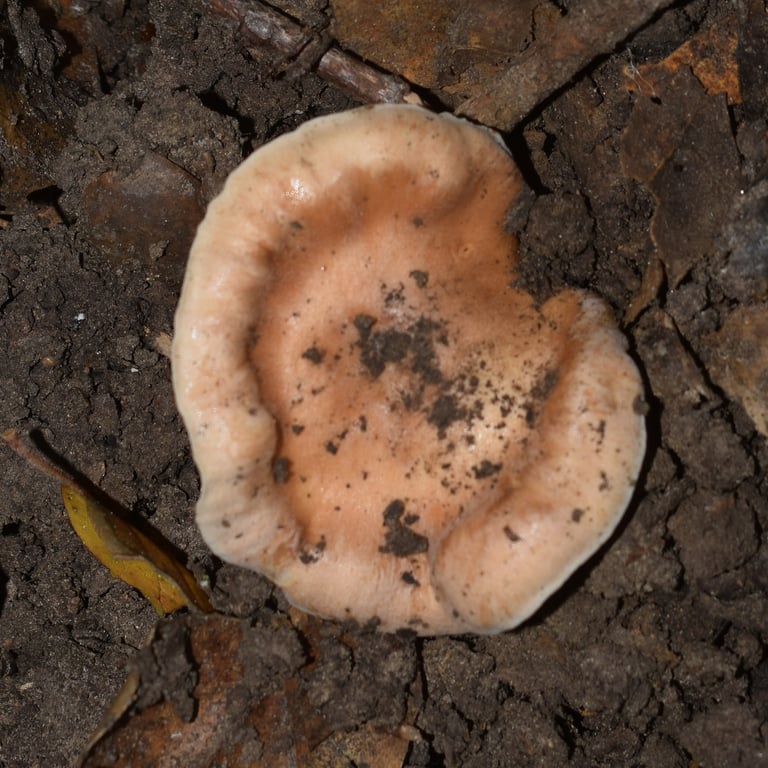
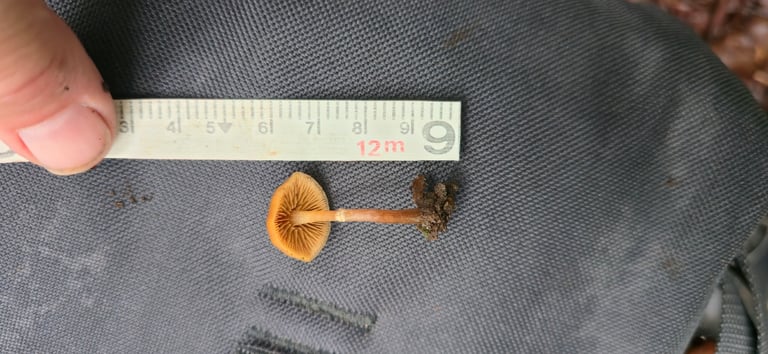
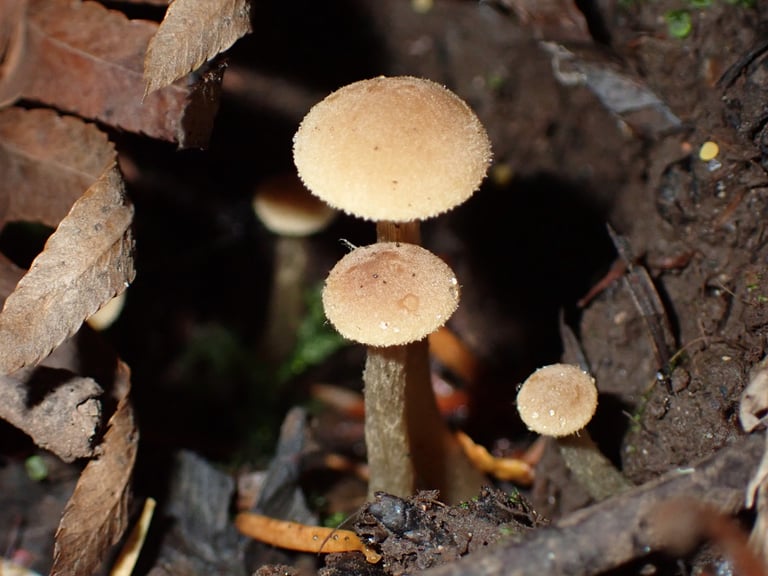
The most reliable identifying features of Hebeloma radicosum are its tapering, root-like stipe base and its strong almond or marzipan odor, produced by aromatic compounds including benzaldehyde and phenylethanol. The cap measures 5 to 10 centimeters across, starting convex before flattening with age. Fresh caps are sticky to the touch, colored yellowish tan to golden brown or ochre, often paler toward the margin, and young caps curl inward at the edge with hanging remnants of the partial veil still attached.
The gills are notched to nearly free from the stipe, with scalloped or fringed edges that become more pronounced in maturity. They start white and shift through ochre to reddish brown as the spores ripen. The stipe itself runs 7.5 to 18 centimeters long and 1.3 to 2.5 centimeters thick, typically swollen in the middle and tapered at both ends, with a ring on its upper portion and pale brownish fibers and cottony scales covering a cream-colored base.
The flesh tastes mild but carries that characteristic almond scent. The spore print is rusty brown to cinnamon-brown, with almond-shaped, warty spores measuring 8 to 10 by 5 to 6 micrometers, borne on four-spored basidia.
Distribution and Habitat
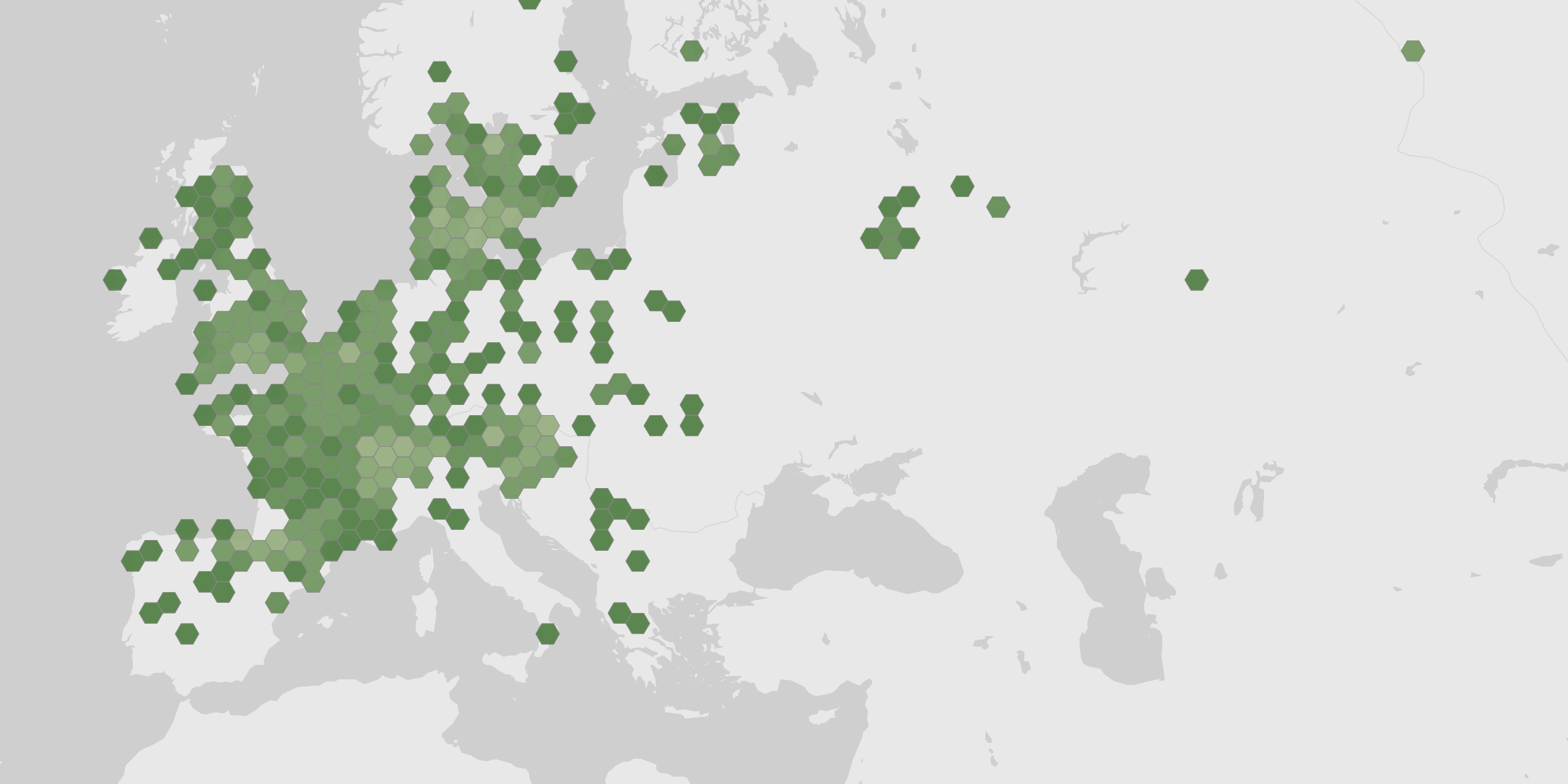
Hebeloma radicosum occurs in Japan, Europe, and North America, where fruit bodies appear scattered or in groups on soil and grassy ground. It is also found near bushes and hedges in residential settings, showing some tolerance for human-altered landscapes alongside its presence in natural woodland.
Observation records show fruiting concentrated in the later months of the year, suggesting a pronounced autumn fruiting period, though these counts reflect presence rather than true abundance or the full extent of the species' range.
Ecology and Relationships
Hebeloma radicosum is an ammonia fungus that associates specifically with the latrines of moles, wood mice, and shrews, drawing on the nitrogen-rich waste these animals leave underground. This tight connection to buried latrines has made the mushroom a useful marker for researchers studying mole nesting ecology, since its fruiting bodies can reveal the location of hidden burrow systems.
A Japanese field study found that male flies of the genus Suillia rest on the mushrooms and actively defend their territory there from rival males while awaiting females to mate with, making the fruiting body a small stage for insect courtship behavior.
In laboratory culture, the fungus reveals unusual growth habits: fruit bodies are negatively gravitropic but not phototropic, meaning they grow away from the pull of gravity without responding to light direction. They do not need light to begin forming primordia, but light becomes necessary later for the fruit body to differentiate and mature, a pattern that likely reflects its life cycle of colonizing deep underground before pushing fruit bodies up to the surface.
Uses and Cultural History
Hebeloma radicosum holds little cultural or culinary significance, appearing mainly as a subject of ecological curiosity rather than any tradition of use. It occasionally draws attention at European mycological festivals and forays as a species of interest for its unusual growth habit and odor, rather than for any culinary or medicinal role.
Fun Facts
- Hebeloma radicosum can be grown entirely in pure laboratory culture, letting researchers study its fruiting behavior under controlled conditions.
- Its fruit bodies grow away from gravity but ignore light direction entirely, a negatively gravitropic yet non-phototropic habit that is unusual among mushrooms.
- While the fungus does not need light to begin forming its early fruiting structures underground, it does require light later on to finish differentiating and maturing once above ground.
Photos
Photographs from via iNaturalist, licensed under CC0 1.0., by Екатерина Войнова via iNaturalist, licensed under CC BY 4.0., by ionafraser via iNaturalist, licensed under CC BY 4.0., by gerardbertrand via iNaturalist, licensed under CC BY 4.0., by Markus Krieger via iNaturalist, licensed under CC BY 4.0., by Manuela Fiorini via iNaturalist, licensed under CC BY 4.0., by victor laborde via iNaturalist, licensed under CC BY 4.0., by Tobias Schiller via iNaturalist, licensed under CC BY 4.0., by Virn Stothers via iNaturalist, licensed under CC BY 4.0., by Ульяна Лалак via iNaturalist, licensed under CC BY 4.0., and by Maaike Verschueren via iNaturalist, licensed under CC BY 4.0., credited on each photo.
Ecology and classification
Classification
- Phylum
- Basidiomycota
- Class
- Agaricomycetes
- Order
- Agaricales
- Family
- Hymenogastraceae
- Genus
- Hebeloma
- Species
- Hebeloma radicosum
Sources
- GBIF Species names and classification
- iNaturalist Photos
- Wikidata Common names and conservation status
- Wikipedia Summary extract