Hibiscus syriacus is the national flower of South Korea, and it is mentioned in the South Korean national anthem. Known as the rose of Sharon, it is a flowering plant in the mallow family, Malvaceae.
The species is native to parts of east Asia but has been widely introduced elsewhere, including much of Europe and North America. Its specific epithet, syriacus, comes from the fact that the first specimens were collected from gardens in Syria.
Other common names include Syrian ketmia, shrub althea, Korean rose and rose mallow. The shrub is grown mainly for its long summer flowering and its tolerance of difficult conditions.
Identification and Appearance
The most useful field mark is the flower: five broad petals, up to 7.5 centimeters (3 inches) across, with a column of stamens and a pistil rising from the center. The stamens are white with yellow tips, and the petals are usually pink, though cultivars also show dark pink, nearly purple, light pink, white, red, mauve, violet or blue, sometimes with a differently colored throat.
The shrub is upright and vase-shaped, reaching 2 to 4 meters (7 to 13 feet) in height. Its stems rarely branch unless they are pruned, so it forms many long, straight stems that rise from about 1.5 to 4 centimeters (0.5 to 1.5 inches) above the ground.
The leaves are usually green or yellowish green, alternate and broadly ovate, with three distinct lobes and coarsely toothed margins. They are about 7.5 centimeters (3 inches) long and have palmate veins.
Most modern cultivars produce almost no fruit. Where fruit does form, it is a green or brown five-valved capsule that is not showy and often lasts through much of the winter.
Distribution and Habitat
The species is native to south-central and southeastern China and to Taiwan, where it grows on sea cliffs, hillsides and along streams and roadsides. In its native range it occurs below 1,200 meters.
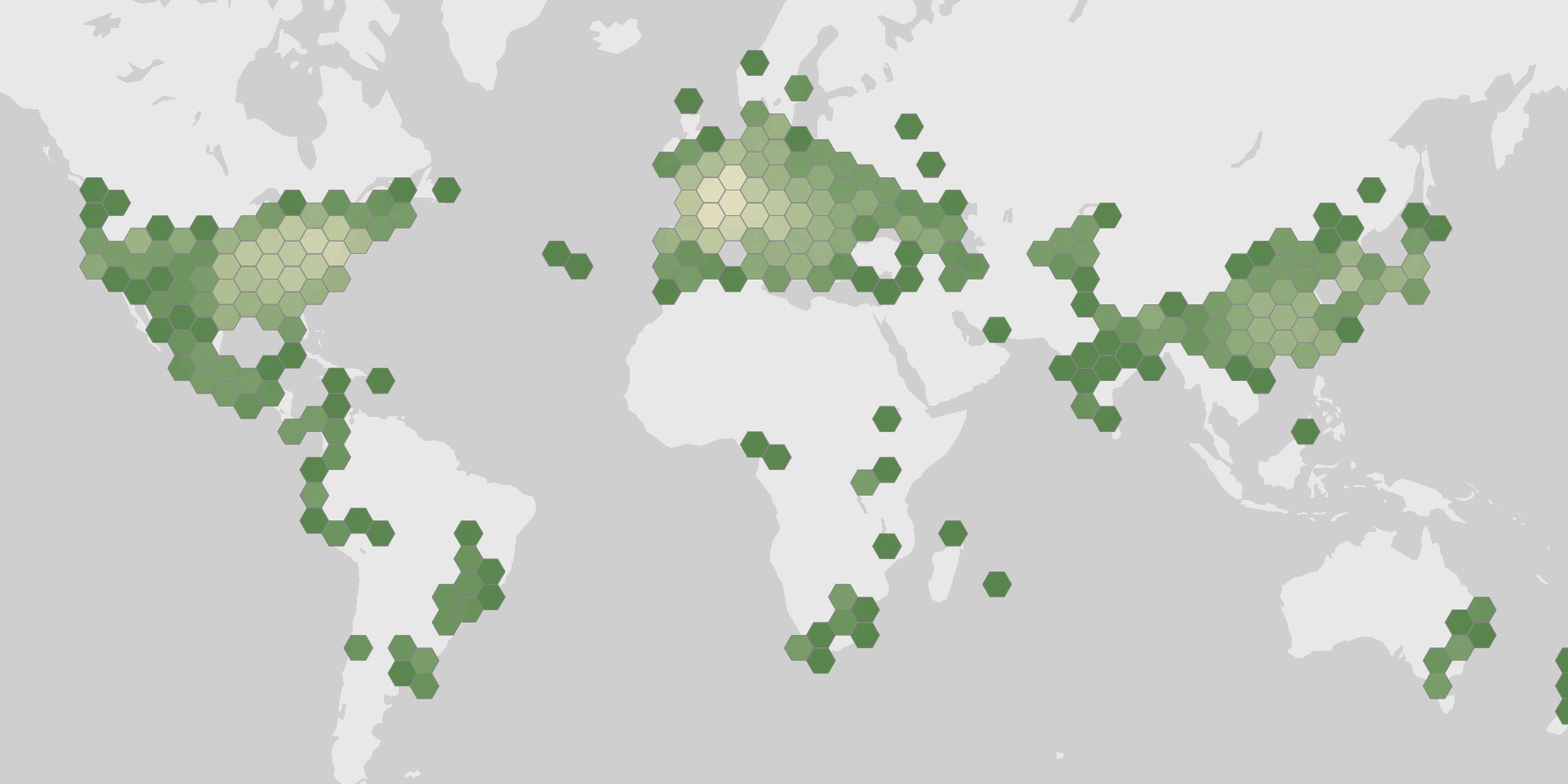
Hibiscus syriacus has spread far beyond east Asia. It has been introduced across much of Europe, including Austria, Germany, France, Italy and Great Britain, and it is established in many parts of North America, from Texas and Utah to New York and Florida-adjacent states such as Georgia. It also occurs in Japan, Korea, India, Pakistan, Iran and Thailand, among other countries.
In suburban and cultivated settings it is common. The plant is extensively grown along roadsides and in gardens, which is why it appears so widely outside its native range.
Sightings peak in July and August, which shows when people most often see the plant rather than how common it is.
Growth and Form
Hibiscus syriacus is a perennial, hardy deciduous shrub. Its upright, vase-shaped form develops from the many long stems that rise from the base, and it reaches 2 to 4 meters (7 to 13 feet) tall.
The bark on the thin, gray branches is marked by pale lenticels, and the branches bear raised leaf scars and small buds. Without pruning, the stems stay largely unbranched, so the plant keeps its open, columnar outline.
Leaves appear unusually late in the season, usually in May. Once the summer flowers open, the flexible stems can bend under the weight of the blooms until they reach about halfway to the ground.
Ecology and Relationships
Many birds eat the plant, mostly passerine songbirds such as finches, larks and buntings. Pigeons, partridges, ducks and geese also feed on it, and its seeds are a food source for several finch species.
Sap-feeding true bugs in the order Hemiptera are among its most common insect feeders. Beetles and moth caterpillars feed on it less often.
Bumblebees and honeybees are the main insect visitors to its flowers, with the bumblebees Bombus terrestris and Bombus pascuorum and the honeybee Apis mellifera standing out. Bees in the order Hymenoptera make up the main visitor group, while hoverflies, beetles and moths visit less frequently.
Soil bacteria in the genus Micromonospora are among the microorganisms listed as its parasites.
Uses and Human Relationships
The shrub is a popular ornamental plant and has many cultivars. Several cultivars have gained the Royal Horticultural Society's Award of Garden Merit.
Gardeners value it for its tolerance of frost, drought, heat, humidity and urban pollution. It produces its best results in a warm, sheltered position with full sun and a well-drained, neutral soil.
It is fairly easy to propagate from seed, though seedling results vary, and it can also be grown from cuttings or layering to reproduce a particular plant.
Old shrubs can develop trunk cankers that may eventually kill them. Leaf spots, blights and rusts also affect the plant, and Japanese beetles can severely damage foliage if they are left unchecked.
Photos
Photographs from via iNaturalist, licensed under CC0 1.0., by D. Rafael S. Fernandes via iNaturalist, licensed under CC BY 4.0., by Kaden Slone via iNaturalist, licensed under CC BY 4.0., by Ambra Galassi via iNaturalist, licensed under CC BY 4.0., and by Alex Press via iNaturalist, licensed under CC BY 4.0., credited on each photo.
Ecology and classification
Growth habit
- Shrub
Classification
- Phylum
- Tracheophyta
- Class
- Magnoliopsida
- Order
- Malvales
- Family
- Malvaceae
- Genus
- Hibiscus
- Species
- Hibiscus syriacus
Sources
- GBIF Species names and classification
- iNaturalist Photos
- Wikidata Common names and conservation status
- Wikipedia Summary extract
- Encyclopedia of Life Habitat, diet and behavior traits
- Plants of the World Online Native range, life form and climate (WCVP)
- USDA Plants US plants: growth habit and growing conditions
- GloBI What it eats, what eats it, parasites and pollinators
- trophiCH
- Wardeh et al. 2015 (EID2)
- DoPI
- EuPPollNet