The northern firmoss (Huperzia selago) is a small, evergreen clubmoss that grows across the cold northern parts of the world. Its range is circumpolar, covering northern North America, Europe and Asia.
It is a vascular plant in the family Lycopodiaceae and a perennial pteridophyte. Its stiff, upright stems are densely covered with scale-like leaves, which gives it a sturdy look even in harsh northern settings.
Identification and Appearance
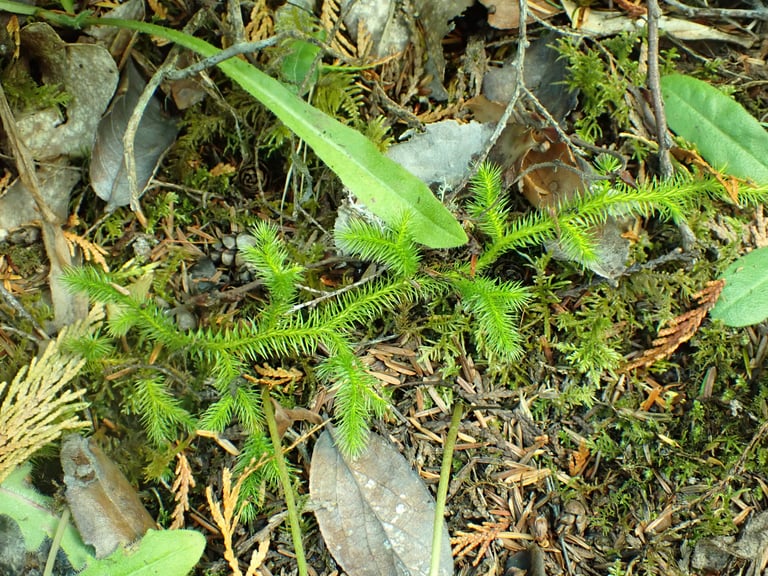
The most useful field mark is the leaf shape. The leaves are flat and needle-like, arranged in a dense spiral around the stem, and measure 4–8 mm long.
The stalk is 5–20 cm tall and branches dichotomously, meaning it forks into two branches of nearly equal length. This even branching gives the plant a neat, symmetrical outline.
Sporangia sit at the base of the leaves near the top of the shoot. Small bulbils often form in the leaf axils, where the leaves join the stem.
Distribution and Habitat
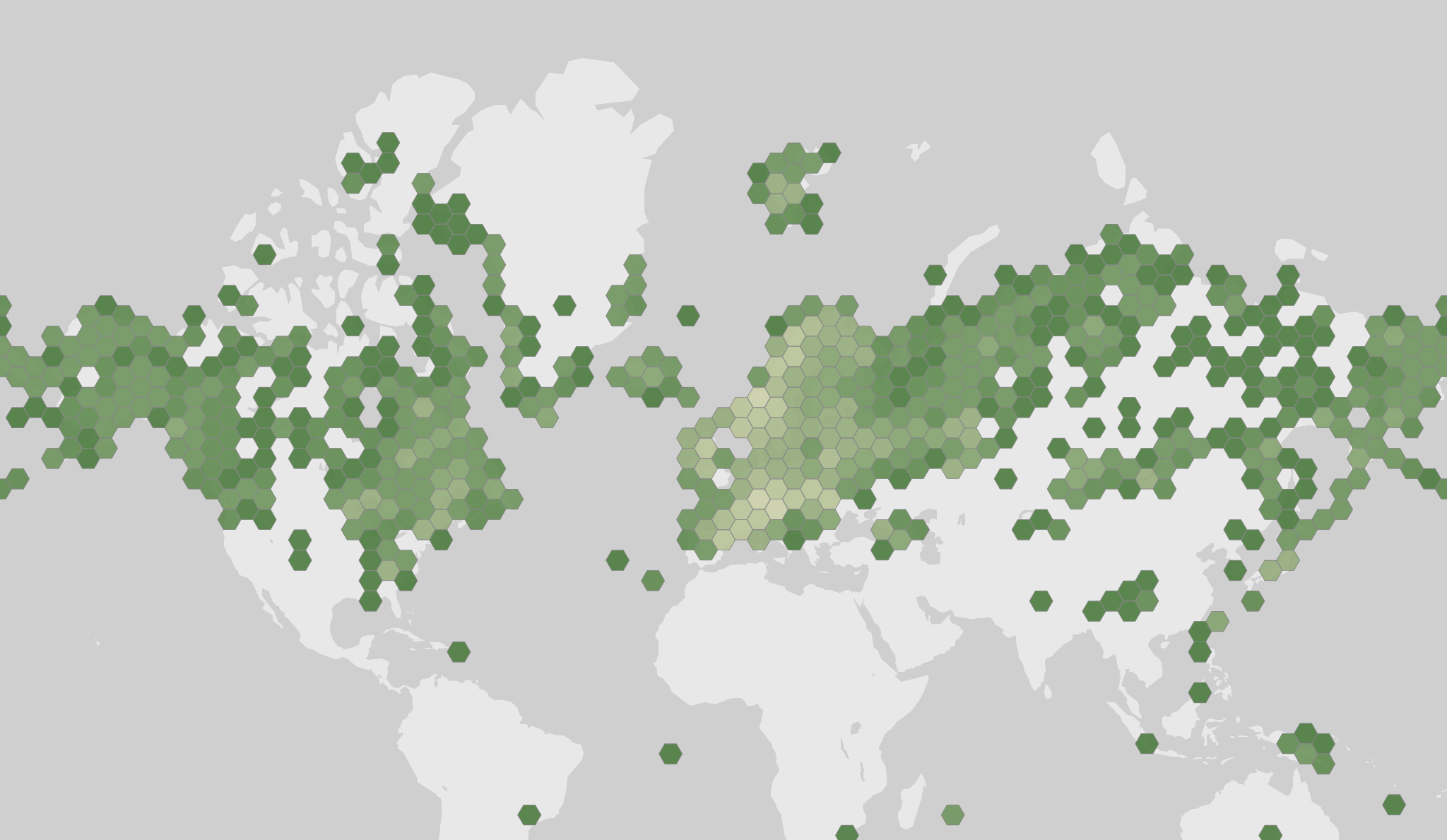
Huperzia selago is circumpolar and occurs across the northern parts of North America, Europe and Asia. In Europe its range runs from Svalbard south to the mountains of northern Spain and Italy, and from the British Isles east through central Asia to the Kamchatka Peninsula, Japan and the Aleutian Islands. It also occurs in Greenland, Iceland and the Faroe Islands.
It grows in sandy borrow pits, ditches, lakeshore swales, heathland and conifer swamps. It is most often found in these wet or sandy settings at low to middle elevations, from sea level to about 700 m.
It rarely grows on acidic, igneous rock or on calcareous coastal cliffs, and occasionally reaches about 1,600 m. In the northeastern United States it is found in boreal habitat but not in alpine zones.
Observation records peak in July and August, though the species is recorded in every month. These records show where people have seen the plant, not how many plants grow there.
Growth and Form
Huperzia selago is a perennial herb with a subshrub-like form. Its upright stems are sturdy and stiff, and they remain green throughout the year.
The dichotomously branching stalk reaches 5–20 cm in height. Because the branches are of nearly equal length, the whole plant forms a compact, evenly shaped tuft.
Ecology and Relationships
Birds are the main animals that eat Huperzia selago. Finches and songbirds, including the common redpoll and the skylark, feed on it, and game birds such as the rock partridge also take it. Pigeons, waterfowl and other smaller bird groups occasionally feed on it as well.
Several fungi, including Fusarium verticillioides, Phoma herbarum and Trichoderma viride, have been found on the plant, but these are not usual partners for the species.
Uses and Human Relationships
Indigenous peoples of the Upper Tanana region used the whole plant in a poultice applied to the head to treat headaches. In Finnish traditional medicine the plant was used as a remedy against rickets, as an emetic and as a botanical insecticide.
The plant contains strong acetylcholinesterase inhibitors, which is why its traditional uses carry real risk.
Photos
Photographs from via iNaturalist, licensed under CC0 1.0., by Tim Aßmus via iNaturalist, licensed under CC BY 4.0., by Patrick Watts-Mabbott via iNaturalist, licensed under CC BY 4.0., by Thomas Ebner via iNaturalist, licensed under CC BY 4.0., and by Hilary Rose Dawson via iNaturalist, licensed under CC BY 4.0., credited on each photo.
Ecology and classification
Classification
- Phylum
- Tracheophyta
- Class
- Lycopodiopsida
- Order
- Lycopodiales
- Family
- Lycopodiaceae
- Genus
- Huperzia
- Species
- Huperzia selago
Sources
- GBIF Species names and classification
- iNaturalist Photos
- Wikidata Common names and conservation status
- Wikipedia Summary extract
- Encyclopedia of Life Habitat, diet and behavior traits
- Plants of the World Online Native range, life form and climate (WCVP)
- USDA Plants US plants: growth habit and growing conditions
- GloBI What it eats, what eats it, parasites and pollinators
- trophiCH
- Wardeh et al. 2015 (EID2)