Hydnellum gracilipes is so fragile that its stipe alone cannot hold the fruit body upright, forcing it to rely on surrounding vegetation like heather for support. It is a tooth fungus in the family Bankeraceae, with fruit bodies described as pinkish to reddish-brown and a texture likened to felt or paper. The species is found across northern Europe, where it grows in mycorrhizal association with pine, and it is currently assessed as Vulnerable.
Its delicate build and specific habitat needs make it a distinctive, if easily overlooked, member of the tooth fungus group.
Fruiting Body and Identification
The most useful identifying features of Hydnellum gracilipes are its tiny size and delicate, papery texture. The cap reaches no more than 3 mm across and is pale purplish-brown, shading to a more yellowish tone at the center. Young caps are covered in fine hairs that give a velvety feel, but this tomentose surface wears away with age, leaving a dull, smooth (glabrous) finish.
On the underside, short spines up to 2 mm long point downward in place of gills. These start pale purplish-brown and darken slightly as the fruit body matures. The flesh is extremely thin, around 1.5 mm, with a faint two-layered structure and a gentle purplish-brown color at maturity.
The stipe grows to just 1.5 cm tall and about 4 mm thick, sharing the same coloration as the cap and following the same pattern of hairy youth giving way to a smoother, mature surface. Microscopically, the hyphae are simple septate and measure 2 to 6 μm wide, while the spores are small, 4.3 to 4.6 by 2.7 to 3.6 μm, pale, roughly spherical, and ornamented with tiny surface projections that aid identification.
Distribution and Habitat
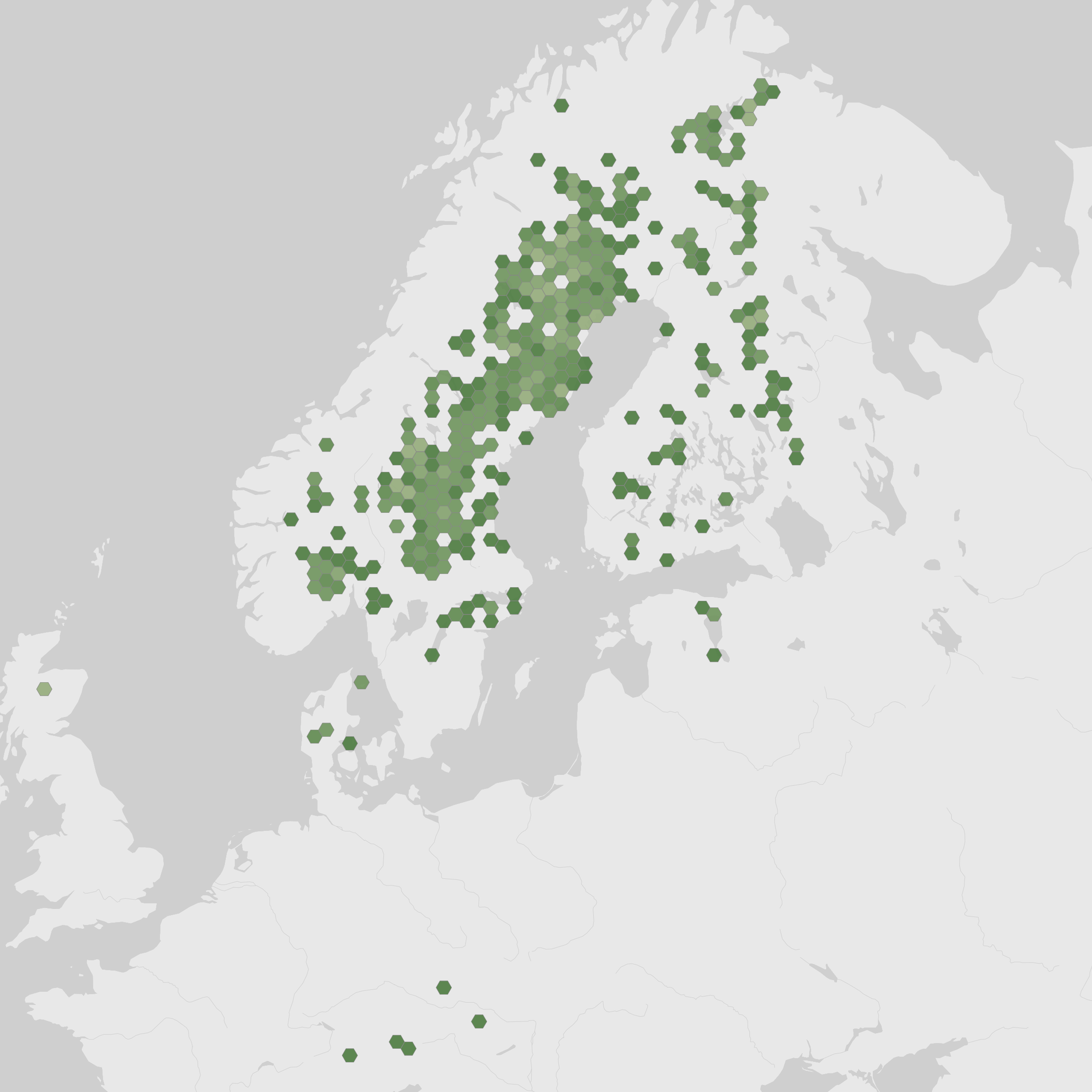
Hydnellum gracilipes is widely distributed across northern Europe, where it forms ectomycorrhizal relationships with conifers, particularly pine. In Norway, its range extends north to Finnmark, marking the northern edge of its known distribution.
In Scotland, the species has been found growing beneath the dense ground cover of common heather (Calluna vulgaris), which appears to offer physical support that the fungus's own flimsy stipe cannot provide. This association with heather-covered pine ground suggests a preference for structurally sheltered microhabitats within its pine woodland range.
Observation records show activity concentrated in the summer months, with counts rising sharply and peaking in the height of summer before dropping off by autumn, suggesting a fruiting season centered on that period, though these records reflect presence rather than abundance or the species' complete range.
Fun Facts
- Its specific epithet, gracilipes, reflects its slender, flimsy stalk, a feature so pronounced that fruit bodies appear to lean on nearby vegetation for support.
- The species was highlighted in a 2011 paper by M. Ainsworth documenting Hydnellum cumulatum and H. gracilipes as two overlooked hydnoid fungi newly recorded in Britain.
Photos
Photographs from by caspar s via Wikimedia Commons, licensed under CC BY 4.0. and by Svencapoeira via Wikimedia Commons, licensed under CC BY-SA 4.0., credited on each photo.
Ecology and classification
Habitat
Classification
- Phylum
- Basidiomycota
- Class
- Agaricomycetes
- Order
- Thelephorales
- Family
- Bankeraceae
- Genus
- Hydnellum
- Species
- Hydnellum gracilipes
Sources
- GBIF Species names and classification
- Wikidata Common names and conservation status
- Wikipedia Summary extract
- Wikimedia Commons Photos