Common holly (Ilex aquifolium) is one of the very few native hardwood trees in the British Isles that keeps its leaves through winter, its glossy, spine-edged foliage and bright red berries turning it into a seasonal emblem long before it became a Christmas decoration.
It belongs to the family Aquifoliaceae within the order Aquifoliales and is considered the type species of the entire genus Ilex. Native to western and southern Europe, northwestern Africa, and southwest Asia, it typically grows as an evergreen tree or shrub in the shaded understory of oak and beech forest. The IUCN lists it as a species of Least Concern, reflecting its wide range and common status across much of Europe.
Despite that reassuring global status, holly's story includes severely fragmented local populations, a long history in folklore and midwinter ritual, and a surprising capacity to spread far beyond its native range — qualities that make it more interesting than its familiar hedge-and-wreath reputation suggests.
Identification and Appearance
The clearest way to recognize common holly is by its leathery, dark green leaves with wavy, spine-tipped edges — though the spines are not universal. Leaves high in the canopy of trees growing in full sun, and those on older or shade-grown branches, often lose their teeth entirely and develop smooth or nearly smooth margins, sometimes with just a single spine at the tip.
Trees typically stand 3 to 15 meters tall, though exceptional individuals reach 24 meters. The trunk can be 40 to 80 centimeters in diameter, rarely exceeding a meter, wrapped in smooth silver-grey bark that develops small fissures with age. Leaves measure 5 to 12 centimeters long and can be as narrow as one-third of that length, dark and shining above and paler beneath, ovate to oblong in outline, with up to six or eight spines on each side when present.
Flowers appear mainly in spring, though a tree can occasionally bloom as late as January. They are small, four-parted, and white, sometimes tinged with red. Holly is dioecious, meaning male, pollen-producing flowers and female, fruit-producing flowers grow on separate trees; a tree must reach roughly 3 meters before it reliably flowers, and rarely does so under 1.5 meters.
Only female trees bear fruit, and only when a male tree grows nearby to pollinate them. The fruit is a bright red or yellow drupe 6 to 10 millimeters across, ripening in October or November. At that point it is intensely bitter with ilicin and is largely ignored by wildlife until frost softens it later in winter. Each berry holds three to four seeds that typically germinate in their second or third spring.
Distribution and Habitat
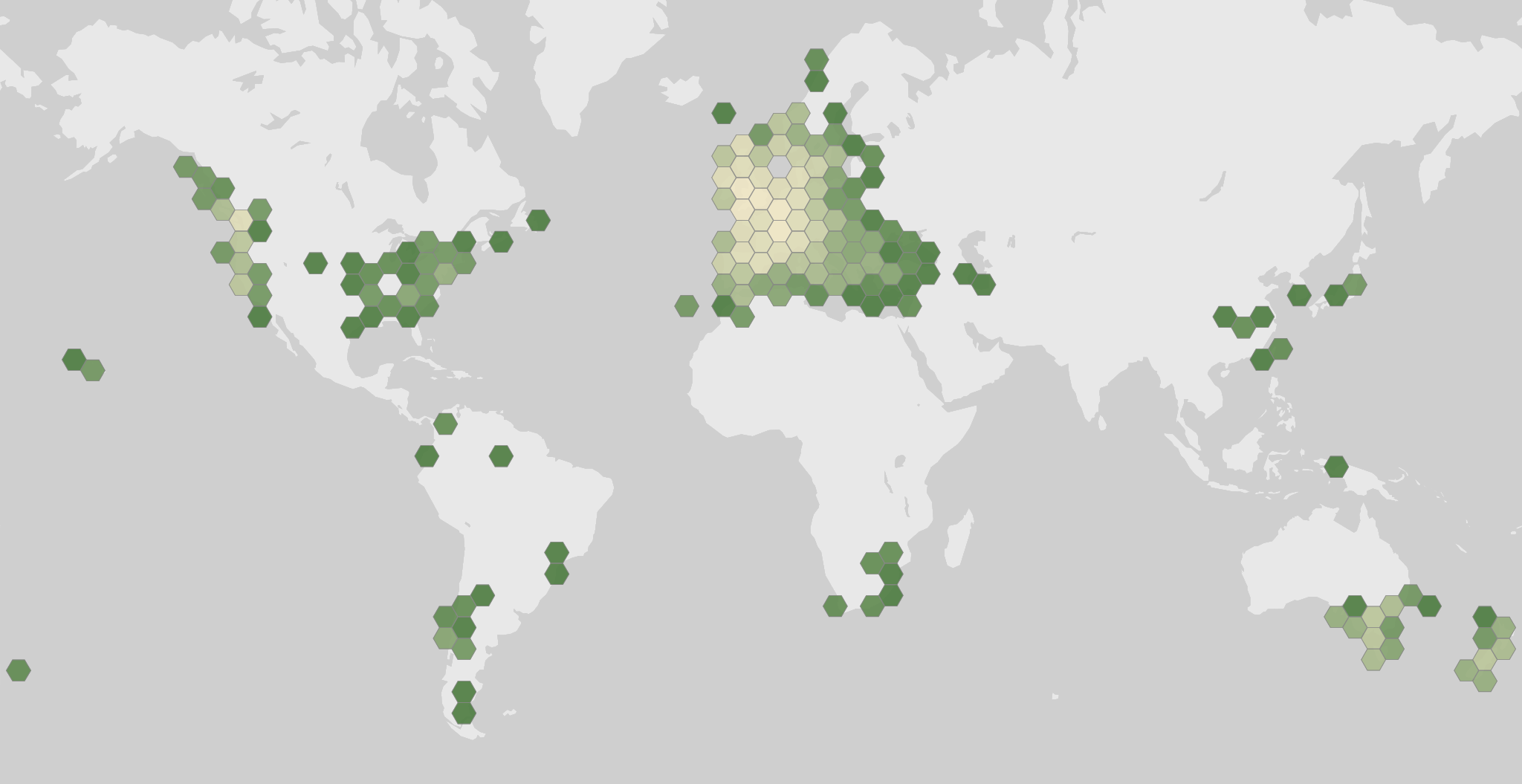
Common holly is native across much of western and southern Europe, northwestern Africa, and parts of southwest Asia, though botanists dispute its status in some regions. Plants of the World Online treats it as absent or non-reproducing in Poland and Hungary but native to Bulgaria and Romania, while the IUCN considers its Romanian status uncertain and regards Hungarian populations as naturalized rather than native; neither source records it as native further east or north in Europe. In Asia the disagreement runs the other way: POWO lists Turkish and Syrian populations as introduced, while the IUCN treats holly as native there and in Iran and Lebanon. The species grows from sea level up to about 600 meters elevation.
Climate change appears to be pushing the range northward and eastward at its margins. By 2005 holly had reached as far north as Kristiansund in Norway, confined to a narrow coastal fringe, and populations in Denmark and Germany are shifting northeast. Despite being common and widespread overall, holly's local populations can be severely fragmented — in Sweden, for example, only a single wild tree is known to remain.
Holly favors the understory or edges of deciduous forest in oceanic or Mediterranean climates, typically beneath oak or beech canopy. In the north of its range it associates with European oak, durmast oak, and downy oak, and can become the dominant tree in cooler woodlands, while in Mediterranean climates it is generally restricted to shaded higher ground.
Outside its native range, English holly has become invasive along the Pacific coast of North America, from California to British Columbia, where it spreads into native forest understory and is officially listed as a noxious weed in Washington State and an invasive plant in Portland. GBIF observation records show a clear seasonal pattern, with sightings peaking in spring — over 78,000 in April — and dropping to their lowest point in December and January, a pattern of when the plant is most often noticed and recorded, not a measure of its actual abundance.
Ecology and Relationships
Holly behaves as a tough pioneer species, favoring moist ground but tolerating both frost and summer drought. Its spiny leaves let it form dense thickets that shield other woody seedlings from browsing animals, helping forests regenerate at their edges; it turns up in Mediterranean garrigue and maquis scrub as readily as in deciduous or oak forest.
Where holly grows in pure stands, its tangled branches form a kind of vaulted shelter used by thrushes and deer, while small birds find protection among the spiny leaves themselves. After the season's first frost softens the bitter berries, they become an important late-winter food source for birds when other resources are scarce.
The small white flowers draw bees, wasps, flies, and small butterflies as a nectar source. Pale blotches often visible on the leaves are the work of the leaf-mining insect Phytomyza ilicis. Some smooth-leaved cultivars respond to physical stress by producing new leaves with more spines, a documented example of epigenetic plasticity in the species.
Uses and Human Relationships
Common holly is widely planted in parks and gardens across temperate regions and is a favorite hedging plant, since its spiny leaves make an effective barrier and it tolerates heavy pruning and shaping. It grows in a wide range of difficult soils, including clay, acidic, and nutrient-poor ground, though it struggles in poorly drained conditions, where root rot, canker, and leaf blight become problems. Numerous cultivars have earned the Royal Horticultural Society's Award of Garden Merit, and the hybrid Ilex × altaclerensis, a cross with the tender species I. perado, was bred at Highclere Castle in Hampshire in 1835.
From at least the 1200s into the early 1700s, holly branches were cut as winter fodder for livestock — most often sheep, but also horses, cattle, and red deer — a practice documented mainly around Sheffield in the Pennines and occasionally in northwest France. Smooth-leaved branches were specifically chosen for cutting. The custom survives in a few places, including Dumfries, Derbyshire, Cumbria, and the New Forest, and it continued in Ireland until the mid-twentieth century.
Holly's hard, fine-grained white wood, with only a faint grey or green tinge, has been used for inlay work, small carved and turned pieces, and, once stained black, as a substitute for ebony; in the 1800s it was considered the best material for driving whips on horse-drawn carriages. The wood also makes good firewood even while green. The berries contain alkaloids, theobromine, saponins, caffeic acid, and a yellow pigment called ilixanthin, and are generally regarded as toxic to humans. Culturally, holly has long been tied to midwinter ritual: it was considered sacred in Celtic tradition, used in Christmas decoration and in place of palm fronds on Palm Sunday in parts of Europe, and credited in folk belief with warding off witchcraft or, in France, hung over animal pens to keep away ringworm.
Fun Facts
- When the Pilgrims landed near Plymouth Rock just before Christmas in 1620, they found native American hollies that reminded them of the holly back home, helping cement the plant's link to Christmas in North America.
- There are 16 species of Ilex native to North America, most of them found on or near the east coast.
- In Celtic culture, the holly tree was considered sacred and thought to carry protective powers.
- The botanist William Dallimore estimated that individual holly trees can live 250 to 300 years.
- Only one wild holly tree is known to remain in Sweden, a striking example of how fragmented local populations can become even in a species considered common overall.
Conservation status
- LC
- NT
- VU
- EN
- CR
Least Concern
Ecology
Habitat
- Forest
- Woodland
- Shrubland
Growth habit
- Tree