American holly is considered the hardiest broadleaf evergreen tree known, tolerating winter lows below -23°C (-10°F) in the mountains of West Virginia, far colder than most evergreens can endure.
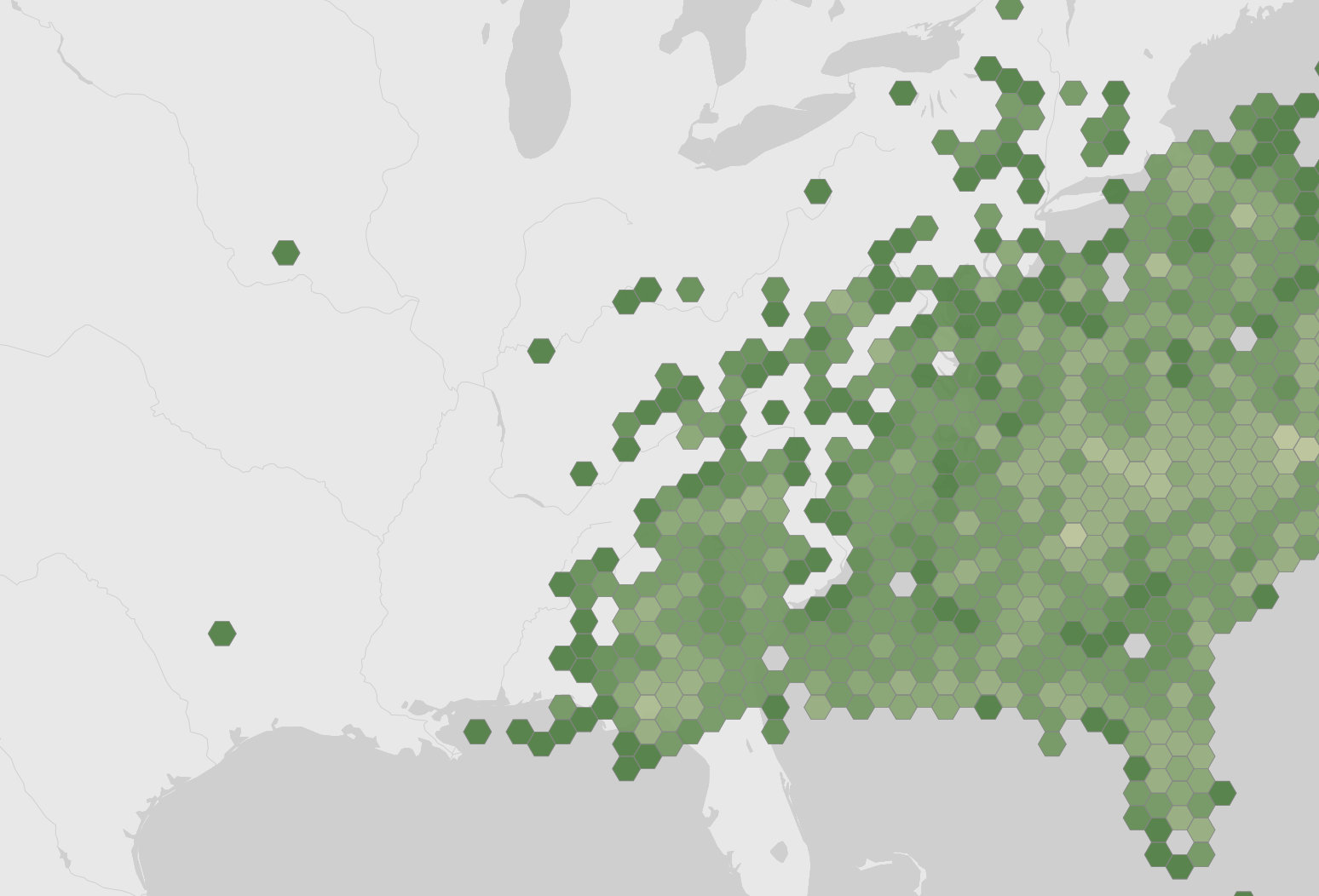
Ilex opaca, the American holly, is a broadleaf evergreen tree native to the eastern and south-central United States, ranging from coastal Massachusetts south to central Florida and west to southeastern Missouri and eastern Texas. Listed as Least Concern, it remains a familiar sight in forests and gardens alike, its prickly leaves and red berries tied to centuries of winter tradition.
Identification and Appearance
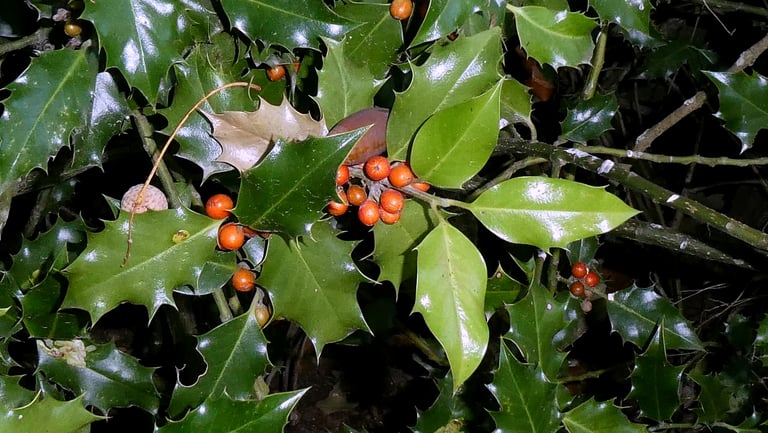
The stiff, spine-edged leaves are the tree's most recognizable feature: yellow-green, dull matte to sub-shiny above, and noticeably less glossy than the closely related European holly (Ilex aquifolium). Each leaf measures 5 to 7.5 cm long and 2 to 4 cm wide, with a wedge-shaped base, a pointed tip, and several sharp, spike-like teeth along the margins. Leaves persist for two to three years before falling in spring as new buds push them off.
American holly typically grows 10 to 20 meters wide and up to 30 meters tall, with a trunk diameter usually around 50 cm but occasionally reaching 120 cm. The bark is light gray and roughened with small warty lumps, while young branchlets are green with rusty down before turning smooth and brown.
The species is dioecious, meaning individual trees are either male or female. Only female trees bear the small red drupes, 6 to 12 mm across and containing four seeds, which often persist into winter. Fruits are occasionally yellow rather than red. Compared to European holly, American holly has larger, less lustrous leaves and a more rigid texture.
The current record tree, located in Rose Bud, White County, Arkansas, has a trunk circumference of 182 inches, a height of 64 feet, and a crown spread of 63 feet.
Distribution and Habitat
American holly occurs across the humid Southeast and adjacent regions, with a native range stretching from Massachusetts, Connecticut, and New York south through the Carolinas, Georgia, and Florida, and west to Missouri, Oklahoma, and Texas. It also appears inland through states such as Ohio, Kentucky, and Tennessee.
Annual precipitation across its range runs from 1,020 to 1,650 mm, exceeding 2,030 mm in the southern Appalachians. Growing season length varies enormously, from about 150 days at the species' northeastern limit in the Appalachian Mountains to nearly year-round in central Florida.
The tree tolerates a wide range of soils, from nearly sterile sandy soils along the Atlantic coast to fertile mountain soils at elevations up to about 915 m. The largest individuals grow in rich bottomlands and swamps of the Coastal Plain, while growth is best on moist, slightly acidic, well-drained sites such as upland pine woods and hammocks. Trees cannot tolerate flooded or saturated soils for more than about 17 percent of the growing season. In the northeastern part of its range, it favors sandy coastal soils or dry gravelly ground farther inland.
Monthly observation records show counts rising toward spring, which may reflect seasonal visibility of the evergreen foliage and berries rather than a true change in abundance.
Growth and Form
American holly is a tree, growing slowly whether rooted in dry upland soil or swampy ground. Mature trees typically reach 10 to 20 meters wide and up to 30 meters tall, with the largest specimens developing in the rich, moist bottomlands of the Coastal Plain.
Ecology and Relationships
Its shade tolerance allows American holly to thrive as an understory tree in moist forests, growing alongside species such as sweetgum, flowering dogwood, American beech, red maple, white oak, and hickories in the pine forests of the Coastal Plain. A variety known as scrub holly grows instead as a shrub in xeric scrub habitats of the Florida peninsula.
Flowers are visited by a range of insects, most notably bees such as Apis mellifera and various Andrena species, along with bumblebees, wasps, ants, and night-flying moths; a flower visit alone does not confirm pollination. The tree serves as a larval host plant for the butterfly Callophrys henrici.
The dense canopy offers birds shelter from predators and storms, and its berries draw a wide range of feeders. Songbirds including thrushes, mockingbirds, catbirds, bluebirds, and thrashers, along with some gamebirds and mammals, frequently eat the fruit; recorded consumers include bullfinches, blackbirds, mistle thrushes, woodpigeons, robins, jays, and magpies.
Uses and Human Relationships
The pale, tough, close-grained wood takes a good polish and has long been used for whip handles, engraving blocks, and cabinet work; it can also be dyed to imitate ebony. Its density ranges from 0.58 to 0.64. The watery sap contains a bitter substance once used as an herbal tonic, and the leaves can be brewed into a tea-like, caffeine-free beverage.
American holly is widely cultivated as an ornamental, with over 1,000 cultivars selected for cold tolerance, growth form, and berry color, including the cold-hardy 'Cobalt', the dwarf 'Cardinal Hedge', the large-berried 'Yule', and yellow-berried forms like 'Canary' and 'Morgan Gold'. It also parents the hybrid Ilex × attenuata together with Ilex cassine.
The tree carries deep cultural weight as a Christmas symbol in North America, a tradition traced to the Pilgrims, who in 1620 found its prickly, evergreen leaves and red berries reminiscent of the English holly back home. In Christian tradition, the thorny foliage recalls Christ's crown of thorns and the berries his blood, while the evergreen leaves symbolize life after death. American holly was named the state tree of Delaware on May 1, 1939.
Fun Facts
- There are 16 varieties of holly native to North America, most found on or near the east coast, and it was this group of "Christmas hollies" that reminded early English colonists of home.
- American holly has a conical growth form and leaves that are typically less glossy and more rigid than those of its European relative.
- Its berry-like fruits are occasionally yellow rather than the typical red.
Photos
Photographs from via iNaturalist, licensed under CC0 1.0., credited on each photo.
Ecology and classification
Classification
- Phylum
- Tracheophyta
- Class
- Magnoliopsida
- Order
- Aquifoliales
- Family
- Aquifoliaceae
- Genus
- Ilex
- Species
- Ilex opaca
Sources
- GBIF Species names and classification
- iNaturalist Photos
- Wikidata Common names and conservation status
- Wikipedia Summary extract
- Encyclopedia of Life Habitat, diet and behavior traits
- Plants of the World Online Native range, life form and climate (WCVP)
- GloBI What it eats, what eats it, parasites and pollinators
- trophiCH
- DoPI