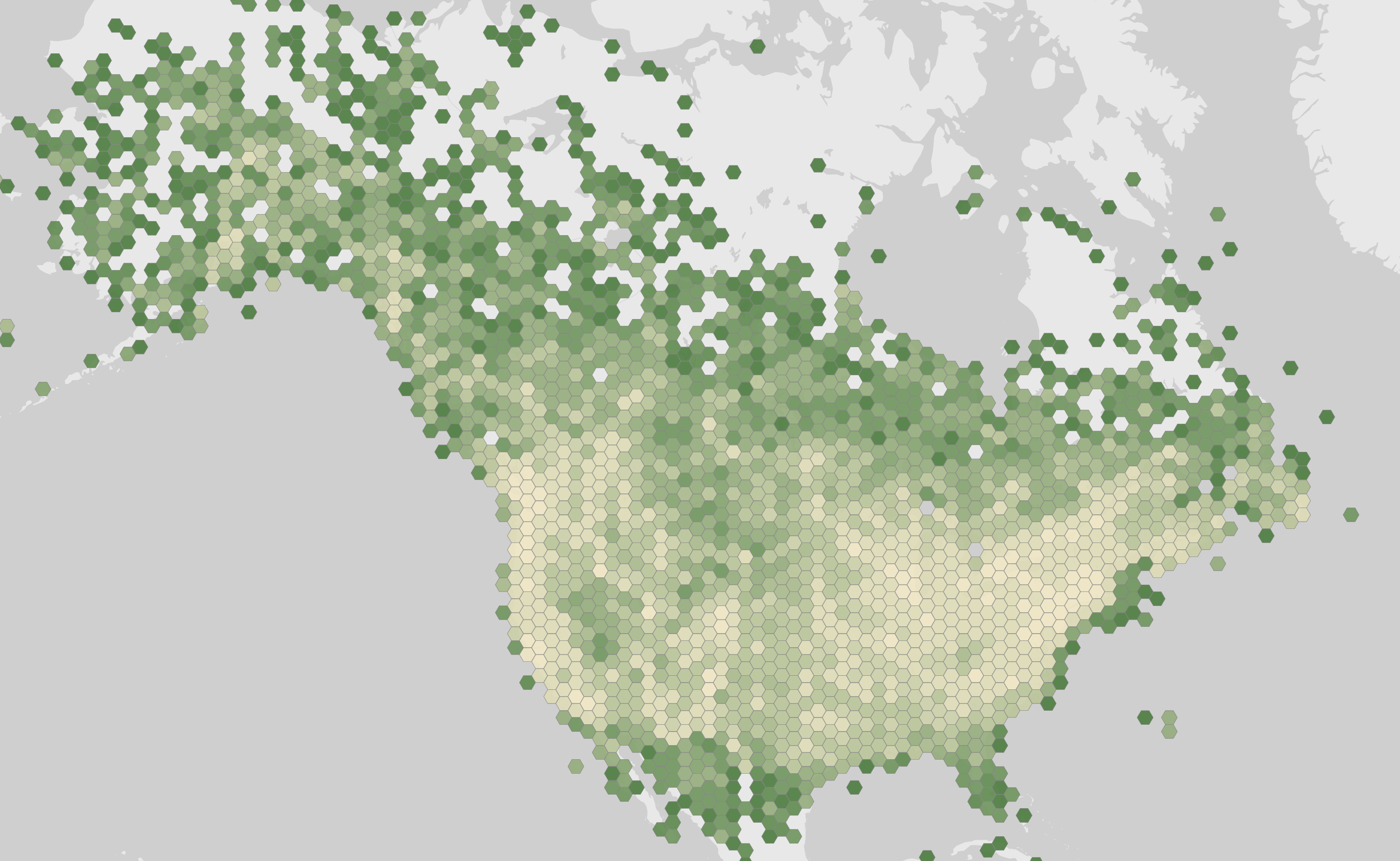
Across North America, a single species carries so much plumage variation that early ornithologists once split it into several separate species before recognizing them as one bird. The dark-eyed junco (Junco hyemalis) is one of the continent's most familiar sparrows, a small, grayish member of the New World sparrow family Passerellidae. It breeds across coniferous and mixed forests from the temperate United States into the Arctic reaches of Canada and Alaska, and in winter it becomes one of the most common visitors to backyard feeders across the country.
The species carries an IUCN status of Least Concern, reflecting its abundance and wide range. Beyond its plainness at first glance, the junco rewards a closer look: its social hierarchies, seasonal migrations split by sex and age, and flashing white tail feathers make it a small but genuinely interesting study in adaptability.
Identification and Appearance
The clearest field mark is the flash of white outer tail feathers, visible in flight and while the bird hops on the ground. Adults measure 13 to 17.5 cm (5.1 to 6.9 in) long with a wingspan of 18 to 25 cm (7.1 to 9.8 in) and weigh between 18 and 30 g (0.63 to 1.06 oz), making them slightly heavier than a chickadee but still compact.
Most adults show gray heads, necks, and breasts, gray or brown backs and wings, and a clean white belly, though plumage details vary considerably across the species' range. The bill is usually pale pinkish. Males tend to carry darker, more sharply defined markings than females, giving them a more contrasted appearance overall.
Juveniles look quite different from adults: they show pale streaks on the underparts and can be mistaken for vesper sparrows (Pooecetes gramineus) before molting into adult plumage at two to three months of age. Even as young birds, however, their heads already appear fairly uniform in color, and their bills retain conspicuous yellowish edges at the gape, remnants of the fleshy wattles that once guided parents feeding them in the nest.
Distribution and Habitat
The dark-eyed junco occupies woodland habitats from sea level up to 3,500 meters, favoring openings and edges over deep forest interiors. Breeding habitat is coniferous or mixed forest, but the species also uses forest edges, woodland clearings, stream borders, brushy cover near mountain meadows, and even old barns. In winter it shifts to weedy fields, open woodlands, hedgerows, suburbs, and farmyards, and it is a familiar sight at feeders throughout its winter range.
Most populations are migratory, moving south to winter quarters between mid-September and November and returning north to breed from mid-March, with nearly all birds gone from wintering areas by the end of April. Some populations, particularly several montane subspecies, are sedentary or only partially migratory. In the Sierra Nevada of eastern California, for example, birds migrate to winter elevations 1,500 to 2,100 meters (5,000 to 7,000 feet) lower than their breeding grounds rather than traveling far south. The slate-colored subspecies (J. h. hyemalis) even turns up as a rare vagrant in Western Europe, occasionally wintering successfully in British gardens.
Monthly observation counts peak from January through April, dip sharply through the summer months to a July low, and rise again from September onward. Read cautiously, since these are presence records rather than a population census, this pattern is consistent with the species' concentration in accessible lowland and suburban habitats during the non-breeding season and its dispersal into more remote breeding grounds in summer.
Behavior and Lifestyle
Dark-eyed juncos spend their days alternating between perching and ground foraging, hopping or walking in bounds of up to 30 cm and breaking into short running spurts only when chasing a rival or snatching moving prey. Time devoted to foraging shifts with the seasons: birds forage roughly 4.5 hours a day in summer but need about 6 hours in winter to meet higher energy demands.
Outside the breeding season the species is social, gathering into winter flocks of typically 15 to 25 birds that sometimes mix with American tree sparrows (Spizella arborea). These flocks assemble 20 to 30 minutes before sunrise and disperse about 45 minutes before sunset to roost, and they tend to return to the same wintering area, roughly 10 to 12 acres (about 40,000 to 49,000 square meters), year after year.
Winter flocks run on a strict social hierarchy: males dominate females, and adults dominate younger birds. Because males control access to food, females often winter farther south to avoid competing with them, while males brave harsher northern winters to stay closer to breeding grounds and claim territories early. Dominant birds assert rank by facing a rival and fanning their tail to flash the white outer feathers, or by rushing and pecking at subordinates; this aggression intensifies as flock size grows. Older males typically reclaim their established territories each spring, while younger males, pushed to the northern edge of the wintering range, must fight hardest to secure a breeding spot.
Communication
Only male dark-eyed juncos sing, typically producing a simple musical trill delivered at a single pitch, sometimes so rapid the individual notes blur together. To advertise a territory, a male may link two or three trills of different pitches into a single warbling song.
Beyond song, the species uses a distinct vocabulary for different situations: a simple explosive call signals alarm, a smacking sequence is used to scold, and a mix of twanging, buzzing, and smacking notes accompanies physical fights between birds. Sharp "tick" sounds and high-pitched tinkling chips round out its everyday calls.
Visual signals complement these sounds, most notably the tail-fanning display that flashes the white outer feathers during territorial and courtship encounters, reinforcing the messages carried by voice.
Diet and Nutrition
Dark-eyed juncos forage on the ground for a broad mix of seeds and insects, shifting the balance of their diet with the season. Outside the breeding season they favor insects, non-insect arthropods, and seeds together, while during the breeding season insects make up roughly half of their food intake, with caterpillars, beetles, and ants the most common prey.
Seeds still form the bulk of the year-round diet, drawn mainly from weedy plants such as ragweed, bristlegrass, dropseed grass, crabgrass, pigweed, and goosefoot. One distinctive foraging trick is "riding" a grass stem: the bird flies up onto a tall stalk, rides it down as its weight bends the stem to the ground, and then plucks seeds from the head while standing. When a thin layer of snow covers the ground, juncos scratch out a rough circular hole 3 to 4 inches (about 8 to 10 cm) across to reach buried grain.
At feeders during migration and winter, juncos are common visitors but still prefer feeding on the ground rather than picking seed from an elevated tray, a habit consistent with their ground-forager anatomy suited to handling both seeds and insects.
Nesting and Breeding
Dark-eyed juncos are monogamous, with males arriving on breeding grounds in spring well ahead of nesting and pairs typically forming by mid-April. A male claims a territory of 2 to 3 acres by singing from the tallest available perch, then pursues an entering female with an aggressive courtship display: spreading his tail, strutting around her, uttering chips and song, and alternately dropping his tail to the ground or lifting it to a 45-degree angle. Once paired, the male stays within about 50 feet of his mate except when proclaiming his territory from a high perch.
The female builds the nest over 1 to 9 days, often with the male helping to bring material, typically placing it on the ground near the edge of a wooded opening, well hidden under weeds, grasses, fallen logs, or tree roots, though nests occasionally appear up to 8 feet up in a shrub or tree. The cup is lined with fine grasses, mosses, or mammal hair and may be reused for two or three broods in a single season.
Clutches contain 3 to 6 white or pale greenish eggs spotted with brown, averaging about 19 mm in length, with the female handling incubation over 12 to 13 days. Chicks hatch altricial, opening their eyes by the second day and showing feathers by around the seventh, and rapid leg development lets them run from the nest if threatened even before they can fly.
Young leave the nest just 9 to 13 days after hatching but stay at least partially dependent on their parents for another 3 weeks, during which both adults defend the nest, remove fecal sacs, and feed the chicks regurgitated food and the occasional caterpillar. Pairs may raise two to three broods across the spring and early summer, and most juncos reach breeding maturity at one year of age.
Population and Ecological Role
Dark-eyed juncos are considered abundant across their range, though the context does not give a specific population estimate or trend date. As common members of forest and woodland ecosystems, they contribute in two main ways: dispersing the seeds of the weedy plants they feed on, and helping to control the insect populations, including caterpillars and beetles, that make up much of the summer diet.
The species is also woven into a wider web of interactions with other organisms. It is occasionally parasitized by brown-headed cowbirds (Molothrus ater), which lay their eggs in junco nests, and it serves as a host for at least 26 genera of parasites. Antibodies to the St. Louis strain of encephalitis have also been detected in the species, marking it as part of the local disease ecology in some areas.
Conservation and Threats
The dark-eyed junco is assessed as Least Concern by the IUCN, reflecting a species that remains quite abundant across its geographic range. In the United States it receives protection under the Migratory Bird Treaty Act, though it holds no special status under the federal endangered species list or CITES.
No specific threats or population declines are documented for the species, consistent with its wide distribution and adaptability to habitats ranging from remote coniferous forest to suburban yards and farmyards.
Cultural Significance
The dark-eyed junco carries symbolic weight in several traditions. In Native American mythology it is described as a bird between worlds, offering insight during significant life transitions, while in a broader Celtic framework it fits the common interpretation of birds as messengers from a higher power. Some traditions also cast the junco as a symbol of love, used in art to depict couples or families.
Beyond folklore, the species holds little direct economic importance. Its main connection to people comes through birdwatching and photography, where its winter feeder visits make it an easy, rewarding subject, and through the modest role it plays in driving sales of birdseed, feeders, and binoculars. By eating insects that people often regard as pests, it also delivers a small practical benefit to the yards and gardens it visits.
Fun Facts
- A flock of dark-eyed juncos is sometimes called a "blizzard," a fitting nickname for a bird so associated with winter feeders.
- Juvenile juncos can be mistaken for vesper sparrows before they molt into adult plumage at two to three months old.
- Fledglings retain conspicuous yellowish edges at the bill's gape, leftover fleshy wattles that once helped parents aim food into the nest.
- One foraging trick involves "riding" a tall grass stem to the ground under its own weight, then plucking seeds from the seed head while standing.
- In light snow, juncos scratch out circular holes 3 to 4 inches across to reach buried grain underneath.
- Winter flocks return to the same 10-to-12-acre area year after year, with older, dominant males reclaiming their established territories each spring.
- The species' song closely resembles that of the chipping sparrow, making it a popular subject for birders learning to distinguish similar bird calls.
Photos
Photographs from via iNaturalist, licensed under CC0 1.0., by Irina Mitine via iNaturalist, licensed under CC BY 4.0., by Daniel Levitis via iNaturalist, licensed under CC BY 4.0., by Sandy Wolkenberg via iNaturalist, licensed under CC BY 4.0., by Eric Austin via iNaturalist, licensed under CC BY 4.0., and by Kalvin Chan via iNaturalist, licensed under CC BY 4.0., credited on each photo.
Ecology and classification
Classification
- Phylum
- Chordata
- Class
- Aves
- Order
- Passeriformes
- Family
- Passerellidae
- Genus
- Junco
- Species
- Junco hyemalis
Sources
- GBIF Species names and classification
- iNaturalist Photos
- Wikidata Common names and conservation status
- Wikipedia Summary extract
- Animal Diversity Web Animal habitat, behavior and diet
- AnAge Longevity