Under favorable conditions this shrub can grow into a substantial tree, with a trunk up to 1 meter in diameter and a crown reaching 20 meters high. Laurus nobilis is an aromatic evergreen belonging to the flowering plant family Lauraceae, native to the Mediterranean region, where it grows as a tree or large shrub with smooth, glabrous green leaves. The species is listed as Least Concern.
Known by many names — bay tree, bay laurel, sweet bay, true laurel, Grecian laurel — this plant carries an outsized cultural legacy for its size, having figured prominently in classical Greco-Roman civilization while remaining a familiar presence in gardens and spice racks today.
Identification and Appearance
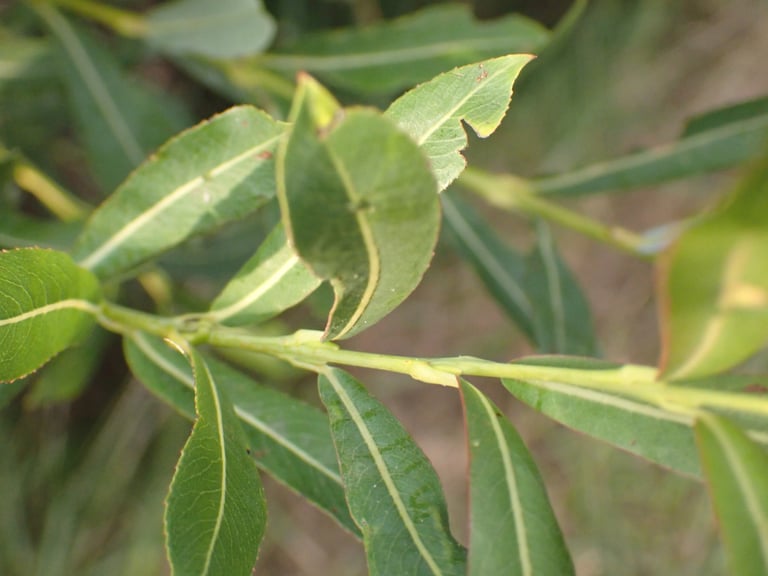
The clearest field mark is the leaf: glossy, glabrous, and dark green, 6–12 cm long and 2–4 cm wide, with an entire margin that sometimes undulates rather than lying perfectly flat. Crushing or bruising a leaf releases the characteristic bay aroma, a quick way to confirm identification in the field.
Size varies enormously with growing conditions. Bay laurel typically appears as an evergreen shrub or small tree between 7 and 18 meters tall, though old specimens can reach 20 meters with trunks up to 1 meter in diameter.
The species is dioecious, meaning male and female flowers grow on separate plants. Each flower is pale yellow-green, about 1 cm across, and borne in pairs beside a leaf axil. Female plants produce the fruit: a small, shiny black, drupe-like berry roughly 1 cm long containing a single seed.
Distinguishing Laurus nobilis from its two related species in the genus Laurus can be difficult, since the diagnostic characters separating them often overlap.
Distribution and Habitat
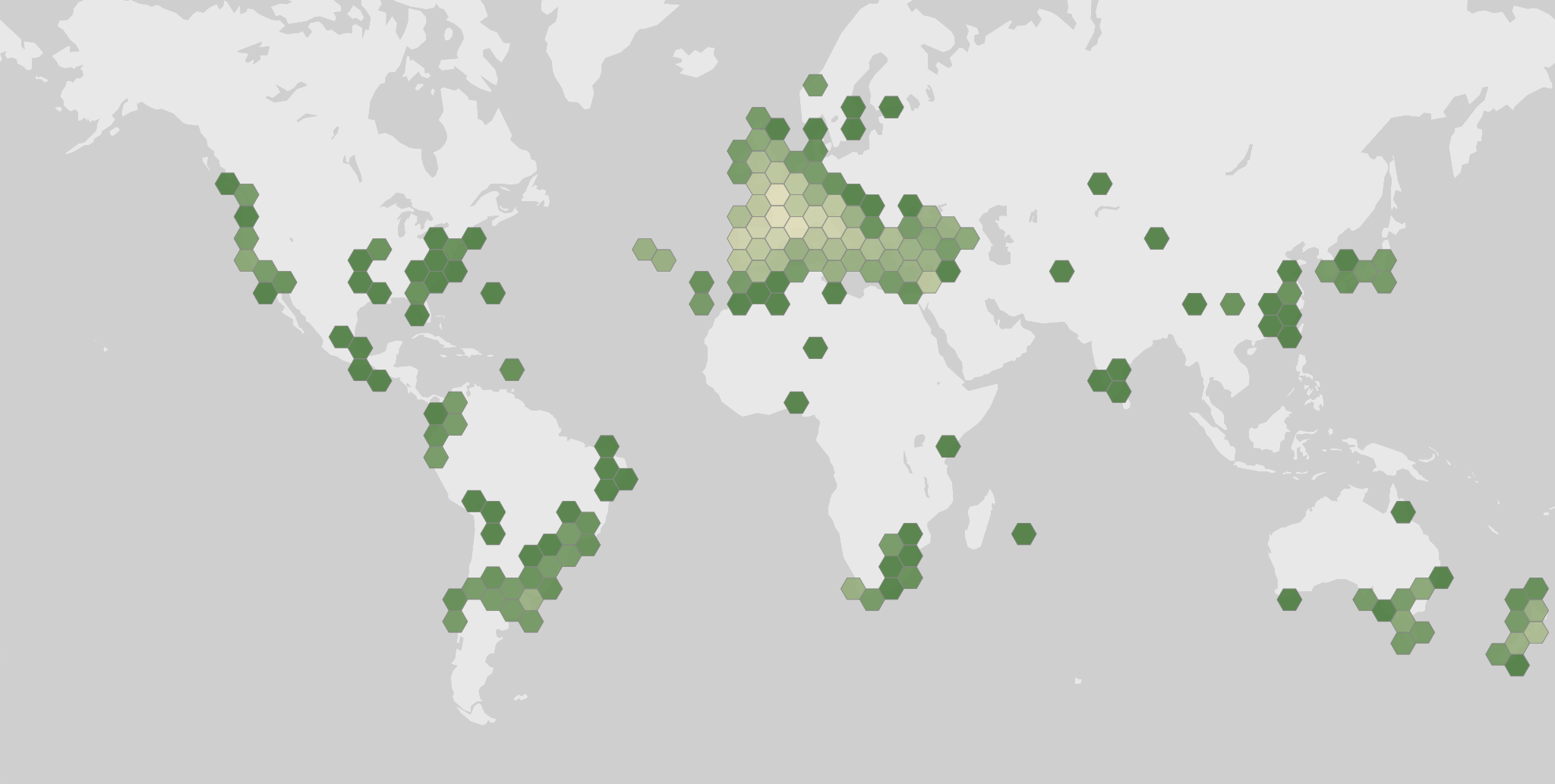
Bay laurel is native to the Mediterranean region, where it grows in habitats consistent with a Mediterranean or oceanic climate, including woodland, forest, and shrubland settings.
Monthly presence-observation data from GBIF show a pronounced peak in April, with over 10,000 recorded observations that month compared to roughly 2,500–3,900 in the winter months of November through January. This pattern likely reflects greater visibility or flowering activity in spring rather than a true measure of abundance or population size, since GBIF occurrence counts record presence, not how many individuals exist or the species' complete native range.
Ecology and Relationships
Laurus nobilis survives today as a widespread relict of the ancient laurel forests that once covered much of the Mediterranean Basin, back when the region's climate was considerably more humid than it is now. As the Mediterranean dried during the Pliocene, these laurel forests retreated and were largely replaced by the drought-tolerant sclerophyll plant communities that dominate the region today.
Most of the original Mediterranean laurel forests are believed to have vanished around ten thousand years ago. Scattered remnants persist in a handful of refuges with unusually humid microclimates: the mountains of southern Turkey and northern Syria, southern Spain, north-central Portugal, northern Morocco, and the Atlantic island groups of the Canary Islands and Madeira.
Uses and Human Relationships
People have used bay laurel for millennia, with early evidence of its use found at Ashkelon in what is now Israel, dating to the 7th century BC. In classical antiquity the plant carried deep symbolic weight: ancient Greeks and Romans fashioned its foliage into wreaths to crown meritorious poets, athletes, and soldiers, a tradition tied to the Greek myth in which Apollo, in love with the naiad Daphne, made wreaths from the laurel tree that Gaia left in her place after transporting her to Crete.
Beyond symbolism, the plant is widely cultivated today as an ornamental in Mediterranean and oceanic climates, and as a house or greenhouse plant in colder regions. Growers use it in topiary, shaping single erect stems into ball, box, or twisted crowns, or trimming it into low hedges, though its slow growth means it can take years to reach the desired form. Two cultivated forms, the golden L. nobilis 'Aurea' and the willow-leaved L. nobilis f. angustifolia, have received the Royal Horticultural Society's Award of Garden Merit. Ornamental laurels can be troubled by the jumping plant louse Trioza alacris, which causes leaf-edge curling and gall formation, and by the scale insect Coccus hesperidum.
In folk and herbal traditions, aqueous extracts of bay laurel have been applied as an astringent and salve for open wounds, and used in massage and aromatherapy; a folk remedy for poison ivy, poison oak, and stinging nettle rashes involved a poultice soaked in boiled bay leaves. The Roman naturalist Pliny the Elder went further, listing laurel oil as a treatment for paralysis, spasms, sciatica, bruises, headaches, catarrhs, ear infections, and rheumatism.
Fun Facts
- The plant's name traces to Daphne, a figure in Greek mythology loved by the god Apollo; when Gaia spirited Daphne away to Crete for protection, she left a Laurus nobilis tree in her place, and Apollo wove wreaths from its leaves.
- As told by the Roman poet Ovid in his Metamorphoses, the Daphne and Apollo story begins with Apollo mocking Eros, setting in motion the chain of events that gave the laurel its mythological origin.
- Archaeological evidence of bay laurel use at Ashkelon, in present-day Israel, dates back to the 7th century BC, showing the plant's long history with people long before its classical Greek and Roman fame.
Photos
Photographs from via iNaturalist, licensed under CC0 1.0., by Umut Nuri Erdoğan via iNaturalist, licensed under CC BY 4.0., by Jose Gutierrez Higa via iNaturalist, licensed under CC BY 4.0., by Colin Meurk via iNaturalist, licensed under CC BY 4.0., by Aubin NORMAND via iNaturalist, licensed under CC BY 4.0., by kardelen via iNaturalist, licensed under CC BY 4.0., by etrusko25 via iNaturalist, licensed under CC BY 4.0., by Alice Shanks via iNaturalist, licensed under CC BY 4.0., and by Louis Aureglia via iNaturalist, licensed under CC BY 4.0., credited on each photo.
Ecology and classification
Classification
- Phylum
- Tracheophyta
- Class
- Magnoliopsida
- Order
- Laurales
- Family
- Lauraceae
- Genus
- Laurus
- Species
- Laurus nobilis
Sources
- GBIF Species names and classification
- iNaturalist Photos
- Wikidata Common names and conservation status
- Wikipedia Summary extract