No wild cat covers more ground than the leopard. From the Sahara's fringes to the snowbound forests of the Russian Far East, Panthera pardus holds the widest geographic distribution of any felid on Earth, even as its populations grow increasingly fragmented.
A member of the Panthera genus alongside lions, tigers, jaguars and snow leopards, this slender, muscular cat ranges through savannas, rainforests, deserts and mountains across sub-Saharan Africa, the Middle East, and South and East Asia. The IUCN lists it as Vulnerable, a status driven by habitat loss and persistent poaching. Its combination of adaptability, stealth and outsized cultural presence makes it one of the more compelling large carnivores to study.
Identification and Appearance
The clearest way to recognize a leopard is by its dark rosettes, arranged in irregular clusters across a coat that ranges from pale cream in arid regions to deep golden in rainforest habitats. Unlike the jaguar, whose rosettes contain smaller dark spots inside a darker outline, the leopard's rosettes are simpler and unbroken. Rosette shape even varies by region: circular in East African populations, more squarish in southern Africa, and larger in Asian leopards.
Body length runs from 92 to 183 centimeters, plus a tail of 66 to 102 centimeters that is white underneath with incomplete spotted bands near the tip. Shoulder height reaches 60 to 70 centimeters. Males are noticeably larger than females, typically weighing 30.9 to 72 kilograms against a female range of 20.5 to 43 kilograms, though exceptional males have topped 90 kilograms. The head is broad and the limbs comparatively short relative to the slender, muscular body.
Spots fade toward a white underbelly and the inner legs, and juveniles are born with woollier, grayer fur that appears darker because the spots sit so densely packed. Guard hairs are short on the face, lengthening toward the flanks and belly, and coats grow longer in colder climates such as the Russian Far East.
Color variants occur throughout the range: melanistic individuals, known as black panthers, carry a recessive allele; pale or white leopards have been documented in India; and a rare reddish morph nicknamed the "strawberry leopard" has turned up in South Africa's Madikwe Game Reserve and Mpumalanga.
Distribution and Habitat
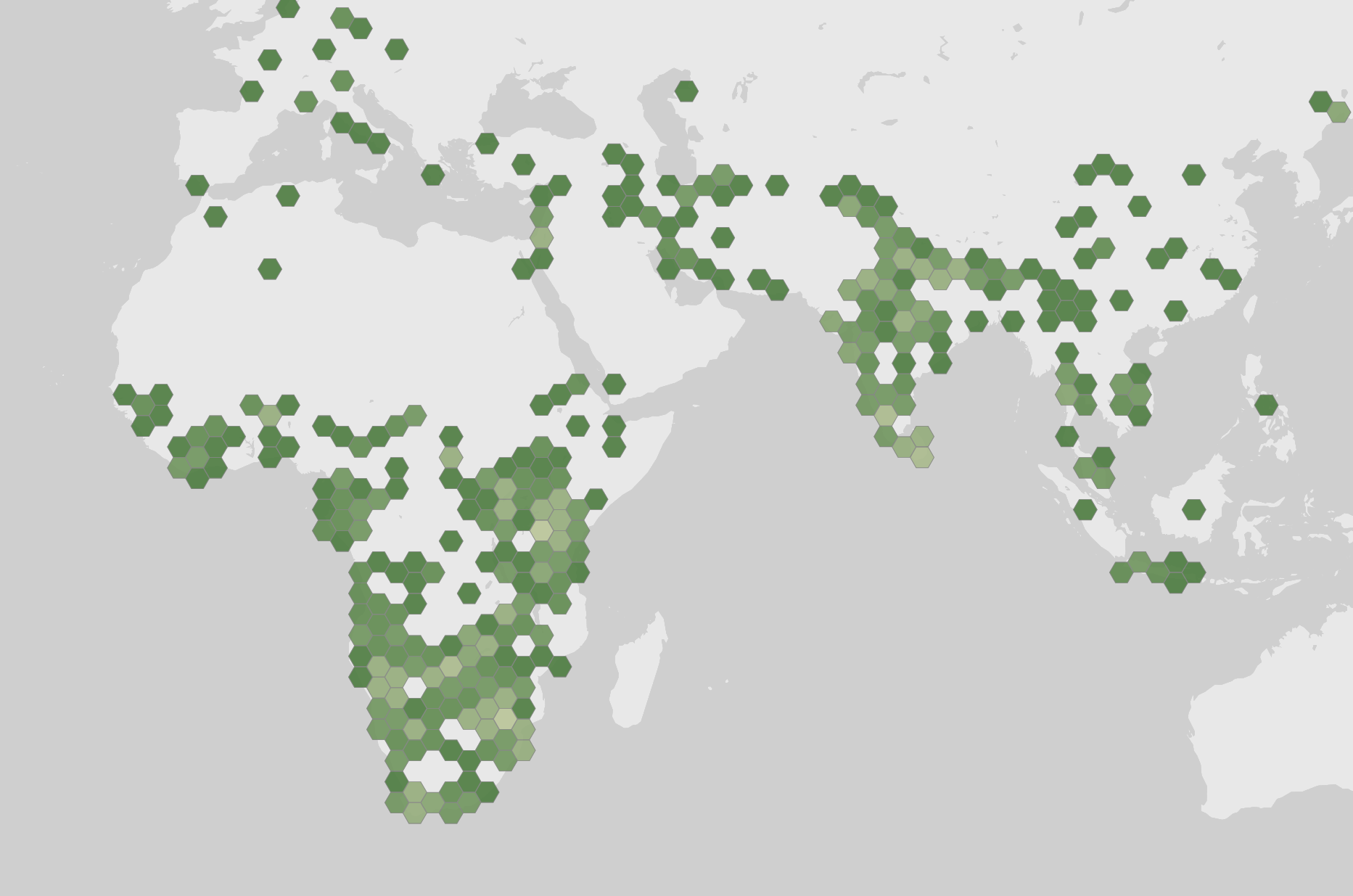
The leopard occupies a broader range than any other wild cat, spanning sub-Saharan Africa, North Africa's remaining pockets, the Middle East, the Indian subcontinent, Southeast Asia, China and the Russian Far East. That range has still contracted sharply in places: West Africa's population is estimated to have declined by 95 percent, and the Sahara's by 97 percent, while the species occupies only about a quarter of its historical range overall.
Habitat use is broad by necessity. Leopards favor mesic woodlands, grassland savannas and forests, but also persist in scrub, desert and mountainous terrain, having been recorded as high as 5,638 meters on Mount Kilimanjaro. In India, surveys across tiger-range landscapes estimated 12,172 to 13,535 individuals living in forested habitat below 2,600 meters, from the Shivalik Hills to the Western Ghats. In Nepal's Kanchenjunga Conservation Area, a camera trap photographed a melanistic individual at 4,300 meters in 2012.
The species tolerates disturbed and even urban-adjacent landscapes when prey and cover remain available, from Sri Lankan tea estates to Pakistani hill tracts, where 18 to 24 individuals were estimated in the Galyat region in 2017. Monthly observation counts show a mild rise through July and August and again in November, but these figures reflect where people happened to record sightings rather than true seasonal abundance or population size.
Behavior and Lifestyle
Leopards are solitary and largely nocturnal, resting through the day in thickets, rock clefts or tree branches before becoming active from dusk to dawn. Where human presence is heavy, they shift toward more strictly nocturnal habits, while in West African forests some populations hunt mainly at twilight when their prey is active.
Each leopard defends a territory marked with urine, feces and claw scrapes. Male home ranges average around 35 square kilometers against roughly 13 for females, though ranges balloon in arid or montane terrain, reaching 451 square kilometers for Namibian males. Ranges expand when human interference increases and shrink where prey density is high. Individuals in South Africa's Kruger National Park typically keep about a kilometer apart, and aggressive encounters are rare outside territorial disputes or contests over a carcass.
The leopard's build supports a highly mobile lifestyle: it can run in bursts over 58 kilometers per hour, leap more than 6 meters horizontally and 3 meters vertically, and descend trees head-first after resting or feeding in the lower canopy. It swims capably and drinks only occasionally, drawing most of its water from prey. Across its range it shares habitat with lions, tigers, spotted hyenas and African wild dogs, dominating only the cheetah among competitors; lions alone account for up to 22 percent of leopard deaths in Sabi Sand Game Reserve.
Communication
Leopards stay largely silent but use a distinctive rasping cough, repeated at intervals, to announce their presence to other leopards; males rely on this call to mark territorial boundaries, and a nearby leopard may answer in kind while withdrawing. The deeper 'sawing' roar, made of repeated low strokes, likely serves the same territorial function and helps attract mates.
Scent plays a central chemical role: females in estrus release pheromones in their urine to signal receptivity, while males grunt at rivals during encounters. Cubs use soft meows and an urr-urr sound to call their mothers, and some leopards purr while feeding.
Visual signals may matter too. The whitish spots on the backs of the ears are thought to aid communication, and the white-tipped tail has been suggested as a possible 'follow-me' cue between individuals, though no clear behavioral link has been confirmed.
Hunting and Diet
Leopards hunt by stealth rather than speed, crouching low and closing to within 3 to 10 meters of prey before launching a single decisive pounce; they rarely give chase if that first attempt fails. Once prey is caught, the leopard breaks its neck to cause paralysis, then asphyxiates it before dragging the carcass to a secluded spot, often a tree branch, or concealing it under leaves and soil.
Their strength lets them tackle animals up to ten times their own body weight, though preferred prey weighs between 10 and 40 kilograms: small antelopes, gazelles, deer, pigs, primates and domestic livestock make up the bulk of their diet. As opportunistic carnivores they also take birds, reptiles, rodents and arthropods, and will scavenge carrion when available, including kills abandoned by cheetahs, solitary hyenas and smaller carnivores.
Leopards regularly cache surplus food and may keep hunting even with several carcasses already stored, a behavior that helps them cope with unpredictable competition from larger predators in the same landscape.
Reproduction and Raising Young
Leopards are promiscuous breeders, with both sexes taking multiple mates across a breeding season that runs year-round in most regions but peaks during the rainy season around May; populations in China and southern Siberia instead concentrate mating in January and February. A female in estrus for six to seven days signals readiness through pheromones in her urine and initiates courtship by brushing against or swatting a male, and a pair may copulate up to 100 times a day for several days, sharing food while together.
Gestation lasts roughly 90 to 105 days, averaging about 96. Litters usually contain two to four cubs, born in a den such as a cave, rock crevice, hollow tree or dense thicket. Newborns weigh under a kilogram, are born with closed eyes that open four to nine days later, and wear a grayer, less-defined coat than adults. Cub mortality in the first year is steep, estimated at 41 to 50 percent, with predation the leading cause; infanticide by rival males, aimed at bringing the mother back into heat, is also documented.
Mothers move den sites frequently to reduce the risk of lions and other predators finding cubs, and may leave young hidden for up to 36 hours while hunting. Cubs start walking around two weeks old, begin eating solid food by six to eight weeks, and are fully weaned by three months, after which they start following their mother on hunts. Independence typically comes at 18 to 24 months, though separated siblings sometimes travel together for months afterward. Births are usually spaced 15 to 24 months apart, and females stop reproducing around 8.5 years of age.
Population and Ecological Role
Leopards occupy a mid-to-upper position in a crowded predator guild, competing directly with lions, tigers, spotted hyenas and African wild dogs for food. To reduce that pressure they shift hunting times and avoid areas where larger competitors concentrate, and they switch toward smaller prey when competition for larger animals intensifies.
This flexibility lets leopards persist in landscapes where bigger cats have already vanished, giving them an outsized role in regulating mid-sized prey populations even in degraded or marginal habitat. They also host a wide range of parasites typical of felids, including lung flukes, tapeworms, spirurian nematodes, hookworms, lungworms and protozoan parasites such as Sarcocystis, linking them into local disease and parasite cycles.
Conservation and Threats
The leopard is currently listed as Vulnerable by the IUCN, reflecting ongoing declines driven primarily by habitat fragmentation and the conversion of forest to agricultural land. That habitat loss shrinks the natural prey base, drives conflict with livestock herders, and pushes leopard mortality upward; poaching and trophy hunting compound the pressure. The species now occurs in an estimated 25 percent of its historical range.
Illegal trade remains severe in places: at least four leopards a week were estimated poached in India between 2002 and 2012 for skins and bones, while surveys in Moroccan markets found dozens of leopard skins imported from sub-Saharan Africa in 2013 and 2014. In the Central African Republic's Chinko area, the population fell from 97 individuals in 2012 to 50 in 2017 amid poisoning and poaching linked to pastoralist incursions. In Java, seizures between 2011 and 2019 included skins, skulls, canines and claws from at least 51 leopards.
Protections exist on paper across much of the range: the leopard sits on CITES Appendix I, hunting is banned in Botswana and Afghanistan, and eleven sub-Saharan countries restrict trade to a quota of skins and body parts from 2,560 individuals. Enforcement and reserve coverage remain uneven, and most leopards in Africa live outside protected areas.
Conservation status
- LC
- NT
- VU
- EN
- CR
Vulnerable
Cultural Significance
Leopards have carried symbolic weight across widely separated cultures. In Greek mythology the leopard's skin was an emblem of Dionysus, who was depicted wearing it and using leopards to travel; in Benin Empire art and sculpture the leopard represented royal power, since it was considered the true king of the forest, and among the Ashanti only the king was permitted a ceremonial leopard stool.
Its image has traveled into heraldry, where the stylized 'heraldic leopard' lost its spots and gained a mane, becoming visually close to the heraldic lion; naturalistic leopard depictions still appear on the coats of arms of Benin, Malawi, Somalia, the Democratic Republic of the Congo, and Gabon, the last showing a black panther. Tribal chiefs and warriors across the leopard's range have worn its fur as a mark of honor and courage, and some traditional healers have used leopard skins as protection against bad omens.
Historically, leopards were also kept in captivity for spectacle and symbolism: the Romans used them in staged hunts, Benin paraded them as totems, and a 13th-century menagerie at the Tower of London once held leopards given to Henry III. A handful of individual leopards became notorious for repeated attacks on people in colonial-era India, drawing the attention of hunters such as Jim Corbett.
Fun Facts
- Melanistic leopards, popularly called black panthers, arise from a recessive allele; a much rarer reddish variant called the "strawberry leopard" has been documented only in a few South African reserves.
- Nine pale or white leopards were recorded in India between 1905 and 1967, an unusual color variation distinct from the more familiar black morph.
- The leopard's diploid chromosome number is 38, a detail that helps distinguish it genetically from other big cats.
- The largest leopard skull on record, found in India in 1920, measured 28 centimeters in basal length and weighed a full kilogram.
- The oldest known leopard, a captive female, lived to 24 years, 2 months and 13 days, well beyond the species' typical wild lifespan.
- Rudyard Kipling's Just So Stories includes "How the Leopard Got His Spots," a folk tale explaining the origin of the leopard's rosettes.
- Because the heraldic leopard traditionally lacks spots and has a mane, it looks almost identical to the heraldic lion on historic coats of arms.
Ecology
Diet
- Carnivore
Behavior
- Nocturnal
- Predator
- Solitary
- Territorial
Habitat
- Forest
- Woodland
- Grassland
- Savanna
Photos
SourcesGBIFiNaturalistWikidataWikipediaAnimal Diversity WebAnAge