When a raindrop or a footstep presses down on a mature Lycoperdon perlatum, the fungus answers with a visible puff of brown smoke-like spores shot from a small hole at its top. That burst is the reason for one of its common names, devil's snuff-box, alongside common puffball, warted puffball, and gem-studded puffball.
This is a fungus of the family Lycoperdaceae, order Agaricales, in the kingdom Fungi, and it carries an IUCN status of Least Concern. Its rounded, spine-studded fruiting body and dramatic spore release make it one of the easiest puffballs to recognize once you know what to look for.
Fruiting Body and Identification
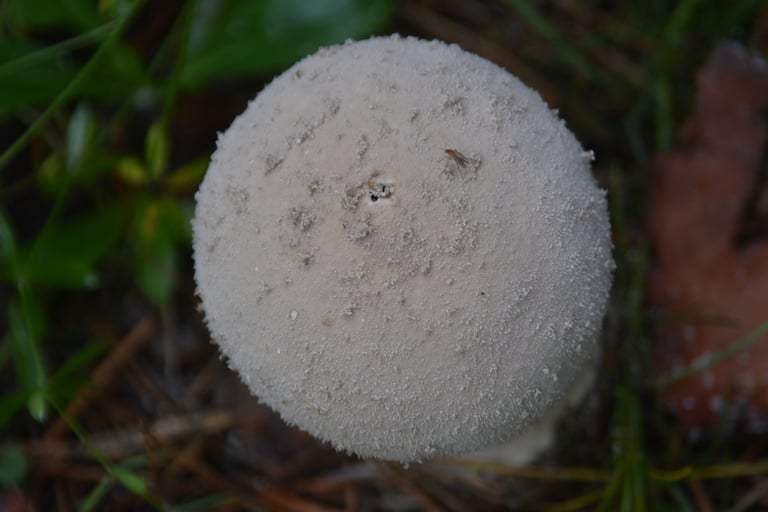
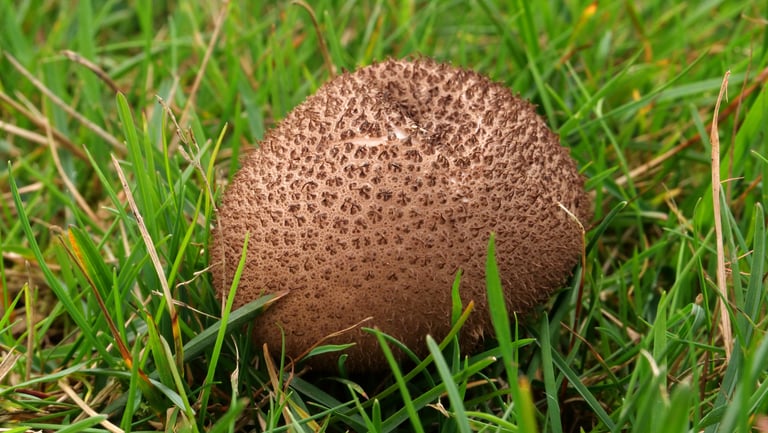
The clearest field mark is the covering of short, cone-shaped spines mixed with granular warts on the outer surface, which rub off easily and leave a netlike, pockmarked pattern behind. Young fruiting bodies are whitish and range in shape from pear-like with a flattened top to nearly spherical, measuring 1.5 to 6 cm wide and 3 to 9 cm tall, with a thick, stem-like base that starts white and turns yellow, olive, or brown with age.
As the fruiting body matures, the outer layer at the top sloughs away to reveal a pre-formed hole, the ostiole, through which spores escape. Inside, the gleba begins as firm white tissue but turns brown and powdery as the spores ripen; the tiny internal chambers that once held the spore-producing hymenium collapse as this happens. Compression from touch or a raindrop of just 1 mm or larger is enough to force spores out through the ostiole at roughly 100 centimeters per second, building a centimeter-tall spore cloud within a hundredth of a second.
Under magnification, the spores are spherical, thick-walled, minutely spiny, and 3.5 to 4.5 micrometers across. The threadlike capillitia running through the gleba are yellow-brown and 3 to 7.5 micrometers wide, while the club-shaped basidia measure 7 to 9 by 4 to 5 micrometers and bear four slender spore-producing sterigmata.
Several other Lycoperdon species can resemble it. L. umbrinum has spines that leave no scars when rubbed off and a purple-tinged base; L. pyriforme lacks prominent spines and grows on rotting wood; L. peckii shows lavender-tinged spines when young; and L. excipuliforme is larger, grayer, and breaks down completely at the top to release spores rather than opening through a single pore.
Distribution and Habitat
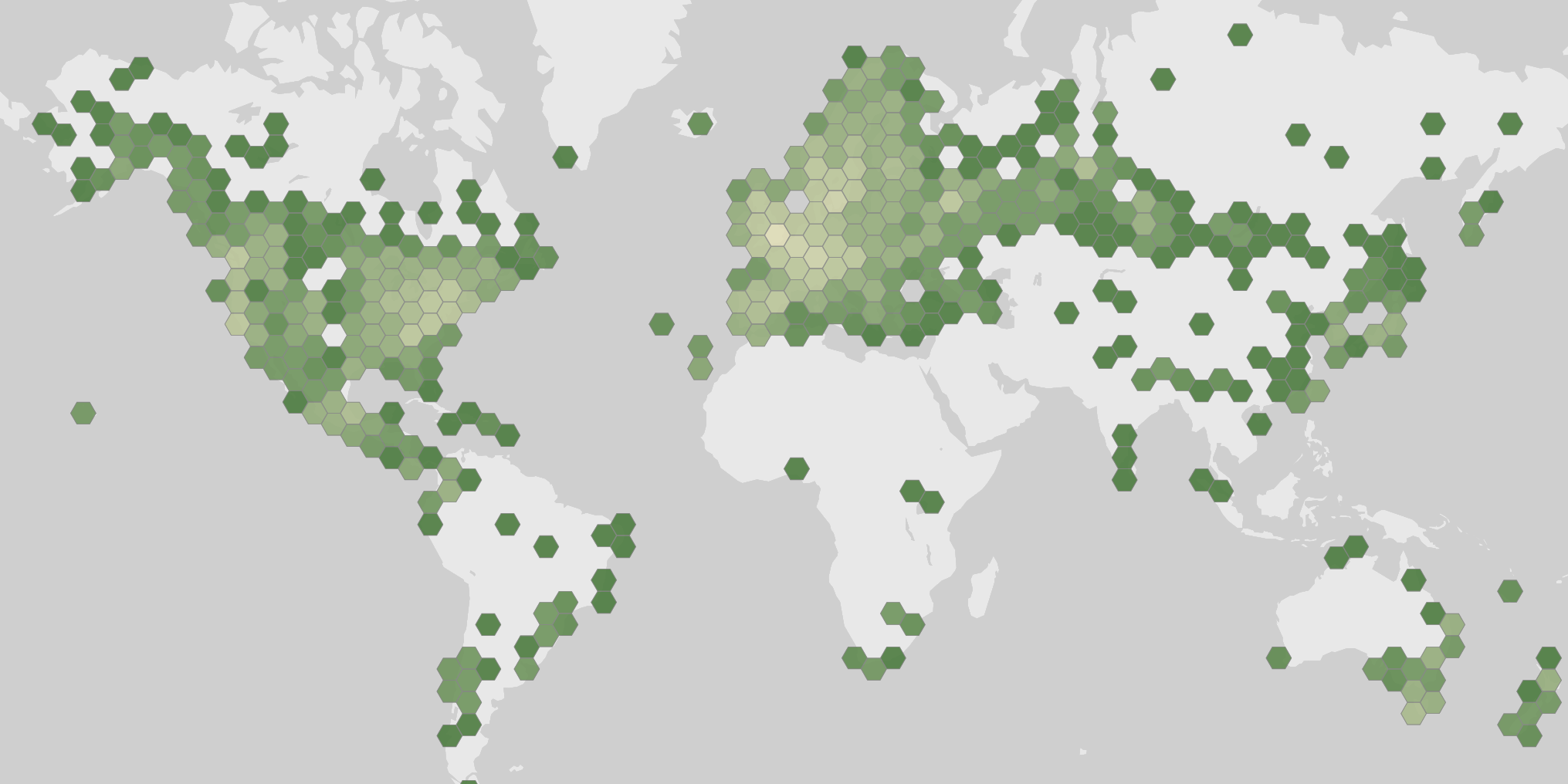
Lycoperdon perlatum has a nearly cosmopolitan range, recorded across Africa (Kenya, Rwanda, Tanzania), Asia (China, the Himalayas, Japan, southern India, Iran), Australia, Europe, New Zealand, and South America (Brazil), with collections even from subarctic Greenland and subalpine Iceland. In North America it is considered the most common puffball species, ranging from Alaska down to Mexico, though it turns up less often in Central America.
It grows as a saprobe on the ground, appearing solitarily, scattered, or in groups and clusters, and sometimes in fairy rings. Typical settings include woods, grassy areas, and roadsides, and it has also been reported from Pinus patula plantations in Tamil Nadu, India.
Monthly GBIF observation counts rise sharply from a few hundred in winter and early spring to a peak of over 27,000 in what appears to be early autumn, before falling off again toward winter. These figures are presence records rather than a measure of abundance or population size, but the pattern suggests this puffball is most often noticed fruiting in late summer and fall.
Uses and Cultural History
Beyond its role in the field, Lycoperdon perlatum has made its way into printed culture: the species has been depicted on postage stamps issued by Guinea, Paraguay, Romania, Sierra Leone, and Sweden, a sign of its recognizability as one of the more familiar puffball fungi.
Fun Facts
- Lycoperdon perlatum is the type species of the genus Lycoperdon, its pear-shaped, pearl-spined fruiting body and spore-puffing pore serving as the model for the whole group's name.
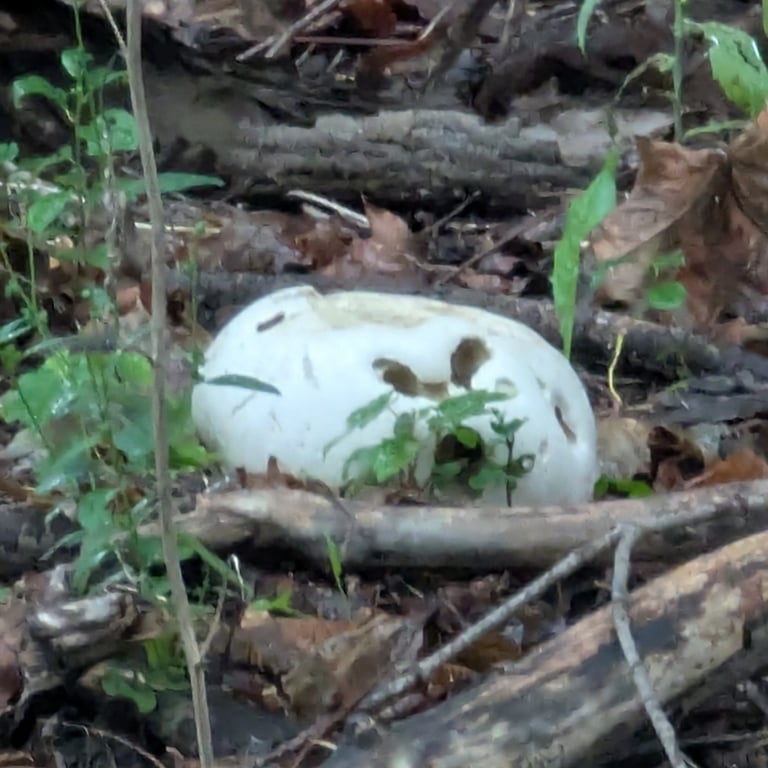
- Seen from a distance across grass, its round white shape has reportedly confused golfers who mistake it for a lost golf ball.
Conservation status
- LC
- NT
- VU
- EN
- CR
Least Concern
Ecology
Habitat
- Forest
- Grassland
- Disturbed Ground